
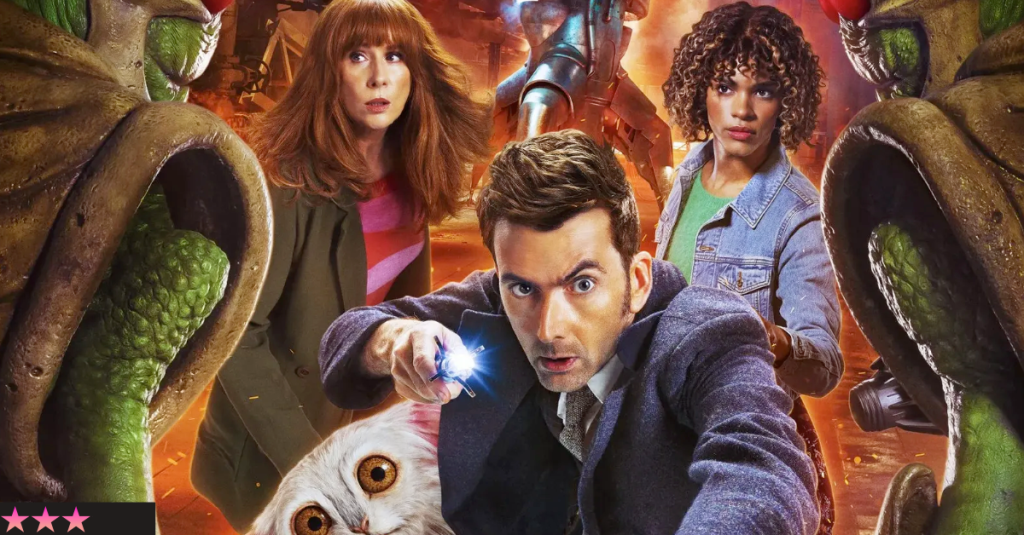
If, in an alternative reality, Doctor Who went on a second hiatus in 2008, only for it to return 15 years later with David Tennant still piloting the TARDIS, The Star Beast would feel like a logical follow-on from that of Journey’s End. This very much feels like a continuation of series four, particularly in terms of its character arcs, tone and story telling mechanics. Incoming (and returning) show runner Russell T Davies utilises chapter one of his 60th anniversary trilogy to revisit the best and not-so-best bits from his previous stint in the head writer’s chair. This is a rewinding of the clock, reapplying formulas that had been tried and tested in an earlier era.
In terms of the returning positives, it’s evident that Davies’ knack for writing engaging characters hasn’t left him during his time away from the series. His ability to paint vivid personas in a handful of sentences remains very much on display. Rose Noble comes to life within minutes of screen time; a social outcast, attempting to support her financially struggling family while shaking off her classmates’ transphobic harassment. Donna may well be as daft and clueless to alien antics as she was when her memory was wiped by the Doctor, but she’s also grown with age. She’s a loving mother who pays attention to Rose’s hobbies, supports her transition unconditionally, takes her ambitions seriously and fights her corner at every opportunity. We learn during these moments that Donna senses something is missing from her life. There’s a conflict within; a loving mother, troubled by a life she cannot remember.
The comedic pizazz peppering RTD’s first era hasn’t gone away either. The Star Beast dishes out jokes from start to finish. Some of them are laugh-out-loud, particularly the ones that are so in line with the characters instigating the punchlines. Donna accidentally spilling coffee into the TARDIS control panel, minutes after telling the Doctor that such an act resulted in her losing her job, is a particular stand out. Of course Donna would drop liquid into an advanced, alien time-travelling vessel. It’s in her nature. None of the jokes in this episode feel forced. Even the more outlandish gags are delivered with enough confidence and bluster, they feel natural to the story. Authentic, visual-heavy humour is the sort of thing Davies can write in his sleep. It comes naturally to his inherent personality. He’s a brilliant jester who oozes silliness and charm upon command. Humour flows through his very being.
Weaknesses from his prior stint are in here too. His habit of ramping up the stakes with world-ending scenarios, only for them to be patched up by a spot of button-twiddling and Deux ex machina is very much on display. At its core, much of Doctor Who consists of pushing buttons and undoing chaos. This doesn’t doom a plot resolution to failure, it’s just that Davies sometimes does it in a manner that feels much too heavy-handed. Disaster strikes, only for it to be literally rewound before the episode’s runtime reaches zero. The Star Beast is no exception in this regard. The quick fixes applied to its plot obstacles occasionally become nonsensical, delivering a resolution that almost works, yet doesn’t quite meet the landing. The resolution to Donna’s memory wipe is a generally clever twist, one that makes the last 15 years of her life part of the solution. Sadly, the quick fix button bashing, not to mention the episode’s attempts to tie the twist into the episode’s larger themes surrounding identity and authenticity, make for a slightly rushed and underwhelming final act.
If anyone is expecting The Star Beast to be a bold new reboot of the show – similar in audacity and scope to Davies’ 2005 debut – prepare to be disappointed. If this was the beginning of Series 14, then the level of unoriginality on show here might be a cause for concern. Despite the show going through a damage control phase following some turbulent years, turning back the clock isn’t the answer to such problems. Except this isn’t series 14, it’s an anniversary special. Much like how the 50th anniversary remixed the RTD 1 and Steven Moffat eras, the 60th looks to be celebrating its existence by whirling through the Doctor-Donna years. This isn’t intended to be a product of series 14, it’s a golden years romp intent on having fun with the toys that made up Doctor Who’s yesteryears. If there’s ever a time to take a look back at past successes, there probably isn’t a better occasion than this one. If we remain in similar territory come Ncuti Gatwa’s debut on December 25th, it’s time to start panicking. Until the anniversary celebrations are done and dusted, however, we have to give this approach the benefit of the doubt.
There looks to be another method behind turning back the clocks for the 60th specials. It is a means of getting bums on seats again. This is The Force Awakens of the RTD 2 era. Bring back a few beloved old favourites, dabble in past glories, raise the eyebrows of fans who’ve cleared off in the years since Tennant and Tate swanned off, then get them hooked on Doctor Who again. Then, when the nostalgia romp is done and dusted, crack on with moving forward. Tennant and Tate are only sticking around for another two stories after this, then it’ll be time for Ncuti Gatwa and Millie Gibson to take over.
Despite everything I’ve just said, if you take a peak beneath its surface, The Star Beast isn’t a total replica of an era since passed. A few subtle differences pepper this script, transforming what could have quite easily been a blatant victory lap into something much more fascinating. There’s a slight discrepancy between this and the tenth Doctor’s era. This version feels a little softer, less arrogant, more grown-up, and somewhat self-reflected in its design.
Let’s look at David Tennant as a case in point. He isn’t playing the tenth Doctor again, much like he did during the 50th anniversary, but the fourteenth. This incarnation has a millennia’s worth of experience separating him from that of the tenth. The episode goes out of its way to remind us of this; having him reference the time his character has spent been piloted by Matt Smith, Peter Capaldi and Jodie Whitaker. There’s an aura of experience lurking behind fourteen’s eyes. The arrogance which dominated Ten’s personality is barely visible any longer. Despite some familiar mannerisms, he’s softer, more expressive, and even critical of himself. The moment when he catches himself using words like “I love her” are massive shifts in behaviour for this iteration of the time lord. Just think how different his and Rose Tyler’s relationship been, had he possessed a vocabulary as expressive as this back in 2006. He questions himself more than last time too, vocally calling himself out whenever he doesn’t understand something. The opening scene perhaps demonstrates fourteen’s shifted persona best, as he becomes visibly overwhelmed by Donna’s presence and her daughter’s familiar name. This isn’t the cocky chap who squees recognition as he waltzes out of his TARDIS and into a new story. This is a man who is confused, unsure, and evidently out of his depth.
Similar alterations present themselves in characters such as Silvia. Her days of verbally abusing her daughter appear to have become a thing of the past. The heartfelt conversation between her and Donna in the kitchen – in which they talk about Rose and her transition – demonstrates how empathetic and compassionate she appears to have become in recent years. She’s more subtle in her behaviour, gently trying to guide Donna away from triggering her suppressed memories, as opposed to dramatic handwaving. At least until the Doctor falls back into the picture. During moments of stress, glimpses of Silvia’s younger self bob to the surface, reminding us of how far she’s come as a character. Time has left Silvia kinder and more loving than she was a decade prior. She’s received the Jackie Tyler treatment; the unpleasant mum, softened into a kinder, more loving version of herself. This leans into Davies strength as a dramatic writer. He makes the world of Doctor Who feel real and loved in. When the camera stops pointing at characters, they don’t simply freeze until gazed upon again. They grow and move with the world around them. No one is static in his version of the show. Everything changes, even when nostalgia comes knocking.
The Star Beast both is and isn’t a return to a deceased era. Davies has reassembled old faces both in front and behind the character for one last victory lap of the empire he rebuilt between 2005 and 2008, only it has had a face lift. Characters are older, our protagonist has transformed into a more vulnerable version of himself, and personalities have blossomed into better versions than the ones they once were. The Star Beast is a distorted memory. Much like we all do when reminiscing over younger years, Doctor Who is looking back on itself with a lens of hindsight applied to it. Davies is attempting to whisk us back, all while reminding us we can never revisit things exactly as they once were. Doctor Who has changed, and there’s nothing anyone can do to change such a truth.
Some might look upon The Star Beast as an attempt to review some of the decisions Davies made last time around. A retrospective of the Tennant era, if you will. While the arrogance of the Tenth Doctor’s tenure served as an interesting character trait, the lack of self-awareness within the show’s writing at times made this an occasionally difficult pill to swallow. Ten’s arrogance even had a tendency to toxify episodes on occasion, reaching its peak during 2010’s The End of Time, a story that had both Tennent and Davies moping around for ten whole minutes before handing the baton over to Steven Moffat. Sure, so it was a grand five years of television, capable of reviving a faded crown jewel, yet such a fact didn’t make it immune to moments of immature hubris. By returning to that era and delivering a more self-critical, toned-down version of the programme, allows Davies to revise the sharper attitudes that dominated his prose last time around. The Doctor-Donna are back, but they’ve bought homes, had kids, and sorted themselves out a touch.
It’s also angrier than it was before. Davies is clearly pissed off with the direction the world has gone in over recent times. Political themes aren’t new to Davies, and did pop up in pervious scripts. I mean Turn Left had immigrants shipped off the labour camps. Even Midnight dived headfirst into the toxicity of paranoia and group think. What is different this time around, is the volume in which he’s broadcasting those messages. The Star Beast is not simply pro-trans, it’s anti transphobia. This is an episode that wears its message on its sleeve, screaming to the world that it is a tale in which being a trans woman quite literally saves the day.
Rose’s gender identity is made central to the story, to the point in which it becomes the very solution to both Donna’s memory wipe, not to mention the episode’s resolution. The script is not ashamed of it’s progressive stance. This approach is evidently deliberate in design, serving as Davies’ method of demonstrating to viewers where his second era stands in terms of its politics. It’s possible this was done in response to various right-wing YouTubers claiming the Chibnall era was much too “woke” for their liking, and that his departure would somehow result in the show dialling down its progressive political messaging. When Davies returned, there seemed to be this notion amongst some circles that the show would stop being inclusive. It appears such fans forgot that Davies wrote the first openly queer drama on Channel 4 in the early 2000s, not to mention how his initial era of Doctor Who introduced LGBTQ characters to the forefront of this programme. Inclusivity and socially progressive political messaging goes hand in hand with the types of TV shows he writes for a living. Opening with a story shouting in support for a community openly mocked and oppressed by a majority of the British media was Davies’ way of telling the haters to be on their way.
Davies’ attempt to ensure his era is inclusive and reflective of modern Britain is something that’s unlikely to fizzle out beyond this story. If anything it will likely become one of the defining factors of his second era. It’s something he’s spoken openly about during the promotional rounds, even shedding light on how he used the latest Children in Need special to temporarily remove the “evil disability” trope from Dalek creator Davros. It is evident that he wants the show to represent the present day as a means of keeping it relevant and with the times. The introduction of UNIT’s new scientific advisor, Shirley, is another step in solidifying this vision, setting up a Gatwa era regular who uses a wheelchair. Davies’ mission statement is clear; bring as many new voices, faces and experiences into the fold, creating a version of Doctor Who that’s more diverse and varied than prior eras. If critics thought the Chibnall era was too inclusive – if such a thing was ever possible – then it’s safe to assume they aren’t going to be best pleased with what lies ahead.
The Star Beast is an imperfect albeit fascinating hour of television. It functions as both a blast from the past, and something unfamiliar. It looks back while donning a lens of hindsight. The end result is a product that bathes in the glories of years gone by without actually writing off the show’s present. Though chapter one of the 60th anniversary is a celebration rife with reminiscing, it is also aware that change is vital if this show is to survive. This may well be series 4.5, but it’s older, wiser, angrier and more self-reflective than anything Davies could have produced back in 2008. It might not be the reboot some were hoping for when news of his return dropped at the end of 2021, although that doesn’t mean the potential for change is absent from its DNA. This doesn’t feel like Doctor Who is attempting to undo the last 15 years. If anything, it’s reminding us of how much the show has changed. The Doctor and Donna are not the same people they once were. Time has transformed them into something new.
Doctor Who feels as though it’s on the cusp of a grand transformation. Though it might not have arrived at that bold new era just yet, something new and alien looks to be lurking on the horizon.
Next time, the Doctor and Donna go on an adventure into the Wild Blue Yonder, thanks to Donna’s inability to hold a caffeinated beverage…



 Amber Poppitt