
The opening to The Church on Ruby Road establishes a subtle albeit noticeable difference between the first and the second Russell T Davies era. We meet Ruby Sunday as a baby, dropped off on the doorstep of a church on Christmas morning. Other than the mother giving off thirteen Doctor vibes, the information of who she is and why she left her daughter there are kept from us. It’s a scene shrouded in enigmatic secrecy.
Introducing Ruby in this manner establishes this character firmly within the show’s imaginary roots. Unlike Rose, Martha, Donna, or Bill, she is not a representative of the domestic side of this universe. She’s no background character or bystander who happens to get swept up in the madness of the Doctor’s life. She is a disassembled narrative jigsaw, invited to be solved by the audience.
There are problems with introducing a supporting character in this manner, as we learned when watching Steven Moffat attempt it with Amy Pond and Clara Oswald. Doctor Who has often been a show about celebrating the remarkable nature of those who are ordinary. Davies seemed to get this when writing for the show. Moffat was criticised for venturing away from this approach during the first five series he head wrote the show for. It wasn’t until his sixth and final series that he started to adopt the Davies approach. It’s interesting then, that history has mirrored itself. This time around, Davies looks to be taking inspiration from Moffat. Even the name “Ruby Sunday” has the fairy tale echoes of Amy and Clara.
All of which supports Davies’ claim that he returned to the show because he had devised a new batch of ideas following his initial departure from the head writer’s chair 14 years’ prior. There are clear hints here that the Moffat era has had some involvement in inspiring these ideas. The Ruby-as a-fairy-tale approach might leave Davies enthusiasts scratching their heads in bewilderment, but it makes sense to see him change tact for his follow-up era. If we are to believe that Russel has returned because he’s got new stories to tell, then it’s natural to assume that he’s not going to be writing the exact same types of characters or scripts during his second run.
Regardless of whether the companion-as-jigsaw model works in your favour does not detract from the atmosphere and intrigue evoked during this opening. It does a solid job in setting up intrigue and mystery for what’s to come. It’s also well shot, eerie and beautiful in equal measure. Perhaps where it does fail, is in the Doctor’s narration. Must we have Ncuti explain to us what is quite clearly playing out on our screens? The voice over detracts from the opening. It’s exposition that’s forced and unnecessary.
What does work, however, is the moment when the Doctor enters the scene physically. Seeing him exit the TARDIS and watch the woman walk away while he sobs caps off the opening with an extra layer of intrigue. The Doctor is more involved in the scene than we are initially led to believe. He isn’t just explaining the events of Ruby’s first Christmas, he played a part in them too. It’s a really good opening; one that gets us questioning what is yet to come.
Still, the narration bothers me. Particularly when we get the same details spoken back to us during Ruby’s interview with Davina McCall in the following scene. If anything, had we just heard Ruby’s recollection of events, it would have felt a little less heavy handed. It would make more sense hearing about this in an interview context, as opposed to from the Doctor in the form of a voiceover. Why bother to put this information in there twice.
While we are on the subject of the opening interview, do we really need to know all about Ruby’s life from birth to present in the first minute she’s on screen? It’s not a deal break, but it does seem strange how Davies was so keen to give us so much information about Ruby’s life this early on. Must we know where she used to live before coming to London right from scene one? Was her not doing too well at school pivotal for us to learn about before we saw her in action? If all this information is important to help us get a better feel for her character, could we not have had these details drip fed to us as the episode (and upcoming series) progressed? There’s a chance I’m being cynical and petty. It just felt a little strange to have Ruby’s story fed to us in such a fast-paced and clunky manner.
Despite the deviations found in the shift in companion execution, having a celebrity in the form of Davina McCall cameo in this episode does hark back to a trope from the first Davies era. Between 2005 and 2010, there was a tendency to incorporate real-life celebrities into his stories. They were usually kept at a slight distance from the action, mind you. One way to demonstrate this could be to compare this to the last time Davina played a version of herself in the show. During 2005’s penultimate episode, Bad Wolf, the presenter featured as a robotic voice version of herself, 200,000 years in the future. She was never actually on screen in the flesh during that story (primarily because she’d been dead for millennia by that stage), meaning she never interacted with the environment, characters or story occupying the episode. In similar examples from the first Davies era, celebrities from our world tended to feature on television screens, remaining at a distance from the action itself.
This time, Davina is physically present, which does feel a little peculiar. It’s as though we are seeing a convergence of pop culture elements, bleeding together. This isn’t the first time Doctor Who has flirted with the concept of crossovers. Heck, Bad Wolf which was described in the paragraph above served as a greatest hits of all the big shows from that time period melding into one. The only difference this time is how intimate a crossover we are getting. Davina isn’t just cameoing as herself, she’s playing a characterised variant of her real-life persona. This is a version of Davina who exists within the universe of Doctor Who. She even falls victim to the antagonists of the story. She’s a character within this universe, one who has presumably witnessed all the invasions and anomalies that have taken place throughout the last five and a half decades she’s been alive.
Whether this attempt to incorporate variants of real life celebrities within the Whoniverse works is difficult to determine. On the one hand, it’s interesting to get glances of familiar celebrities existing and living out their life in a version of earth that’s teaming with extraterrestrial interference. On the other hand it’s also quite distracting. To some, seeing Davina McCall interviewing a character whose victim to the strangeness of the Whoniverse might make this version of reality feel more lived in and believable. To others, it might come across as a distraction; a means of making the show feel a bit more silly. Having celebrities known for reality TV get almost crushed by a time-travelling goblin creates a tonal dissonance that reminds audiences how daft this show can be when it wants to be.
There’s also the distraction of Davina not being a particularly great actor. This isn’t intended as an insult. Acting isn’t her primary talent. When she’s interviewing Ruby, it’s fine, as she’s simply emulating the profession she’s known for being good at. The moment she starts to interact with the main plot, however, it yanks you out of the drama. It doesn’t quite work, outlining the limitations you get by pulling a stunt like this.
Davina’s purpose in the story is to motivate Ruby into expositing her backstory, as well as helping to drive the plot about Ruby finding her birth mother. She essentially introduces us to the Doctor’s latest companion. Ruby is portrayed as the epitome of perfection, a portrayal that reaches its emotional peak when her stepmother, Carla, is moved to tears simply by contemplating Ruby’s presence in her life. This idealized image is further emphasized when the Goblins wrench Ruby from her timeline, leaving Carla a shadow of her former self. Bereft of Ruby’s influence, Carla becomes a sorrowful figure, her joy and career in fostering withered away.
The scene may be a subtle homage to It’s a Wonderful Life, yet it feels overly eager to paint Ruby’s virtues with such vibrancy. While there’s inherent value in showcasing companions as inherently good people, and Ruby’s positivity is not in question, the extent to which the narrative insists on this point is peculiar. Ruby’s interactions with her family already illustrate her significance in their lives. We don’t necessarily need a scene like the one showing a broken Carla. The implication that Carla’s life would crumble without Ruby borders on the script engaging in emotional manipulation, suggesting an insecurity in the narrative’s ability to win Ruby over to its audience. It’s already evident that Ruby enriches her mother’s life, but it’s also likely that Carla would have found happiness elsewhere had their paths never crossed. A more subdued acknowledgment of this possibility might have lent a touch of realism to the festive special. The Doctor’s visible dread upon discovering Ruby’s abduction from time already conveys the gravity of the situation to great effect.
Unlike previous Davies companions, at this stage in the game, Ruby seems to lack a sense of authenticity and relatability. She is introduced more as a mystery to unravel, than as a person. Her character is presented to us as a beacon of hope; the glue holding her loved one’s lives together. While it’s crucial for the audience to connect with her through her positive characteristics, the narrative must establish these connections with a little subtlety and nuance; otherwise it makes it more difficult to engage with Ruby’s character and backstory.
Moreover, the tonal dissonance in Davina McCall’s phone call to Ruby on Christmas day is jarring to the point of cruel. Informing Ruby that there is no trace of her biological family is a traumatising call to make in and of itself. For Davina to then swerve the conversation from such a revelation toward blaming Ruby for her bad luck streak is as startling as it is cruel. This moment highlights a broader issue with the script’s inability to make Ruby feel like a real person. Instead, she’s a component of the plot; only there to serve as an event instead of an individual.
Ruby’s character, as presented, doesn’t resonate with the authenticity of Rose, Martha, or Donna. She comes across as an anomaly. An otherworldly enigma. The script’s apparent disregard for her humanity in such moments raises questions about whether this is an intentional choice or a narrative oversight. Regardless of the case, it presents itself as a distraction from the emotional centre of this story.
2023 was intended to serve as a fresh start to the series; a jumping on point for viewers both old and new. The reason Rose worked so well when the show went through a similar process in 2005, was because of how relatable she was. We saw the strangeness of the Doctor’s world through her eyes. Her response, confusion and struggles she faced felt believable. Ruby isn’t Rose, and while there is no requirement to make them doppelgängers – something that would have created a whole heap of new problems – it makes sense to try and ground Ruby if she is to become the audience identification figure. For a companion intended to guide potential new viewers into the show, Ruby fails as a surrogate for those audience members. She feels more like a late-stage Doctor Who companion, a Clara or an Amy; characters who are fully integrated into the science fiction ideas central to the series’ plot.
None of this makes Ruby a bad character, per say. It just makes it difficult to fully invest in her as a co-lead at this stage. There’s still plenty of time for the character to take flight and develop into someone who I care for. As far as things go at this stage, however, it’s very difficult to properly relate to this character.
While the episode falters in its attempt to establish Ruby as a companion worth investing in at this stage in the game, The Church on Ruby Road excels in showcasing the allure of the fifteenth Doctor. The Doctor’s exuberant dance in a nightclub, donning a vest and kilt, offers a striking visual spectacle that boldly diverges from the conventional depictions of Time Lords we’ve seen up until this point. This depiction, brimming with youth and vitality, serves as a powerful reminder of the show’s capacity for reinvention, capturing the spirit of the times with remarkable acuity.
This scene serves as a reminder of the show’s capacity for change. It’s a fresh take on a character who has been everything from a Victorian gentleman to a cricket enthusiast. Ncuti Gatwa’s fifteenth official incarnation of this character embodies the spirit of the modern age, much like Eccleston’s portrayal did in 2005. This depiction of the character underscores the show’s core concept: the Doctor is a being of adaptation, mirroring a forever changing world.
Gatwa brings a new energy to the role, embodying a Time Lord reborn. His portrayal is charismatic, flirtatious, and intellectually agile, capturing the essence of a character who is always in motion, always thinking. Gatwa’s performance allows the audience to visualize the Doctor’s cognitive process, as he navigates unfamiliar situations with a keen mind, piecing together information with rapid precision.
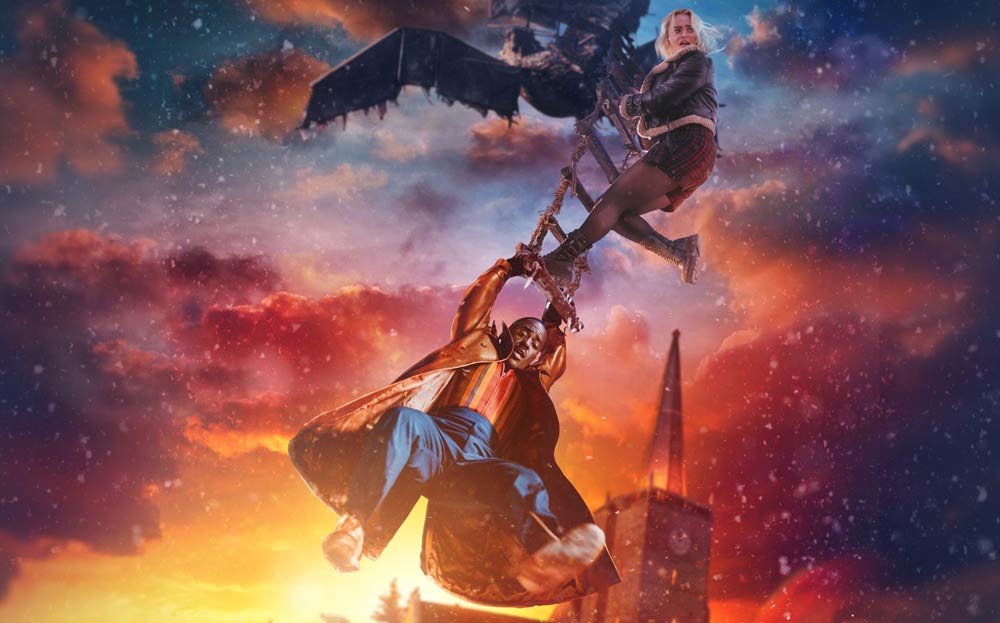
All of which comes in handy when it comes to fighting the threat of this story. The goblins are a threat more rooted in fantasy than they are in science fiction. Elements of Jim Henson’s labyrinth are peppered throughout the story, hinting at a more whimsical stance on the second Davies era. This again suggests that these newer batch of stories will be influenced by the Moffat era, which made heavy use of incorporating fairytale elements into the show. Being a character traditionally rooted in science fiction, the fifteenth Doctor is going to have to make heavy use of the kinetic pizzaz and light-speed investigatory skills showcased at the top of this era, especially in the wake of a hoard of sky goblins who’ve mastered the bewildering “science” of ropes.
Shifting genre isn’t unusual for Doctor Who. As already mentioned, the show has adapted fairytale elements in its recent past. What’s notable here, however, is Davies’ use of the genre changing styles from the moment in which The Giggle ended.
It’s worth noting how The Star Beast and Wild Blue Yonder both felt more like traditional Davies era, science fiction-oriented episodes. The former was about an alien ship crashlanding in London, while the latter was about shape shifters skuttling around on a space station at the end of the universe. The Giggle on the other hand, felt like a watershed moment for the show; the point in which the second Russell T Davies era officially began.
The episode following The Giggle appeared to endure a metamorphosis from science fiction to fantasy, going from spacecrafts on the cusp of reality, to sky goblins skuttling about on the outskirts of our world.
Are the walls of the show’s reality beginning to break down? There’s certainly enough in here to suggest this might be the case. Reality appears to be slipping from beneath the Doctor’s feet. The Goblin song during the episode’s midpoint suggests something unusual is happening. The Doctor and Ruby devising a musical number on the fly, straight after the Goblins have finished their own routine certainly hints at this. It doesn’t seem believable that the pair could have devised such lyrics in the heat of the moment. It’s as if the genre skipped a beat and Doctor Who momentarily transitioned into that of a musical.
Such sudden shifts in tone extend to characters as well as genre. The first time we’re introduced to Mrs Flood depicts her as one of the ordinary residents of this story’s world. She takes pride in her fitness, going so far as to boast about her fun run PB. She comes across as less endearing as the police officer in an earlier scene, mind you. She’s bickering with her neighbour, blaming the poor chap for the Doctor’s TARDIS blocking the footpath. A bit presumptions of her. No idea why she thinks her neighbour would erect a blue box of wood in the street to spite her. Sounds like the sort of person convinced the world is out to get her.
The next time we see Mrs Flood, right at the top of the third act, something interesting happens. She witnesses the TARDIS dematerialising in front of her. She appears shocked at the sight, further cementing her as an ordinary citizen of this planet. From that moment on, something shifts in Mrs Flood. Her entire demeanour changes. She becomes more like Ruby; a plot device that belongs firmly in the Doctor’s world. She’s more relaxed, seemingly in control, and oddly self-aware that she’s a character in a science fiction TV show. She winks at the audience and demonstrates extensive knowledge about the lore of Doctor Who.
Upon first viewing, you’d be forgiven for thinking that something was overlooked the first time we saw Mrs Flood. Upon second rewatch, however, it’s clear that something shifts the moment she sees the TARDIS. She goes from an argumentative bystander to a mystery for the audience to solve. Surely seeing the TARDIS dematerialised wasn’t the primary crux in this transition. Many people have seen the TARDIS vanish in front of them, and it’s never turned them into plot devices aware they’re in a television programme. The reality of this fictional universe appears to be changing shape in real time. Much like how the mishearing of “Gravity” in Wild Blue Yonder altered the past, the present also looks to be reshaping itself in the new Davies era.
Is the DNA of this show being fiddled with because of the events that played out in The Giggle? If so, then what’s all this leading to? If Davies is toying with the internal reality of this show’s universe, what type of story is he planning to tell? At the moment, the answer to this question isn’t quite clear. There’s a chance this could all lead to nowhere. If Davies is just toying with the rules for a laugh, then there’s a risk this could all end up as a hot mess. If we are headed somewhere strange and specific, however, then we might be headed for a series final that’s as fascinating as it is unique.
The Church on Ruby Road certainly has its faults. Its introduction of Ruby doesn’t quite sell her as a companion that audiences can resonate with. While there’s still plenty of time for the show to convince us that she’s someone we should care for, it doesn’t quite manage to sell that notion here. She feels more like a plot mechanic than a living person. Where the episode does shine bright, is in its introduction of the fifteenth Doctor and Ncuti Gatwa. Both the character and actor introduce an electrifying reinvention of the timelord that revitalises the show. After years of stale storytelling, Davies and Gatwa have found a way to inject life into a property that many thought was taking its last gasps in recent years.
Another area where The Church on Ruby Road exceeds in stirring up interest is in its use of rule breaking. This is not a story that’s content in following the status quo. Its rebellious, surreal, and provocative in terms of altering its own structure at the click of its fingers. It demonstrates this best in its utilisation of fantasy, musical numbers and background characters converting into puzzles to be solved. In normal times, I’d accuse such tactics as inconsistent storytelling. In a post-Giggle world, however, such rule breaking skulduggery fills me with intrigue on the reasons behind the strangeness of it all.
Perhaps when all is said and done, I might look back on this episode with different eyes. If the questions fail to lead to any satisfying answers, maybe all this genre hopping and character transformations will amount to nothing worthy. At the time of writing this essay, however, The Church on Ruby Road serves as an effective taster of an era filled with mystery, flare and change.



 Amber Poppitt
2 responses to “‘New Man, New World’ – Doctor Who 1.0: The Church on Ruby Road”
Fantastic Review! Looking forward to your thoughts on the latest episodes
LikeLiked by 1 person
My review for Space Babies should be up before the end of today. The Devil’s Chord tomorrow. A little later than I had planned, but I’m almost caught up!
LikeLiked by 1 person