
Space Babies had a lot leaning on it. Despite the multiple openings we’ve had to the second Russell T Davies area thus far, this functioned as the official pilot for the show’s rebooted series. It was, in many ways, intended as the first proper jumping on point for audiences since 2005’s Rose (also written by Davies). Although the story does demonstrate a handful of beginner guidelines, this is a surprising note to open the series on, particularly when it’s intended to garner engagement from both avid and new audience members alike. It’s a story that’s light on plot, lacking in genuine character conflict, and far more proud of itself than much of its audience appears to be.
General reactions to this episode have appeared to be largely negative. It’s Davies’ lowest rated episode on IMDB to date. At the time of writing, it sits at 5.6 stars out of 10. The average rating of Davies’ episodes combined during his first era sits at 8 out of 10. While IMDB ratings aren’t gospel, they do serve as a useful indicator as to how well something is received. This is not a great reception, and one that’s frustrating at a time when Whovians are desperate for the show to become the biggest thing on TV again.
While I certainly do not despise this episode as passionately as some I’ve spoken with do, I cannot doubt it’s the sort of story that leaves me disheartened. Davies claims to have returned to the show because he’d been inspired by new ideas for the series in the years since he departed. Whereas episodes such as Wild Blue Yonder and The Church on Ruby Road serve as evidence for such claims, Space Babies feels a bit more like a story penned at the tale end of a show runner’s tenor. It certainly isn’t enough of a failure for me to think this return is a failed project, it’s just a little deflating, is all.
There are elements to this episode that I do like. The most notable standout is Ncuti Gatwa as the Doctor. The man is an electric performer, packed with more zest and passion for the role than any actor seems to have been for a long while now. Two stories in, and it’s evident why they hired him for the role. Space Babies does not do anything to take away from my love of this Doctor, and the excitement I have for his future in this show remains intact. The way he moves around sets, twiddling buttons and waltzing through environments with choreographed perfection is a delight to watch. There’s echoes of Matt Smith in his performance; a man who moves around the world in a way dissimilar to anyone else sharing a scene with him.
Much like his ability to show the Doctor’s mind whirring away in The Church on Ruby Road, Gatwa’s micro expressions continue to impress here. The way he’s able to communicate concern and confusion over Ruby’s presence when he hugs her is mesmerising. All he does is glance toward her, yet in that briefest of eye movements, you’re acutely aware of how unsettled this latest companion of his makes him. As a person who struggles to read other’s body language, I take real pleasure in watching an actor this capable of broadcasting their inner world with such clarity.
For all my issues with the plot of Space Babies, Gatwa shines bright in this story, forever finding new ways to animate and have fun with the material he’s given. The quality of a script doesn’t appear to limit him in the way it would most actors. He still finds ways to muster magic from mediocrity. He adds rewatch value to a story I’d otherwise have avoided viewing more than once, making reviewing this story a lot easier than it would have been had a less talented person been piloting the story.
While pretty much every other Doctor has taken an episode or several to slip into the role, Gatwa appears to have slipped into this performance as if he’s been playing it for years. He’s sussed how he wants to play the character before the cameras started rolling. Even if it transpires that Space Babies was made at the end of the series one shooting schedule, the fact he’s been so confident and in command of the role from as early as The Giggle suggests things are only going to continue getting better for him from this point onward.
On a more superficial footing, the episode looks gorgeous too. At least for the most part. We could do without the poorly animated facial expressions of the talking babies. Baby speech aside, the rest of this story is golden. Davies has been keen to express in interviews that his vision for this era is to bring Doctor Who in line with the premium-budgeted television shows of the last couple of years. He wants the series to adopt a larger scale, giving it the freedom to have more monsters, worlds and appeal. Space Babies does a finer job than the last four episodes in demonstrating the shiny new coat of paint the series has received under the new Disney Plus agreement.
This is demonstrated in the first scene, where the Doctor shows off the TARDIS’s time travelling capabilities by taking Ruby to prehistoric earth. The scene only lasts a few minutes, before they’re off to the far future. The dazzling special effects in this sequence are all the more surprising when you consider how inconsequential the scene is for the wider story. It’s used as a demonstration and a joke, before moving on to the main bulk of the story. The last time the Doctor wanted to show off the variety of places the TARDIS could take his companion, he just sat at the console, telling Rose where they’d landed (see The End of the World). Never before has this show had the freedom to build an environment packed full of CGI dinosaurs, just to serve as a throw away gag.
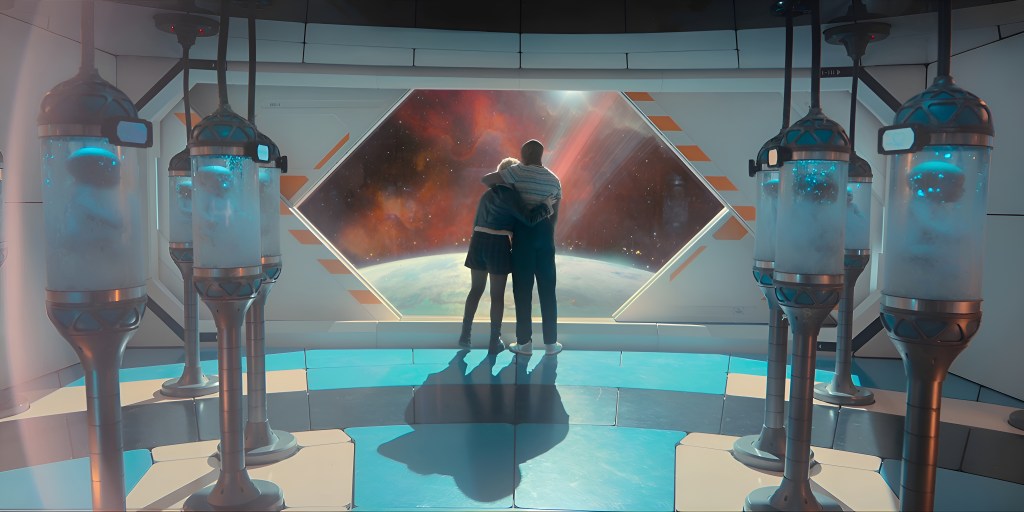
The remainder of the episode sports a sizeable handful of pretty imagery too. The beast in the space station’s basement is aesthetically pleasing; which is something I never thought I’d say about a Demogorgon-inspired xenomorph made from snot . The shot of the Doctor and Ruby looking out toward the alien world is jaw-droppingly gorgeous too. This is a version of Doctor Who that has a hefty sum of money tucked in its back pockets now. While demonstrating this isn’t enough of a reason for everyone to flock back to the series, Space Babies manages to do a decent job of establishing how the show will look and feel going forward.
For all its visual and performative achievements, however, Space Babies is an episode that could have benefited from a rewrite or two. While it looks and feels like a series fizzling with pizzaz and promise, it falls short of drawing us into the series good and proper.
My main issue with Space Babies is that it’s lacking a proper plot for us to sink our teeth into. There’s an absence of depth or character conflict, making the finished product difficult to engage with. The general rundown of the story is that there’s a bunch of abandoned babies wheeling around a space station, left by parents who did not want them. The computer, meanwhile, has built a monster made of bogies that scuttles around the basement, scaring the children. As soon as the Doctor discovers the monster is a product of the same system that birthed the babies, he uses the waste tanks to propel the vessel toward a planet.
I don’t think this was necessarily an episode that was doomed right from the word go. There are glimmers of potential to tell a good story with this idea. For one thing, the idea of babies born and abandoned because of “pro-life” laws is dark, relevant and angry in a way Doctor Who often excels at being. There’s a lot of directions this sort of story could have gone in. What makes it most disappointing is the fact they decide to just let the idea fizzle out so quickly.
Perhaps one way to make this story properly work, is to use it to apply conflict to our leads characters. The biggest issue I had with the story is the fact that there was no believable or interesting reaction from neither the Doctor nor Ruby. There is an inherent wrongness to the idea of six-year-old babies who’ve been abandoned in the cosmos because of cruel legislation. Instead of reacting in horror, confusion or heartbreak, they just coo and cuddle the kids at every opportunity.
One way to approach this could be to have Ruby and the Doctor disagree on what to do with these kids. They could have tied this back to their own orphan roots. Ruby has had a positive experience when it comes to adoption. She found herself in a loving family. She grew into a healthy and happy adult who even helped her foster mother look after the other brothers and sisters who came and went over the years. The Doctor, on the other hand, has not been so lucky. He was found by a species who kidnapped, experimented, and tortured them, exploiting their regenerative abilities then lied to them about who they were. These are wildly different experiences that could have subconsciously shaped their reaction to a group of abandoned children wheeling around a lost vessel in the vacuum of space.
Maybe the Doctor deduces that the babies are safer with Nan-E. Sure, they may be trapped in space, but at least they’d be looked after, secure from the vulnerabilities of a callous universe. The Doctor might be afraid that if they find the children a home, some of them may be exposed to cruel parents who wouldn’t treat them right. Ruby, meanwhile, might champion the idea of finding them a place in the universe. She might sense that Nan-E is oppressing the babies through her love, tricking them into a life of fear and repletion. Ruby knows that these babies’ happiness lies somewhere out there in the stars. The children need to grow, take risks, and find themselves in the wider cosmos. This could have been the story where she became the Doctor’s equal and emotional anchor, reminding him of why he travels and why he has faith in the universe.
In this version of the story, Nan-E could have worked as the villain, expanding on the role of the over-protector that’s demonstrated in the draft that made it to our screens. Once the Doctor finally comes around to Ruby’s perspective, it’s revealed that Nan-E has been engineering the scenario playing out on the ship. She just wants to protect the babies. They’ve already been let down by the species they belong to, so she’d do anything to keep them protected from further harm. This version of Nan-E could have been an antagonist with an internal logic. Like the Doctor, her drive to keep them from emancipation might have been born from a desire to keep them safe.
It might not be a terrific idea, but at least this could have been a nice way to garner some character conflict out of the two leads. Ruby hasn’t really had much of an opportunity to come into her own yet. This could have been the episode where that happened. Here she had a chance to establish her moral framework, distinguish herself as a person in her own right, and teach the Doctor to look beyond his subconscious reactions to the events playing out before him.
This is usually how the second episodes have played out in the past. 2005’s The End of the World saw Rose suffer a breakdown in the wake of the weird space station the Doctor took her too. The Doctor was showing off, whereas she was fighting to keep it together. This caused a conflict, which encouraged the Doctor to open up to her about his PTSD. Even the disappointing The Shakespear Code gave Martha an opportunity to establish herself. Sure, it was her beginning to formulate her eventual departure, not to mention the start of the Doctor’s abysmal treatment toward her, but at least it was giving us the foundations of character conflict. Donna’s second mainline episode is perhaps the best example, in which her devastation of letting everyone in Pompei perish motivated the Doctor to break one of his most rigorous rules.
Ruby deserved more from this story. Davies could have given her an opportunity to present her case for becoming the Doctor’s companion. What made her stand out? Beyond the mystery of her birth, why did the Doctor want to travel with her? We needed a little bit more than her cuddling babies and throwing paddies when she discovers she’s covered in baby snot.
The decision to drop two episodes simultaneously for this series might be more telling than initially assumed. It’s normally standard procedure for Disney Plus to have a two-part premier for new shows. Perhaps this was the reason why Space Babies and The Devil’s Chord came out simultaneously. Or, maybe it was because Davies and the rest of the production team arrived at the realisation that this story wasn’t as effective of an opener as initially assumed.
Who knows, perhaps it really was always the plan to drop two episodes at a time. Have this one serve as the technical filler, where they run through the mechanics of TARDIS translation and time travel, then throw us into the fourth-wall breaking chaos of episode two. Either way, it’s wise of them not to drop this one on its lonesome. I had the fortune of watching this story with someone who’d never seen Doctor Who before. It’s safe to say they did not like this episode in any sense of the word. Had it not been for the improved follow-up story, it’s likely they’d have not given this series a second chance beyond this point. This isn’t the kind of Doctor Who episode you show your mates when trying to explain why you love the series so dearly.
Whether the decision to release Space Babies and The Devil’s Chord simultaneously was born out of concern for the quality of this opener is besides the point. This is not a great episode, and is surprising to think that it came from the same man who gave us Wild Blue Yonder just six months prior. It feels underdeveloped, only really serving as a bit of fluff for Gatwa and Gibson to flex their chemistry.
It’s also remarkably frustrating when the script appears to be boasting about its core premise as though it’s brilliant. The way the Doctor keeps blurting out “space babies”, as if we’re all supposed to chuckle at how barmy a notion it is, is nauseating to witness. There appears to be a slight absence of self-awareness going on here. The whole “isn’t this keraazy” approach suggests that Davies thought this episode was a lot cuter and kooky than it really is. It’s possible they thought audiences would watch this and die at the cuteness of the CGI kids chatting technobabble while wheeling about a spaceship. Maybe on paper, this premise might have looked a little more tangible than it did in practice. I can imagine Davies pitching this one to Phil Collinson and Julie Gardner over coffee, with the lot of them all hooting in delight over it. The finished product, however, feels weird and cringeworthy.
As already mentioned, this is not a doomed concept from the word go. I hate to dedicate 2000 plus words to slagging off the opening episode to an era of the show I’ve been excited for since they first announced Davies’ return in 2022. I refuse to believe this is the product of someone void of new ideas for Doctor Who, and I genuinely believe this had a lot more potential than what we ended up getting.
There’s also some fascinating imagery that’s worth commenting upon. The LV426 inspired lower decks contrasted against the child-like upper decks is strange and unnerving. I’m quite inspired by the idea of a nursery with a xenomorph-like creature skuttling about in its basement. Imagine if they’d made the babies into young kids, alone and curious as to what on earth was skulking about on the decks below. There’s genuinely a germ of a Stranger Things style episode hiding in the deepest depths of this idea. Even the creature’s Demogorgon inspired design fits the bill. Davies almost had something creepy and brilliant here. It just never quite functions as a finished product.
The question is, could this story have worked if it had been placed elsewhere in the series? While it probably wouldn’t have gotten better reviews if repositioned, it might have been less of a problem for the newcomers still familiarising themselves with Doctor Who. Maybe it would have fared better a little later on down the line. Cut out the new audience exposition, then slap it before an anticipated series final. Get everyone hooked on the stronger episodes first, then use this as a spot of filler when everyone is itching for the resolution to this series. This really isn’t the sort of story you should be opening your new series with, particularly when the series in question has been designed as a new start intended to tempt audiences back after years of brand decline.
Space Babies is far from a complete disaster. There are good ideas in here that could have made for a much better episode, had it been tackled from a different angle. It’s also a gorgeous-looking bit of fluff that allows Gatwa room to flex his acting muscles. It also happens to be Davies’ weakest script to date, and not the sort of story you want to open a series with. For a writer who has returned to a show with the level of love and enthusiasm he’s expressed during many interviews, it’s surprising to think this is the draft Davies decided to settle on. For a script that had so much leaning on it, the finished product fails to be anything beyond a 46-minute piece of pretty looking padding before things get weird.




 Amber Poppitt
4 responses to “‘Orphan 56’ – Doctor Who 1.1: Space Babies”
It’s definitely relying on the cuteness factor to get past its weaknesses. For me it worked.
LikeLiked by 1 person
I hadn’t realised how little they relied on CGI for the babies on set. Hats off to the little kids for being so well behaved during filming!
LikeLike
Spot on. Definitely the weakest episode of RTD2 and I think your suggestions would have improved a lot of the problems in the script, which felt too superficial at times, almost like it was attempting to show new fans how quirky it could be with its ‘space babies’ concept. The performances from ‘the adults’ saved the episode for me, although it’ll probably won’t see many rewatches outside of a season rewatch.
LikeLiked by 1 person
Much agreed. Ncuti really saves this episode from falling apart. He makes the rewatch much more enjoyable. I’m continuously delighted by his casting.
I’ve just finished watching the Unleashed making of episode for this one. I must say, it looked like a lot of fun putting this episode together. What I’d give to be a set designer at the Bad Wolf allotment right now!
LikeLiked by 1 person