
Doctor Who’s tendency to produce theme park tours through history is never usually my cup of tea. Simplified, stereotypical depictions of past eras and the figures who occupy them often have a tendency to distract from the wider story being told. It becomes less about the content of a story, and more about that particular writer’s infatuation with a particular period or figure dominating that episode. Translating complex time periods and figures from deceased years to a “weren’t they great” caricature doesn’t always result in disaster, yet it tends to lead to a predictable formulaic outcome that serves more as filler than excitement.
With that in mind, The Devil’s Chord is a breath of fresh air; an episode that flirts with the possibility of becoming another generic Doctor Who historical, before flinging such a possibility out the window. This is the type of the script that feels as though it’s winking at viewers like me, subverting our expectations right after making us believe we’re in for the same old fan fair. This is the stuffy historical transforming into a reality bending pantomime before our very eyes.
We start with the Doctor and Ruby drooling over the idea of visiting the Beetles during the swinging sixties. They dress up in Austin Powers cosplay, set sail for St Johns Wood, and waltz into Studio Two to witness one of Britain’s most influential pop bands make history. Except events don’t play out as intended. The Beetles are naff. So is Cilla Black, for that matter. Music has been sucked from the world, leaving out of tune melodies about pet dogs in its wake. Music has become a mere dream, echoing in the deepest depths of the human mind. Reality has gone wrong. The swinging sixties have been replaced by a grubby parallel universe, a parody of its former self.
The episode could have quite easily become a tale about the Doctor and the Beetles working together to correct the timelines. It does sort of follow that trend during the start and finish. For the middle chunk of the story, however, it tries out something completely alien. The Beetles quickly vanish from the episode entirely, focusing instead on the reality bending antics of the dreaded Maestro, played to perfection by Jinx Monsoon. Music battles, spontaneous dance numbers, villains aware they belong to a TV show, alternate futures weaving into being and a villain worthy of a place as the series big-bad dominate much of this episode. Time itself hasn’t just malfunctioned, but so has Doctor Who. What should have been a business as usual shatters into a chaotic kaleidoscope of strangeness. There are hints of series finals, anniversary specials, and differing genres all together throughout the second and third acts.
Maestro is a villain worthy of being a final boss for Ncuti’s to face. She’s the offspring of the Toymaker, capable of rewriting reality at the click of her fingers. She’s barmy and unpredictable in a manner that is terrifying to witness. Much like her father, Maestro is a monster who makes the Daleks look like salt shakers by comparison. She doesn’t belong in an episode this early on in a series. There is a finality to her presence and strength which makes her more inclined to be kept at an arm’s length until the back end of a series. Even her visual appearance screams that of a villain intended to be teased for as long as possible. She is a striking threat. Time and effort has been placed into her design. The bright orange hair, flamboyant outfits, sadistic grins, spider like movement as piano climbing antics transform; all of it cultivating an otherworldly presence that shines brighter than most Doctor Who villains.
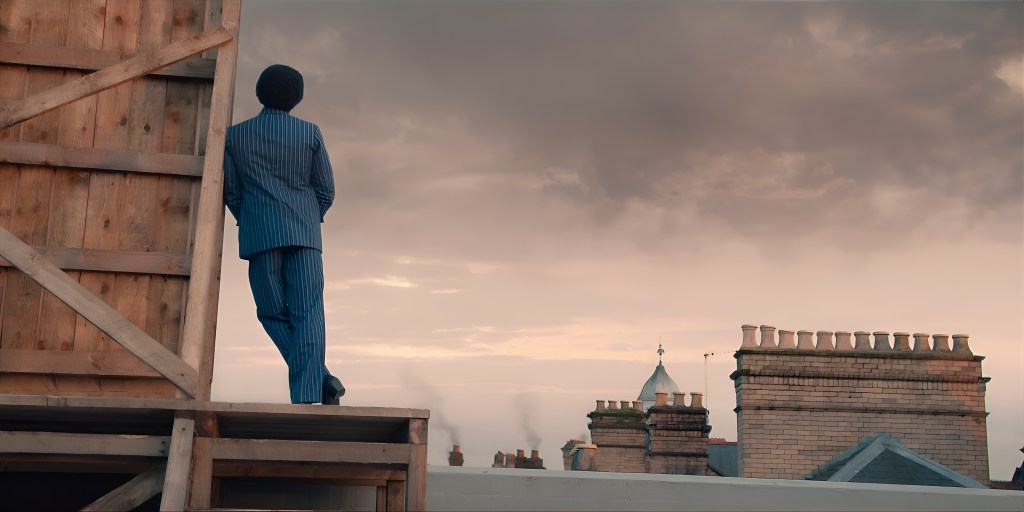
Maestro represents the shattering of the status quo. An otherworld entertain that crawls through the foundations of a Doctor Who set and sets the place a light. She’s a parasite of the show’s unfamiliar future. Yet there are hints of bygone eras in here too. The scene with which the Doctor gazes out at the sixties London Skyline, as Ruby plays a song from her own memories, represents the Doctor looking back at his past. It’s the calm before the storm. One last look glance at the familiar before the uncertainty of his future strikes. Moments prior, The Doctor makes reference to him living in London during a his “first” incarnation, with his granddaughter Susan. Once upon a time, 1963 was the Doctor’s home; both in terms of the episode airings, and the character’s literal place of residence.
As Ruby plays, the Doctor looks toward Shoreditch, presumably reflecting on the years he can no longer return to. He knows his former self and Susan are there. Susan attends Colehill, while the Doctor hides from the time lords he is running from. When Ruby asks if they can go visit his granddaughter, he tells her no. Time travel is too complex, too messy. The Susan of the Doctor’s present is missing in action, presumed dead. He cannot simply travel down her personal timeline to visit her. All he can do is remember what once was. Whether or not the shattering of the status quo will change this has yet to be seen, but at this point in the story, the Doctor isn’t speculating on possibility, he’s mourning what was.
When the scene wraps, the reflection ends and the episode transitions from introspection to reality-tinkering. The Doctor learns that Maestro is the offspring of the Toymaker, attempts to figure out the song sheet from which she sings from, and realises that the reality-bending skullduggery did not die at the tail end of the Giggle.
Davies’ new era is all about moving forward. The Doctor splitting in two and breaking apart from his past self is a demonstration of this. Ncuti’s performance depicts a man springing forward. Be as that may may, excitement for the future doesn’t eradicate a longing for the past. This applies in life as well as art. We can anticipate what is to come by also feeling sadness for what no longer is. The fifteenth Doctor may well be focusing on the horizon before him, but that doesn’t mean he’s sad about the sights that are now behind him.
In an episode all about shattering the status quo. The rooftop scene feels like a melancholic farewell to simpler times. A tearful glance at the Doctor’s known universe before diving headfirst into the unknown.
The Devil’s Chord spends much of its run, weaving and flowing between being a penultimate episode on the eve of change, as well as a reflection on the status quo right before the twelfth hour strikes.
Some have criticised this episode for arriving too early on in the series. It felt too big and bold for episode two. In some respects, this criticism makes sense. The scope of this is so vast and barmy, it barely makes sense when viewed in the context of a two part series premier. The fact this aired on opening night does feel like the work of madness. How can we have a breakdown of normality when we’ve not even had enough time to properly establish what normality looks like?
Ever since the Toymaker infiltrated the Doctor’s universe, Davies has been keen to promote the idea of a reality that isn’t quite working as expected. This fictional universe is in flux. There’s an instability in everything. We’ve seen this play out in a number of ways. Mrs Flood shifting from a petulant neighbour into a Tardiswiki within a mere beat, skygoblins who’ve mastered the science of rope, timelines that can rewrite themselves at the mere squashing of a butterfly, and now a formulaic historical bending into a parallel universe before the cold open has had chance to wrap up.
For all the references to Ruby’s past, a shattered reality is the arc of the day. Davies is keen to communicate this to his audience at every opportunity. The rules he established during his last run aren’t being followed at this stage. Time can be rewriten, fantasy can outshine the science fiction, and anything can happen. This is not Doctor Who as we know it. He lured is with the promise of familiarity when Tennant and Tate returned, yet when the Doctor cast that salt at the end of reality, familiarity shattered.
The Devil’s Chord is a stark reminder of this. Space Babies played it safe, giving us a story where very little happens. There’s no villain, minimal insight into our characters’ internal worlds, and no plot beats that send the story down new avenues. Episode two, on the other hand, is the polar opposite. Ruby and the Doctor reflect on moments from their past, Maestro functions as a threat big enough to send the Doctor fleeing into a cellar, and each scene leads into one far dissimilar from the last. If Space Babies doesn’t lean in enough into the unknown, this one does to the point in which the show almost snaps. It’s a gotcha that’s visible because of how much it contrasts from the last.
Whether going in this hard works or not is wildly subjective. I think there’s a valid argument to make which suggests this is too much for a series intended to function as a soft reboot. Going from nothing to surreal runs the risk of turning a lot of new viewers off, particularly those who may not be accustomed to how diverse a show Doctor Who can be. If you don’t know how fast the show can change each week, you might be alienated by the idea of narratives collapsing this early on into a series’ run.
Having said that, Davies tried a similar trick in 2005, only for the show to be a rip roaring success. He wasn’t afraid to celebrate the weirdness Doctor Who was capable of in episodes such as The End of the World, and it paid off. People didn’t turn off in mass. The idea that audiences are not capable of difference and unpredictability underestimates the demand for something different. Doctor Who isn’t a show that is intended to be just another science fiction series. It’s often at its best when it’s trying to be anything but a carbon copy of anything else that’s on TV at that time. The reason it isn’t playing things safe is because it is a show known for trying out new things. It’s weird and cooky and more than capable of tipping nonsense in the cauldron from time to time.
Furthermore, the idea that Davies’ return is intended to be a reboot just for new audiences might be overlooking the bigger picture. He isn’t simply trying to get new folk onboard, he’s attempting to entice old viewers back too. It isn’t just a reboot for Disney Plus, it is a reboot for Whovians as well. 19 years after he injected life into the show, Davies is attempting to make the show relevant again. There is a sense of reinvention happening before our very eyes. Opening with a series all about reality and rules shattering might be his way of going about doing this. He’s injecting new life into the series by smashing the old guard down. It’s chaotic because the opposite would be predictability. At a time when Doctor Who isn’t quite as relevant as it once was, predictability doesn’t feel like a recipe for success.
The Devil’s Chord is a script that is some of the strangest, most experimental writing I’ve seen from a Doctor Who episode in quite some time. Is there a sense that Davies is occasionally throwing ideas at the wall, hoping some will stick? Perhaps. But is it grabbing my attention? You bet. The positioning of this story as the second episode of the series has a lot to say about this series as a whole. There is a moment in the episode in which Ruby makes reference to her being from June 2024. This would suggest that the episode was originally slated to take place towards the end of series one. Moving the episode to the front end of the series helps to sell Ncuti’s opening series as one that intends to be unpredictable, strange, experimental, and dissimilar to the series from prior eras of Doctor Who.
This is a loud, kinetic story that is bustling vibrant imagery and wall breaking quirkiness. It’s going to be a bit much for some. As an attempt to appeal to a broader audience, it might not be a success. As a chapter of New Who attempts to sell the promise of a series dissimilar to anything we’ve seen before, this is hitting all the right notes.
Whereas Space Babies served as a flat opener to this series, The Devil’s Chord ramps up the steaks, promising a series that could spiral in any direction at any given time.




 Amber Poppitt
2 responses to “‘Change, My Dear’ – Doctor Who 1.2: The Devil’s Chord”
Hated this episode. The Maestro was insufferably over the top, to the point I wanted them to shut up most of the time they were on screen. So I’m glad they didn’t serve as the final villain.
And “pit the Doctor against powers that can crush him like a bug” doesn’t work for me if all the Doctor can do is run (or try stuff that fails).
LikeLiked by 1 person
Fantastic Review! I’m not quite sure how I feel about this increased emphasis on fantasy and god-like beings. I’m hoping it’s a temporary story-arc that will either resolve itself at the end of this series or RTDs run. Part of the charm of Doctor Who has been the fact that it was strictly sci-fi and that there were rules behind the supernatural elements. Loving all the mysteries that RTD has set up, and am hoping for a decent (and logical) payoff at the end of it all
LikeLiked by 1 person