
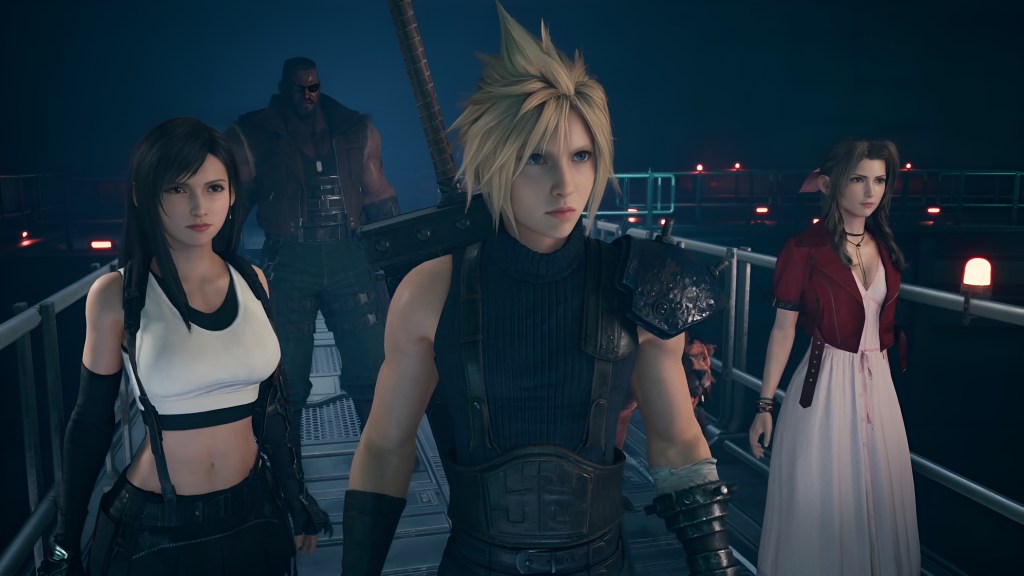
Whispers of a Final Fantasy VII Remake began bouncing around the ether as far back as 2005. Square were partly to blame for this, as they opted to further wet the whistles of fans by releasing a technical Demo for the PlayStation 3 at 2005’s E3 event. The demo in question offered up a next generation reimagining of the opening minute and a half of the original game. The demo was built by the dev team that went on to make Final Fantasy XIII. Despite common assumption, this demonstration was never intended as some sort of grand reveal. No plans to build a PlayStation 3 version of the original were ever actively discussed by Square at the time of this teaser’s inception or release. Be as that may, its existence crystalised an ever growing demand for the company to retell their most famous of fables through the lens of a more state-of-the-art game engine.
Although no official pledges to remake VII from the ground up were made official in the years prior to June 2015, mutterings were indeed being had behind the scenes, to some degree, at least. Director Yoshinori Kitase, writer Kazushige Nojima, visual director Tetsu Nomura and producer Shinji Hashimoto had mused over the urge to manage a remake over the years. Nothing would become official for another decade after the technical demo’s release. By which time, the quartet found themselves driven to commit before it was too late. None of them were getting any younger, after all. If a remake was to happen under their watch, it was now or never.
An official announcement was made at E3 in June 2015; a decade after that partially misleading PS3 demo set fandom alight with hope. It would be another fives years before the game finally reached the market, however. Plans on how to structure the project’s release varied over those years. Some sources suggested the game would be episodic, only having the game reach the public in brief, segmented chunks. A game of this scale could not be delivered in Unreal Engine 4 in a singular narrative, it was concluded. There simply wouldn’t be enough hard drive space on a PS4 to handle such a title. Plus it probably wouldn’t make much financial sense to release so much content within a single sale. Then there was the deadline considerations to take into account. Releasing Final Fantasy VII under multiple titles allowed the development team to work on the project one step at a time, free to rebuild and distribute this re-imagined world over a prolonged period.
In the end, a compromise of sorts was made. Final Fantasy VII Remake would be released as a series of sequels, much like that of Final Fantasy X and Final Fantasy XIII. The first in the series would cover the Midgar portion of the original game, which made up about the first 10-hours of the story.
Opting to zone in on Midgar for the debut story makes sense from a commercial, narrative and practical perspective. For one thing, this is the part of the game that works in isolation from the wider scope of Final Fantasy VII. Though it serves to set up the primary plot, there’s a narrative consistency to this portion of the game that stands on its own two feet. In addition to it having a dissimilar tonal style from the remaining 70 plus hours of gameplay, it has its own mini narrative that operates in isolation. There’s a set-up, a small band of leading cast members, a mid-point twist that exposes Shinra’s manipulative intentions, a blooming love interest between Cloud & Aerith, an all is lost moment after Sector 7 is crushed to oblivion, a successful rescuing of one of the leads, and an eventual escape into the wider world beyond. Despite the countless plot threads left unanswered, there’s a sense of a story wrapping up at the 10th hour of the original game.
Had the Final Fantasy VII Remake flopped, it still would have felt like a finished product when all was said and done. There is a structure to this opening part that does not end abruptly. As unfinished as it might be by the time we see Cloud and company venture beyond the periphery of Shinra’s metropolises, there’s a sense of completion. Leaving Midgar is the end of an era that does not feel out of place playing out within the confines of a single game.
It’s also the most linear part of the original, allowing Square to work out the logistics of a project this vast within a relatively safe space. Rebuilding a game of such size within an engine powerful enough to build largely-convincing worlds is not easy task. When the team first started renovating Gaia in 2015, they likely had little idea on how achievable such a project may have been in the long haul. Starting with a coherent beginning, middle and end, set within a series of familiar glorified corridors is a sensible place to start. It gave them a familiar template that could get them from A to B. Had this been a sprawling vista with endless outcomes, the chances of them buckling under the weight of their own ambitions may have been all the more likely.

The finished result showcases the advantages to such an approach. Final Fantasy VII Remake is a game that has enough of an identity to stand on its own two feet, without relying upon sequels in order to operate as a finished product. The game introduces its core characters, establishes the primary threat as the Shinra Electrical Company, teases its overarching big bad through a series of premonitions, and leaves out characters in a moment state of serenity before the next step in their journey. We’ve met the primary leads, lost some beloved faces along the way, discovered the metropolis of Midgar, and witnessed the demise of President Shinra. The journey may not be over, but the chapter closes with a sense of closure that feels both satisfying and intriguing.
Of course, there are downsides to this approach too, which is also made apparent through the game’s release. The decision to blow the opening 10-hours into a 32-hour game creates an experience that’s a lot more flabby than the blueprint it originated from. There are often times throughout where you can feel the game dragging its heals from one chapter to the next, not quite willing to progress out of fear of finishing too soon. Mini-games, side quests and detours take away from the sense of urgency behind the story’s plot. This is a game about an earth sucked dry by a manipulative Monopoly willing to murder entire segments of their population in order to further their agendas. Having Cloud and the gang get preoccupied by troublesome tealeaves and games of Whack-a-Box feels a little inappropriate, given the context. Parts of the game feel like a university student, padding out their essay wordcounts with meaningless paragraphs that feel irrelevant to the major theme of their paper.
Final Fantasy VII Remake is at its sharpest and most faithful during the opening portions of its gameplay. The bombing mission that opens the game is one of the slickest and most thrilling reimagining’s of a sequence that was already pretty darn great to begin with. Granted, it’s a shot-for-shot retelling of the original game, but that doesn’t take away from the jaw-dropping craftsmanship on display here. The pacing, tone and gameplay mechanics are next to none, throwing us into a kinetic opener builds toward a climax which refuses to slow down. The chapter’s penultimate showstopper involves a retooled boss battle against a scorpion sentinel which pushes Unreal Engine 4’s cinematic potential to its limit. It’s the sort of sequence that puts forth a solid argument for why videogames should now be considered a storytelling medium on par with film.
Chapter one feels sleek and functional, like a state-of-the-art gizmo designed to bedazzle its audience. At least this is how it felt back in 2020. Games have come a long way in the last four years, but it’s still easy to appreciate the craftsmanship on show here. This can especially be said about the game’s battle mechanics. Controversy bubbled after it was announced the game would be ditching the original’s traditional turn-based approach for a more contemporary real-time system. The finished product delivered a system that felt like a perfect blend between the two. Players still have to wait for their ATB gauges to fill before casting spells or using items yet can happily slash and dodge whilst waiting for their time to shine.
You can essentially toggle the game between being more turn-based or combat oriented depending on the difficulty setting. Easy mode allows players to dice their opponents to death. Normal gives a more balanced approach, giving you the freedom to chip away and enemy’s HP, all while figuring out the right spells to cast to land that finishing blow. Hard mode feels much more like a traditional turn-based game, expecting players to rely solely on the right selection of special moves in order to make it out of the battle in one piece.
Final Fantasy VII Rebirth did not add all that much to this combat system when it was released in February 2024. Perhaps this is because the product we got with Remake felt like a natural evolution of all the battle systems Square had tried and tested in the run up to this game’s release. Attempts to spruce up and inevitably retire the turn based approached had been worked through and revised extensively over the last decade and a half; from Final Fantasy XII’s movement-enabled battle system, to XIII’s paradigm-layered approach, to XV’s semi-clunky real time set-up. It wasn’t so much a case that the previous attempts were straight up failures. They just felt like ongoing projects, is all. Remake delivers a combat experience that feels like a refined and perfected follow on to all of those previous battle systems; delivering an intuitive, energetic, and accessible endpoint to an almost two-decade long project.

As already mentioned, the game does become clunky on occasion. The slick battle system and sharp-as-nails opening aren’t enough to maintain a tight momentum for all of its entire 32-hour run. For all of Final Fantasy VII Remake’s successes, as its core it’s a ballooned 10-hours’ worth of gameplay stretched to almost breaking point. It hovers on the verge of almost not quite working as a game of this size. One argument might be to suggest the game is scaled down into something a little more similar to that of Spider-Man: Miles Morales; a stand-alone expansion that exists on the outskirts of a larger project. Yet for all the flaws of a narrative that’s tripled in size compared to its source material, the bloated nature of Final Fantasy VII Remake isn’t enough to hinder the narrative as a whole. In fact, it actually kind of helps it in some respects
All the side quests and detours do detract from the urgency of this story. But they also help to make the major plot beats more impactful. The fact we get to spend over 30 hours in Midgar makes this portion of Gaia feel ever more familiar to us. The ancillary treks build the world up more than that of the original. Does it make Remake more superior to its 1997 blueprint? Not exactly. It just makes the place feel a little more intimate.
This aspect extends to its characters too. Getting more time with Biggs, Wedge and Jessie provides a larger canvas to flesh them out upon. First time viewers would be forgiven for thinking they were major players in the Final Fantasy VII canon.
All of which makes the demise of the Avalanche ancillary characters and departure from Midgar all the more heart wrenching. This is a game clearly aware that pretty much everyone playing – both old and new – are aware of how the story progresses. Heck, why else would they reveal Sephiroth as early as Chapter two. The creators know that everyone knows the lore. Therefore, it makes sense to try and enhance the experience by shaking the status quo up a little. If everyone knows that Sector 7 is destined to be crushed beneath a city-sized plate, why not force us to fall further in love with the victims of such devastation. If everyone knows Cloud and co will soon be fleeing Midgar all good and proper, why not familiarise us all with every nook and cranny occupying this concrete jungle.
There’s an underlying narrative to Final Fantasy VII Remake that is unique to this interpretation of the game. As we’ve already established, this is not a remake in a traditional sense of the word. It certainly starts out that way, but as we progress, the narrative begins to buckle. The tightness of chapter one gives way to a bloated mid-section. The bloated mid-section gives way to a final chapter that’s about as unhinged as a door in a tornado. There’s no doubt that this is an intentional creative decision. Whether you love or hate this decision, Final Fantasy VII Remake is all about transcending the status quo. It throws us into a familiar world, before unrooting that familiarity.
The logic goes that a faithful remake to a game everyone presumably knows the outcome of has no emotional stakes. If everyone knows the twists and turns, what is the point in retreading all the same old beats. Final Fantasy VII Remake wants us to believe that this won’t be the same as last time. The early introduction of Sephiroth, the inclusion of the Whispers, the foreshadowing of Aerith’s fate, and the remixing of end-game battles at the tale end of Cloud’s time in Midgar are attempts to cell this notion to us. Does it mean the climax of part three will be unlike anything we’ve seen before? Who knows. The point of Remake isn’t to confirm or deny this possibility. The point is to convince us that we don’t know this version of the story. It wants us to guess, it wants us to hope, it wants us to fear.
So, is this a remake, or a reboot? I suspect it’s both. This game doesn’t actually go out of its way to drastically re-invent anything we’re familiar with from the original game’s opening 10-hours. If anything, this feels like a shattered version of that original game. The narrative has exploded. All the pieces are all there, they’ve just been moved around and spaced out. Between the shards of familiarity, we get side-quests and ventures into the world of Midgar. It’s a fractured game that flirts with the idea of change, all without actually giving us anything radically dissimilar.
On a personal level, this approach worked a charm on me in 2020. I’ve always approached this project as a separate entity from that of 1997’s Final Fantasy VII. This is a parallel version of those events, one that is free to do as it pleases, as far as I’m concerned. Whether or not this Final Fantasy VII project flourishes or fails has never ran the risk of tarnishing my perception of that original game. All the same, I admire this game’s ability to get me curious as to how the narrative plays out going forward. Upon completing it in April 2020, I felt as though I didn’t know where this story was going. Would Aerith die at the Forgotten Capital? Would Sephiroth’s plan to rule in isolation succeed? Would Shinra flourish of fall? For the first time in two decades, these questions became pertinent once again.
Of course, we now know the answer to some of these questions. While the existence of 2024’s Rebirth doesn’t exactly shed light on the ultimate outcome of this project, it gives us a slightly better idea as to whether such flirting was a bluff or a promise.
Final Fantasy VII Remake promoted the idea of a faithful retelling of the 1997 original. The promise is literally written within its title. Jazzed up graphics and battle mechanics aside, the opening segment of the game sticks to the promise of its title. By its end, we’re promised the opposite.
This is a game that evokes the mood and world of the 1997 original, albeit in prettier graphics and a set of gameplay mechanics that match the climate it was remade within. With that in mind, Final Fantasy VII Remake furthermore functions as a standalone tale capable of standing apart from its future instalments, as well as the predecessor responsible for its existence. The bloat and fractured approach to this reimagining might cause the narrative to sag and wobble on occasion, yet the final product is more than capable of telling a story that engages and entertains for a large portion of its 32-hour runtime.
This remake’s decision to shake its faithful pledge of mirroring its predecessor transforms this into a dissimilar experience entirely. It’s a game capable of making us weep at plot developments we’re all too familiar with, inviting us to indulge in environments once restricted by an antiquated game engine, and making us curious as to how familiar twists may play out during future instalments. As a debut intended to draw audiences back in to a world they left 23 years prior to this one’s release, it manages to make the landing.




 Amber Poppitt
You must be logged in to post a comment.