

Despite a difficult production – largely in part to Columbia Pictures’ financial troubles at the time of its development – Close Encounters of the Third Kind went on to be a roaring success for the then 30-year-old Steven Spielberg. The film cost $19.4 million dollars to make, yet upon its release in 1977, it brought home a worldwide box office grossing £306.9 million.
Columbia Pictures celebrated a major triumph with the movie, prompting the studio to eagerly pursue a sequel. Spielberg, the writer and director, was seen as crucial to the success of Close Encounters and was invited to return for the continuation. Initially, Spielberg declined. At this point in his career, he had only a few original films to his name and had never worked on a sequel. In his own words, he believed that making one would be nothing more than a ‘cheap carny trick.’ However, the recent release of Jaws 2 made him reconsider. Despite its financial success, Jaws 2 received lukewarm reviews from critics and audiences alike. Although Spielberg had no involvement in that particular film, he felt partly responsible for its failure. He believed his refusal to return led to Universal Studios giving full creative control to director Jeannot Szwark, allowing him no say on which direction the story went.
As a result of this regret, he decided to take up Columbia’s invite to work alongside them in the development of a Close Encounters sequel. While he had no desire to direct, he felt that maintaining a degree of influence would give him the power to steer it in a direction that he deemed more suitable to his tastes.
Be as that may, reluctance still persisted. The first Close Encounters movie was a deeply personal shoot for Spielberg; one born out of his passion for UFOs, as well as memories of his father taking him to watch meteor showers when he was a child. Returning to extend a story so intimate to Spielberg’s life and view on the universe would be far from an easy task. Did he try to replicate the themes and formula, resulting in the risk of a cheapened copy of the original, or should he take the story down an unfamiliar road, using the premise as an opportunity to explore new ideas?
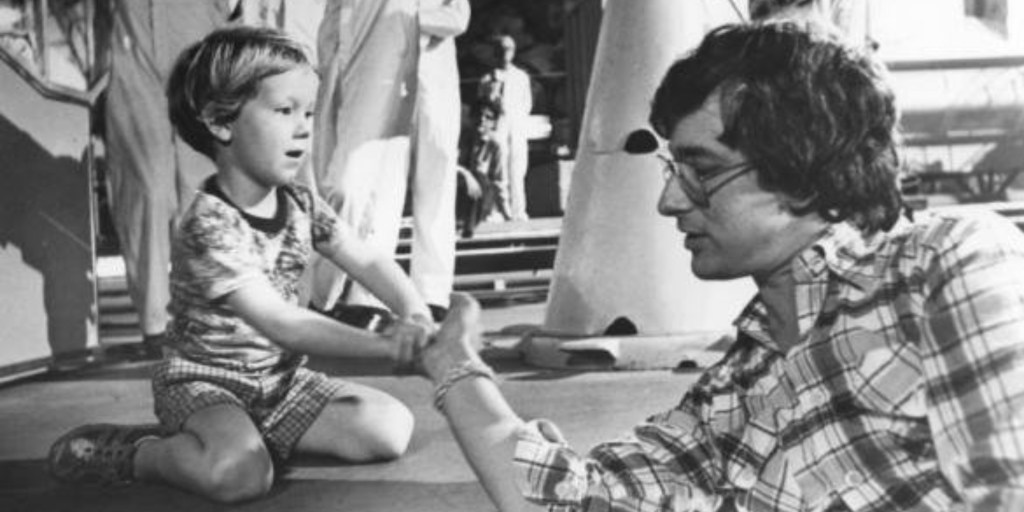
Spielberg chose the latter, opting to take the Close Encounters down a far different path. While its predecessor served more as a meditation on humanities’ qualities concerning curiosity, obsession, connection and the drive to uncover meaning to the universe; Spielberg’s intended continuation would be far different by design.
The intention was to flip the story on its head, essentially creating the polar opposite of what came before. Gone was the wonder and fascination of alien encounters. The follow on would be about fear of the unknown; a story depicting extra-terrestrials as threats from the unknown. The sequel would be about monsters who descended from the night sky to terrorise and torment humanity.
Part one was written with Spielberg’s childhood lingering in his minds’ eye. He penned Close Encounters with the Disney fables and UFO daydreams of his younger years running through his imagination. With that in mind, it is fair to presume that Spielberg was approaching part two with contemporary thoughts at the forefront. With the Cold War shaping much of what pop culture was producing at the time, the realm of science fiction that Close Encounters of the Third Kind reflected was from a bygone era. Films such as Invasion of the Body Snatchers, The Thing from Outer Space, the retelling of H.G Wells’ War of the Worlds and Ridley Scott’s Alien were using extra-terrestrials for metaphors of threatening forces from beyond the boarders of daily life. The world was an anxious, nihilistic and suspicious place in the late 70s. Aside from a handful of notable exceptions, science fiction cinema was beginning to reflect such pessimistic outlooks.
So with a newly established tone and theme in place, it was time for Spielberg to begin constructing a plot to build upon these murkier foundations.
Yet to do so, he would need some inspiration.
Josef Allen Hynek was born on May 1, 1910, in Chicago, Illinois. His father was a cigar maker, and his mother worked at a local grammar school. As a child, Hynek often fell ill and was confined to bed. To ease his boredom, his mother read him astronomy textbooks, igniting a lifelong passion for the stars that led him to become an astrophysicist.
In the 1940s, while working at the Johns Hopkins Applied Physics Laboratory, Hynek helped develop the proximity fuze, a groundbreaking radio-controlled detonation device. This ‘smart weapon’ was crucial to the Allies’ success throughout the second world war.
After his wartime contributions, Hynek gained recognition and access to numerous researchers, government contractors, and research grants. One notable post-war project involved launching meteorological instruments into the atmosphere using V-2 rocket cones salvaged from the Germans.
With his impeccable reputation and experience as one of the first officially recognised rocket scientists, authorities soon sought Hynek’s help to investigate the mysterious flying saucers reported by pilots in the 1940s.
This led Hynek to become a key player in the Air Force’s official UFO study, Project Sign. The project’s goal was to determine if UFO sightings derived from potential enemies, and whether they posed a threat to national security. Hynek’s role was to review UFO reports to see if they were scientific phenomena or undocumented foreign crafts. He found that about 80% of the cases were misidentified meteor showers, visible planets, or other astronomical phenomena. The remaining 20% remained unexplained.
After his contract ended with the Air Force in 1949, Hynek returned to academia. Meanwhile, some of the remaining Project Sign staff began promoting ‘extraterrestrial theories’ for UFO sightings, which the US Government disapproved of, leading to their reassignment or dismissal. Project Sign was eventually dismantled and replaced by Project Grudge, which aimed to debunk UFO sightings as ordinary events, countering the growing sensationalism and anxiety surrounding UFOs amongst society.
It soon became clear, however, that the public and media’s fascination with UFO sightings was becoming more difficult to curb than predicted. Project Grudge was considered a failure and was reinvented as Project Blue Book. This time, the mission statement was to uncover definitive answers for the public, finding explanations for unidentified sightings to assure citizens that they were not under threat from little green men.
Project director, Lieutenant Edward J. Ruppelt reached out to Hynek for assistance on Project Blue Book, hoping he would be able to assist in decoding some of the unresolved Project Sign case files. His re-involvement in the world of UFOs reinvigorated the astronomer’s interest in the subject. Only now, he had embraced the topic from a more open-minded perspective.
In his debut publication, The UFO Experience, Hynek introduced the UFO Classification System, which included the now-famous “Close Encounter” terminology. Hynek’s system categorised encounters into three types: the first kind, involving visual sightings of a UFO within 150 meters; the second kind, involved UFO events with physical effects, such as interference with vehicles or electronic devices; and the third kind, included encounters with humanoids or other occupants.
In addition to inspiring the film’s title, Hynek would eventually go on to serve as a technical adviser on Speilberg’s Close Encounters of the Third Kind. He even had a cameo during the film’s third act.
It was little surprise, then, that Spielberg turned the Hynek during the conceptualisation stages of the feature’s spiritual sequel; seeking inspiration from a man who had dedicated so much of his life to the subject of otherworldly beings.

During the research stage Hynek would share with Spielberg a series of real-life cases that he’d both worked on and heard about during his time at Project Blue Book. Amongst these, was the Hopkinsville encounter of 1955.
The incident allegedly occurred on the Sutton family’s remote farm in Hopkinsville, Kentucky, on August 21st of that year. According to the official police report, the sightings began when a visiting family friend, Billy Ray Taylor, saw a silver metallic object hovering silently in the sky above the farmland. The object glided toward the house before descending to the ground.
Billy Ray tried to convince the wider Sutton family of what he’d seen, yet his claims were laughed off as delusional. It wasn’t until an hour later, when Billy Ray and Lucky Sutton went to check on their barking dog in the yard, that the chaos began. As they approached the backdoor, they spotted a short humanoid creature surrounded by an other-worldly glow. The creature had elongated arms, bulbous eyes, oversized heads and talon-like hands.
Billy Ray and Lucky panicked, grabbed their rifle and shotgun, and fired at the creature. Despite their efforts to wound the glowing figure, it flipped and scrambled back into the darkness.
The remainder of the evening consisted of the Sutton’s witnessing and failing to successfully shoot the strange creatures. One entity reportedly glided down from a tree, another grabbed Billy Ray’s hair as he stepped outside, and several were seen peering into the home’s windows.
Police who inspected the scene found evidence of bullet holes and shotgun shells, confirming that the Sutton residents had indeed opened fire in the areas they had alleged to. Nevertheless, officers found no evidence of the creatures described by the family. In the years following the encounter, many have written off the case as a hoax cooked up by the Sutton family. Even Project Blue Book decided not to investigate the matter in any official capacity.
Nevertheless, it was a story that captured the public’s imagination. Spielberg quickly fell into this camp when Hynek regaled this tale to him. The idea of extraterrestrials landing on a remote farm to torment its residents inspired Spielberg to turn it into his next film; a story which he titled Watch the Skies.
There was one drawback, however. The Suttons were not keen on having a film made about them. Instead of scrapping the idea altogether, however, Spielberg’s plan was to retool it enough to avoid running into any lawsuits with the Suttons.
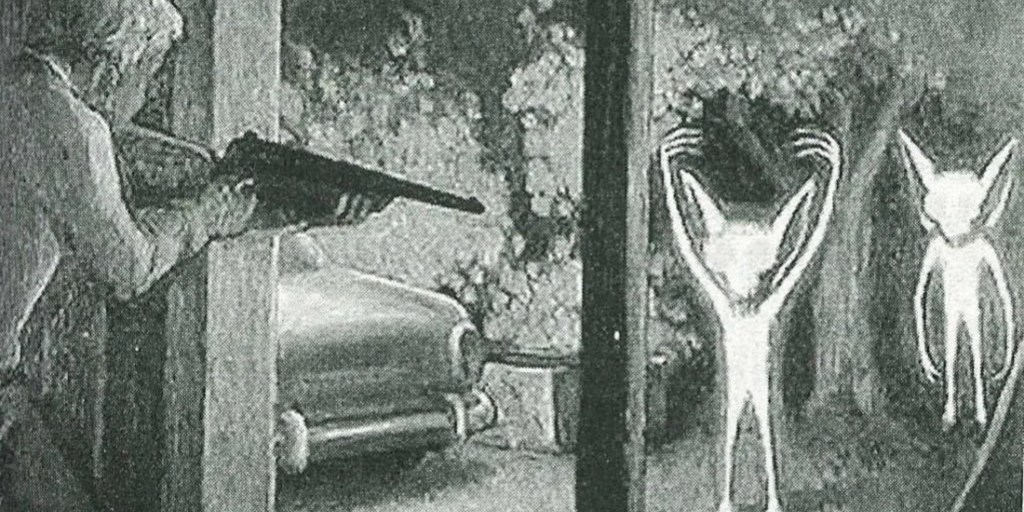
Spielberg and project Collaborator Ron Cobb, got to work fictionalising the events of the Hopkinsville encounter. They hired screenwriter John Sayles to assist them in reworking the story.
Prior to his time working within the Hollywood film industry, Sayles had spent his twenties working blue collar jobs and going on hiking trips to widen his worldview in the name of improving his writing. By the time he’d appeared on Speilberg’s radar, he had already written two novels, as well as a screenplay for Joe Dante’s 1978 film, Piranha.
Piranha was a low-budget knockoff of Jaws, which caught Spielberg’s attention. He admired the script and decided to hire Sayles because of this.
Sayles utilised Speilberg’s Watch the Skies treatment to put together a 99-page screenplay renamed Night Skies. As intended, Sayle’s script took inspiration from the Hopkinsville encounter, reshaping it into more of a grisly dark comedy set in the present-day.
The script, as it was delivered in early 1980, told the story of a small family living in a farmhouse in the midst of rural America. The arrival of the alien creatures would be signalled by UFO markings and mutilated cattle whose flesh has been stripped from their bodies. Before long, the family of protagonists would find themselves host to five visitors from another world. Each of the five aliens would have their own unique abilities and personalities. There would be a hypnotic one named Hoodoo. Klud and Squirt would be described in the script as the “mischievous” duo. The leader and most viscious member of this pack ,however, would be Skar; a bird-like creature who had the ability to mutilate lifeforms with just the tip of his glowing finger. The fifth member of this extraterrestrial crew would be a child-like alien named Budde.
Being the youngest of the pack, Budde was more innocent and friendly than the other aliens. He would befriend the family’s autistic son, and would ultimately be left stranded on earth at the end of the film.
Sayles’ script would take part of its inspiration from the historical feature Drums Along the Mohawk; replacing the indigenous Americans attacking Gil and Lana’s home with Skar and his cohorts.
As Sayles worked on refining his script, pre-production on Night Skies got underway, and Spielberg began searching for the film’s director. His first choice was Toby Hooper, who had just completed The Texas Chainsaw Massacre. Keen to focus his talents on making a haunted house movie, however, Hooper decided that the project was not for him and passed on the offer shortly after talks began.
Next on the list of directing potentials was project collaborator Ron Cobb, who had impressed Spielberg with his work as production designer and illustrator on George Lucas’ Star Wars. In April of 1980, Cobb was officially signed on to direct, with Variety announcing the Night Skies title to the wider public.
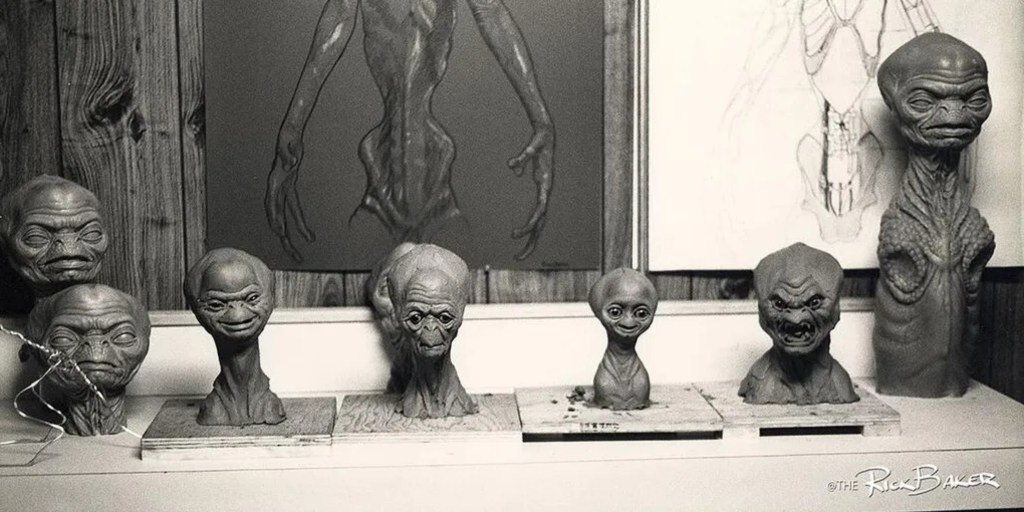
Cobb decided that due to the technical demands of Sayles’ screenplay, Close Encounters’ technician Carlo Rambaldi was probably not the best fit for the job this time around. Due to being obscured and shrouded in bright light Rambaldi’s designs could afford to be flimsy and free from excessive movement. The Night Skies’ creatures were intended to be at the forefront of the movie, however, mutilating animals and breaking into homes. It was on this advice that Spielberg got in touch with Rick Baker.
At the time of contact, Baker was in the midst of putting together his now famous werewolf transformation for John Landis’ 1981 film, “American Werewolf in London.” In an interview with Cine-fantastique magazine – Baker considered the opportunity by Spielberg to be a “a dream come true”. During the same interview, Baker also informed Spielberg that this would be a considerably expensive project, costing around $3 million dollars for the effects work alone.
A preliminary budget of $70,000 was assigned to Baker during development, despite the fact that Sayles was still redrafting his script. Content with the work that Sayles, Baker and Cobb were getting on with, took a hiatus from pre-production, setting off to work on George Lucas’ debut Indiana Jones movie; Raiders of the Lost Arc.
Baker quickly started working on the creature designs, even building a functioning prototype of one of the creatures. He sent tapes of the prototype to Spielberg, who was thrilled with the progress. Indiana Jones producer, Kathleen Kennedy, contacted Baker to share Spielberg’s excitement, quoting him as saying the designs made Yoda look like a toy by comparison.
Spielberg was happy, the script was coming together, a director was signed up, and the visuals were taking shape. The enthusiasm, love, and effort going into Night Skies made the project feel unstoppable.
But as we now know, history had different plans.
References
Hasted, N. (2017, September 21). Loving the Alien: How Steven Spielberg changed science fiction. The Independent. Retrieved from The Independent
Hutchinson, S. (2017, December 14). 15 Things You May Not Know About Close Encounters of the Third Kind. Mental Floss. Retrieved from Mental Floss
Janssen, V. (2023, September 14). How the ‘Little Green Men’ Phenomenon Began on a Kentucky Farm. HISTORY. Retrieved from HISTORY
Lambie, R. (2019, June 12). How Steven Spielberg’s Night Skies Became E.T. Den of Geek. Retrieved from Den of Geek
Madden, C. (2022, February 28). E.T. Was Originally Going To Be A Horror Movie – But Steven Spielberg Saw A Different Path. SlashFilm. Retrieved from SlashFilm
Majestic Documents. (n.d.). Project Grudge. Retrieved from Majestic Documents
O’Connell, M. (2024). J. Allen Hynek Biography. Center for UFO Studies. Retrieved from Center for UFO Studies
Squires, J. (2014, May 29). Steven Spielberg’s Night Skies: The Most Important Movie (N)ever Made. Halloween Love. Retrieved from Halloween Love
Taylor, D. (2014, June 5). The Real Story Behind Those Rick Baker ‘Night Skies’ Photos. IndieWire. Retrieved from IndieWire
Wallenfeldt, J. (2024, September 24). John Sayles. Encyclopaedia Britannica. Retrieved from Encyclopaedia Britannica








 Amber Poppitt
You must be logged in to post a comment.