
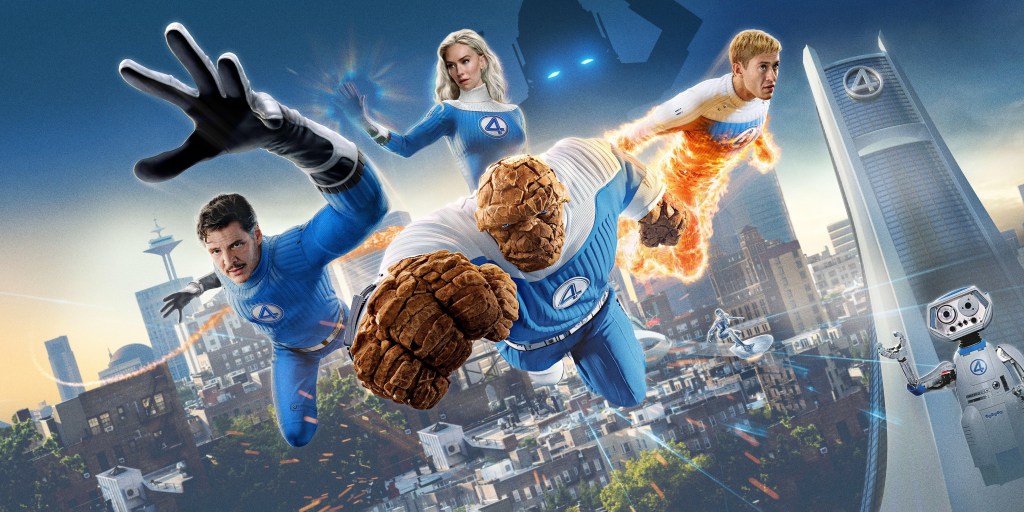
As far as features go, The Fantastic Four: First Steps is a lot of fun. It’s grandeur in its scale, unwavering in its confidence, and unique in terms of how much it feels like an adaptation of a story from another time. This is a movie that embraces the retro-futuristic aesthetic of a version of the science fiction genre from a bygone age, resulting in a feature that pays homage to a type of visual storytelling that’s both familiar and alien
Aesthetics aside for one moment, The Fantastic Four: First Steps is a film that exudes a remarkable giddiness in its self-contained nature, seemingly unburdened by the continuity constraints that have, at times, hampered more recent MCU projects. This sense of liberated glee prompts a compelling question: could its position as a product of Marvel’s Multiverse Saga have not only contributed to its overall success as a Fantastic Four adaptation, but also signal a potentially promising direction for future features overseen by Kevin Feige and his Disney colleagues?
The Multiverse Saga at Marvel Studios has been chugging along since January 2021, commencing with WandaVision and delivering films such as Spider-Man: No Way Home, Deadpool & Wolverine, and Doctor Strange in the Multiverse of Madness. While these ventures have provided varying degrees of entertainment, the overarching Multiverse narrative has, for me at least, presented a few points of contention that have become more apparent over time.
There’s a few problems with splitting up film series into a strand of infinite timelines. Firstly, it just becomes a tool to widen the scope of crossovers, allowing not only characters from different movies to come together, but characters of different franchises or reboots. This was highly effective when first attempted in Spider-Man: No Way Home, a film I praised considerably upon release, but is a technique that quickly diminishes each time it is applied. Doctor Strange in the Multiverse of Madness was an example of this, in which crossovers from the 20th Century Fox X-Men franchise were used mostly as jokes or methods to generate headlines prior to its release. Patrick Stewart’s return existed largely just to generate some buzz before killing him off as a gag. Likewise, in Deadpool & Wolverine, characters from retired movie series were dusted off and paraded around for a gag or two before being brutally murdered for comedic effect.
It’s not that there was anything inherently terrible about these revivals, it’s just the more it is utilized, the cheaper it becomes. Much like any kind of nostalgia gimmick, the effects wear off considerably quickly. Reminiscing over movies we remember from our younger years only evokes pleasure for a short period of time. Each time you do a crossover, the impact diminishes. There’s only so many times you can dish up old favourites before the crowds stop losing their minds.
The second, and perhaps bigger issue with infinite timelines, is the complete removal of the stakes. If there are endless variations of reality, then any character that has been killed off can theoretically return. We saw this in Deadpool & Wolverine, a film that was a lot of fun, but ultimately raised a concerning question; what is the point in doing a Logan style send-off, if our heroes can just jump to another reality and pluck an unlimited number of Hugh Jackman’s out of thin air? On that basis, what’s to stop Wade Wilson from visiting a Tony Stark who never snapped his fingers?
All of which led me to wonder whether the Multiverse saga was a doomed concept with diminishing returns. Was it an idea that sounded amazing on the surface, with the promise of threading in Sam Rami’s Spider-Man universe with Brain Singer’s X-Men timelines? Only for it to descend into a convoluted cash-grab that eradicated all the stakes and desensitized us to narrative crossovers? Could there be a way to actually utilise the infinite timeline idea to do something interesting?
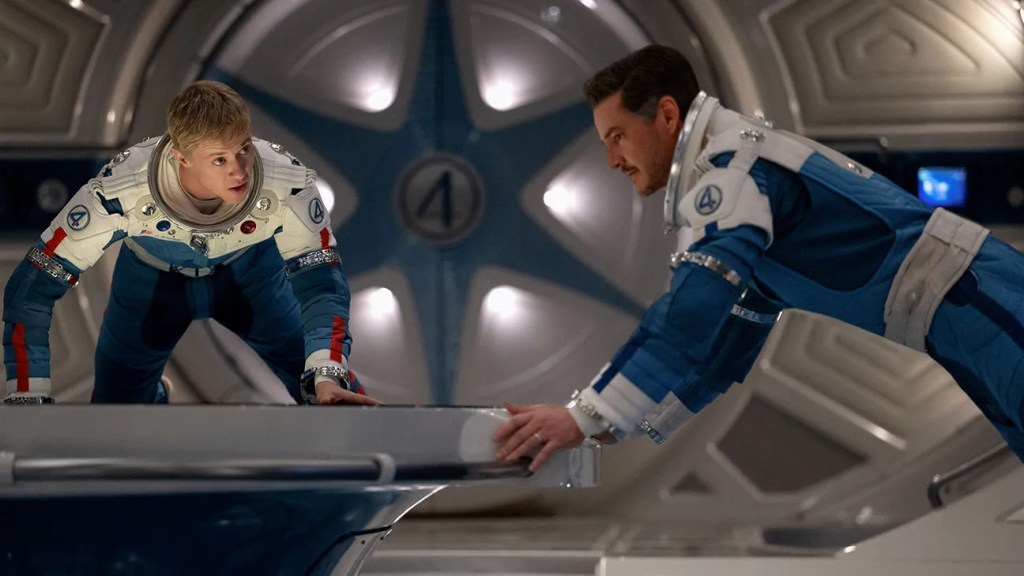
The Fantastic Four: First Steps is a potentially promising answer to that question. It’s a film that essentially utilises the multiverse concept to create a story that feels inventive, fresh, and unshackled from the burden of serialised storytelling that has become synonymous with the Marvel Cinematic Universe since 2008. This is a film that feels liberated and free to stand out, not in spite of the kaleidoscope of realities available to the filmmakers working on these projects, but because of it.
Visually speaking, First Steps is able to indulge in the 1960s inspired retrofuturism that dominated the Jack Kirby source material. It’s vibrant, imaginative and very much a product of a science fiction aesthetic that no longer exists. It’s also something that might have been a lot harder to pull off, had this been made without the context of the multiverse applied to it. Had Matt Shakman attempt to tell this story inside the pre-established MCU timeline, there is a strong possibility that the attempts to get it to fit both aesthetically and narratively into Feige’s movie making model would have contorted it into something that snapped under its own pressure.
The Fantastic Four has been a difficult comic book to adapt over the years. Over the last four decades, a trio of reboot attempts—spearheaded by Roger Corman, Tim Story, and Josh Trank—have each, in their own way, faltered in capturing the essence of Kirby’s creation. The core struggle, it would seem, lies in replicating the bright, otherworldly, and inherently optimistic tone that defines the source material. Each cinematic attempt has either outright rejected this vibrant spirit or significantly compromised it, striving to ground the characters in a reality more closely aligned with our own.
Yet, The Fantastic Four sprang from the fertile imagination of the 1960s, a period deeply intertwined with humanity’s burgeoning space age. It was a time when scientific advancement and a boundless sense of possibility were inextricably linked; the future was envisioned as a euphoric, exciting frontier where technology would elevate us to brave new worlds. In stark contrast, contemporary science fiction has a tendency to adopt a grittier, more cynical lens than the one employed during Kirby’s era. This tonal divergence, perhaps more than any other factor, has proven to be a considerable issue plaguing attempts to bring Marvel’s First Family successfully to the silver screen.
The early 2000s attempt tried to make a more light-hearted approach with Tim Story’s approach, however it didn’t quite work. This period of film-making was very much in the shadows of tentpole movies such as the Matrix, which donned a much grittier coat of paint that was hard to scrape off when it came to movies being made around this period. Furthermore, the post-9/11 landscape meant that the wider culture at large was in a much less optimistic place; a facet that extended to that of pop culture too. The noughties were a period in which a fair few movies were moody, mopey and a touch too edgy; a grumpy teenager who wanted to sit in its room and contemplate the ills of the world. This grimness, coupled with the emergence of more stern, nuanced, and grounded comic book adaptations such as Christopher Nolan’s Batman Begins, rendered any attempt at quirkiness found in projects such as Fantastic Four as an almost deliberate act of oversaturation, akin to unnaturally cranking up the contrast on an already dark image. It felt forced and off. It’s not that upbeat films didn’t exist during this period, it’s just the zestful, quirky nature of the Fantastic Four felt out of place when compared with a sizeable amount of blockbuster releases at that time.
Both the real world, and the fantastical landscapes that dominated our culture were far removed from that of the one Kirby’s 1960s original was made in. While this tonal discrepancy was not the sole factor that contributed to Story’s film failing as an effective adaptation, the flat attempt to find a middle ground in tone and execution certainly did little to bolster its success.
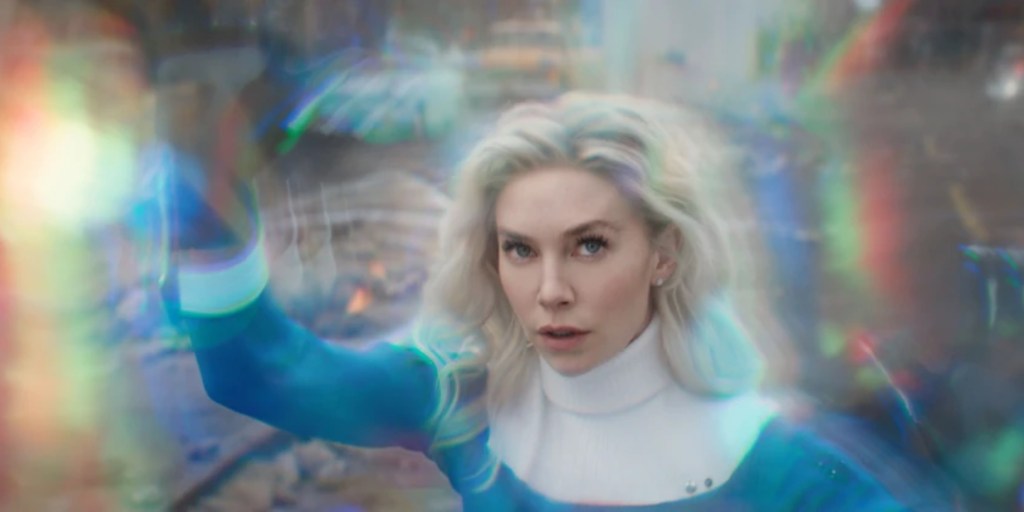
Tosh Trank’s 2015 attempt tried to lean into the more dystopian obsessed trends of the period it was made in, going so far as to reject Kirby’s visions almost entirely. Trank had no intention to try and force his model to fit into the mold of 1960s retro-futurism, instead deciding to embrace the post Dark Knight, Man of Steel landscape of superhero cinema. Although Marvel Studios were figuring out ways to bring like-for-like comic book adaptations to the silver screen, broody adaptations operating outside of the Disney system were becoming more and more in vogue. Fan4stic was operating on the fringes of the MCU model, opting instead to make something darker and far removed from the mainstream. The finished product felt lightyears away from anything resembling The Fantastic Four; becoming a product that seemed familiar in name only.
Matt Shakman’s version seems capable of sidestepping both of these trappings. It isn’t trying to force a positive vision on a product born into a more pessimistic, post 9/11 world., nor is it trying to lean into the brooding MCU subculture of its 2015 predecessor. Having this be set in a universe that’s quite deliberately not meant to be anything like our own liberated it from trying to both fight against or be apart of anything in particular. This is a film that could quite literally be the very world it’s source material was set in.
Kirby’s original vision of futurism often feels out of place within contemporary pop culture fiction, largely because the conventions of the genre have evolved with societal shifts. Yet, by applying the concept of the multiverse, this expectation to avoid outdated styles is sidestepped entirely. The retro-futures imagined in the 1960s, while seemingly nonsensical in a world that has diverged dramatically from such predictions, becomes plausible within a parallel universe. After all, if events unfolded differently in one version of Earth, who is to say that the retro-futuristic dreams of yesteryear never materialized elsewhere? There’s an inherent logic and compelling logic to these concepts when viewed through the lens of a multiverse, a logic that feels absent when it is presented within the confines of a conventional science fiction or comic book narrative set in a similar timeline to that of our own.
In addition to this, setting The Fantastic Four: First Steps in its own timeline allows this film to breakaway from the main bulk of the MCU timeline. After almost 18 years of interwoven storylines and character crossovers, Kevin Feige’s empire is starting to feel a little heavy under the weight of it all. It’s difficult to question why Doctor Strange or Peter Parker don’t just swoop in to help out when the Thunderbolts are getting into a spot of bother. Likewise, with all the television tie ins cropping up on Disney Plus, it’s difficult to figure out what has and hasn’t happened in this timeline.
By breaking away and telling a story in a timeline free from all the baggage, the pressure is removed. Shakman is at liberty to build his story from the ground up without having to consult any MCU Wikis beforehand. Marvel’s first family is exactly that; the first of their kind. There’s no Tony Stark, no Peter Parker, and no Stephen Strange to worry about. This allows for a more focused film, one that is not at risk of references, cameos, or explanations as to why neighboring superhumans aren’t helping out at a time of a global crisis. The film can simply get on with telling the story it wishes to tell; free from having to map out the logistics of its place amongst a map of countless other projects.
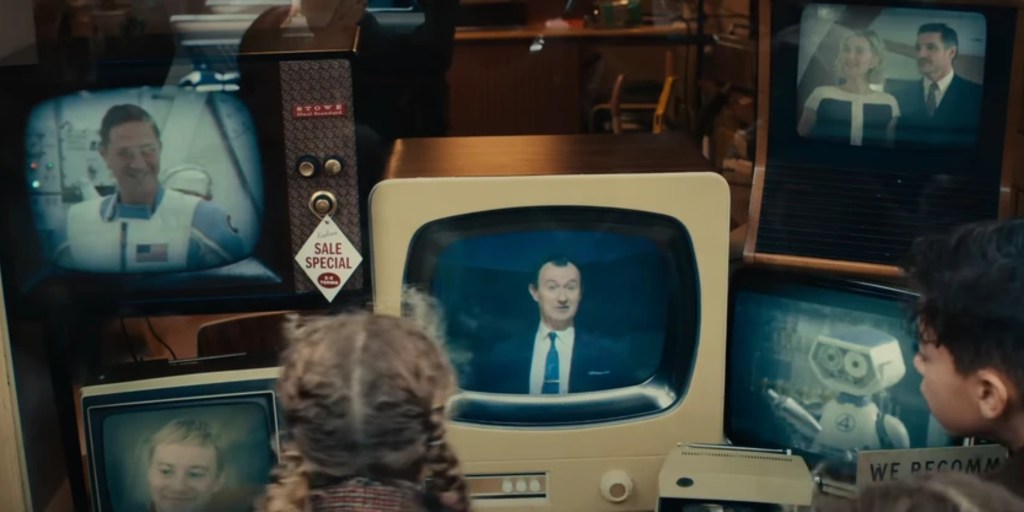
First Steps stands out as a singular, standalone entity, which is quite a rarity for superhero movies these days. Sure, it’s going to end up getting threaded in to the wider MCU when Avengers: Doomsday in December 2026, but as of right now, this is a film with a beginning, middle and end. Nothing beyond that, save for a few teasers for things to come. This is remarkably rare in an age where movies of this sort are often doomed to get shackled to larger continuities.
All of which makes for a movie that is not only its own thing in terms of its narrative, but also its visual execution. The skeptic within me suggests it’s very possible that this movie isn’t as unique as I’m making it out to be, and that the churn of Marvel movies has made anything remotely unique within this lineup appear like a miracle by comparison. Yet several hours after seeing this movie, I can’t help but feel that this poses an interesting potential for Marvel going forward. If DC is set to become the “new Marvel”, now that James Gunn is patching together a new interconnected universe, could Marvel attempt something a little different? Something that might resemble a more visually ambitious version of the standalone model we saw prior to 2008? Once the next Avengers movies are out and about, might there be a chance for them to start doing more standalone projects that lean into more experimental or unique forms of storytelling?
Why not start doing away with mainline MCU movies, and try out a few more standalone projects in the style of First Steps? I don’t mean make a load of retro futuristic flicks or direct comic book inspired remakes, but just try out more standalone features that experiment with themselves? Why not attempt a Thor movie with a totally alien aesthetic, directed by a director who has a specific vision. Why not do a new Iron Man series, but one that is completely detached from the version of this story we’re already familiar with. It’s unlikely that such a model will become Disney’s default storytelling tactic going forward, considering team-up movies have made them a fair few quid in the past, but it’s certainly an option they could entertain going forward. Much like DC’s Elseworlds lineup, there’s nothing stopping them from doing a few branch-off features from time-to-time.
The Fantastic Four: First Steps isn’t necessarily a game-changer of a movie, but it is an enjoyable and exciting project that feels remarkably liberated from many of its peers. The 1960s retro-future aesthetic is a genuine breath of fresh air. Its ability to express itself without feeling the need to rally against or lean into the cultural expectations of its time frees it up to be confident in itself. This, coupled with its liberation from continuity constraints, helps it feel lighter on its feet than many movies associated with this genre. There is a lot to appreciate in the creative freedom evident within this film. I genuinely feel that its positioning as a multiverse product significantly contributes to this, and I cannot help but feel there is potential here to further explore and enjoy the concept.
After years of being pessimistic about the multiverse saga and its tendency to be utilised for cynical cash grabs, here is a movie that I feel might have just proven me wrong.
Whether Marvel run with this going forward has yet to be seen. I hope that they do though. Maybe then, we can get some interesting new stories told within this genre; ones that don’t have to worry too much about ticking boxes and following established timelines.




 Amber Poppitt
Leave a comment