
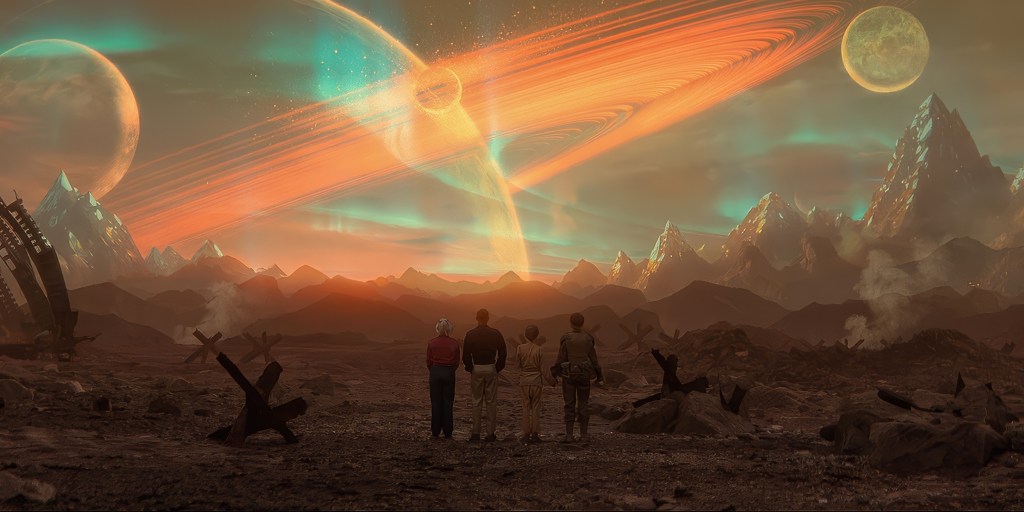
Following a seven-year absence from the show, Saturday the 18th of May 2024 saw one of the program’s most long-serving showrunners return to write for the second Russell T Davies era. Much like Davies, it was assumed that once Steven Moffat exited the series, it would be unlikely that he’d be back anytime soon. Regardless of his love for the program, not to mention the fact that it’s one of the things that got him into writing in the first place, his reflections concerning the backlash he experienced during his tenure suggested a man left somewhat wounded by the experience :
“The level of hate you get could down three passenger jets. I mean, seriously, it doesn’t stop. I was vilified endlessly. I was a homophobe, misandrist, and a misanthrope, and a sexist and misogynist and a racist. I was against so many people I could only be described as an omni-bigot, which I would suggest means I’m treating everybody equally.”
The announcement on March 19th 2024 of his return was unexpected, albeit perhaps less so following Davies’ own comeback. His return raised several questions. After seven years of running the program and a total of 52 episodes penned in his name, what would his 53rd script for the series entail? Would he bring something fresh to the screen after a seven-year hiatus? Or would we get a spoonful of regurgitated Moffat tropes that we’d seen a handful of times before?
The answer is a mixture of the two. On the surface, Boom would go on to tell a story that felt as though it was flicking through the ‘Moffat 101’ handbook. A high-concept bottle episode? Check. A monster with a built-in set of rules? Check. Glitchy technology that’s used to evoke tension or emotion? Check. Razor-sharp dialogue that borderlines on the poetic? You get the picture. All that was missing was his usual timey-wimey antics (that would have to wait until the festive season).
Yet, upon closer inspection, there is something slightly different about these Moffat motifs which makes them feel slightly different from how we’ve seen them play out before. There’s something slightly more sombre and reflective in their approach here that gives this episode a slightly different flavour. This is Moffat as we know him, only it’s more melancholic and contemplative. The energised, optimistic spark that peppered much of his most Moffat-esque episodes has been dialled down here, offering up something more subdued in return. The episode is not a mere repeat, but instead potentially more a subtle deconstruction of a writer’s own creative endeavours.
Perhaps the most recognizable tool from Moffat’s work on show here is the high-concept trap centred at the heart of Boom. This has become a staple of Moffat’s work which first became popularized in Blink. That story saw the Doctor come into contact with the Weeping Angels, a species that become quantum-locked the moment you look at them. Upon physical contact, the Weeping Angels send their victims several decades into the past, feeding off the lost time of their present. To survive these villains, a series of set rules must be followed: don’t avert your gaze, and do not let them touch you. It isn’t a case of simply outrunning or opening fire on these creatures. Instead, you must play the game to win.
As the years progressed, we saw numerous villains that possessed boardgame-like instructions that needed to be followed. The Vashta Nerada from Silence in the Library & Forest of the Dead forced our heroes to stay outside the shadows for protection. Likewise, the Silence from The Impossible Astronaut & Day of the Moon had to be looked at in order to be remembered by our protagonists.
What’s different about the high-concept “villain” in Boom is the fact that it is not a traditional villain by Moffat’s standards. This isn’t a fantastical, quantum-locked entity. Sure, there are guidelines to follow in order for it not to destroy you, but these are much less far-fetched by design. The mine operates on pressure activation, vital readings, and cardiac monitoring. It’s much drier and more technical by design, more a slab of technology that could be manufactured in our own world, rather than something out of a science fiction fairy tale.
It isn’t that Moffat hasn’t tied his ideas into more “grounded” technological concepts before. His earliest work on Doctor Who, The Empty Child & The Doctor Dances and The Girl in the Fireplace, did explore ideas surrounding machinery as the threat. The only difference here is the threat feels so much more faceless. This isn’t a gas-mask wielding child or clockwork robot with a french mistress fixation; it’s a metallic disk with LEDs strapped to its sides. It’s a very real-world bit of machinery with some sci-fi concepts applied to it.
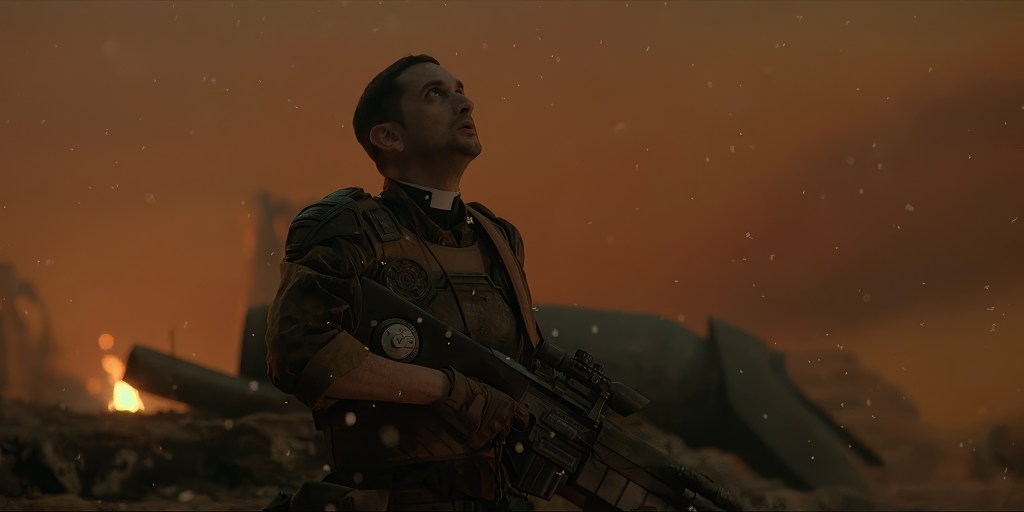
Shifting from a fantastical quantum alien to a blunt, physical threat more in line with real-world threats moves the drama into slightly dissimilar territory from what we’re accustomed to. Instead of doing Doctor Who as an action-adventure set in a whimsical reality, the drama stems directly instead to an internal, raw tale of a man trying to cope with pure, unyielding terror. The Doctor isn’t running around, zipping through time, or figuring out conceptual loopholes to try and weaponize his enemies against their own powers. The Doctor remains static for a majority of the story’s runtime. He must survive through redistributing his weight, calming his nerves, and trying his best to manage the behaviors of the lifeforms around him. He’s just a man trying to survive the immediate threat of an explosion. Much more grounded than sending letters through time or engineering the moon landing to hypnotise an entire species against manipulative aliens.
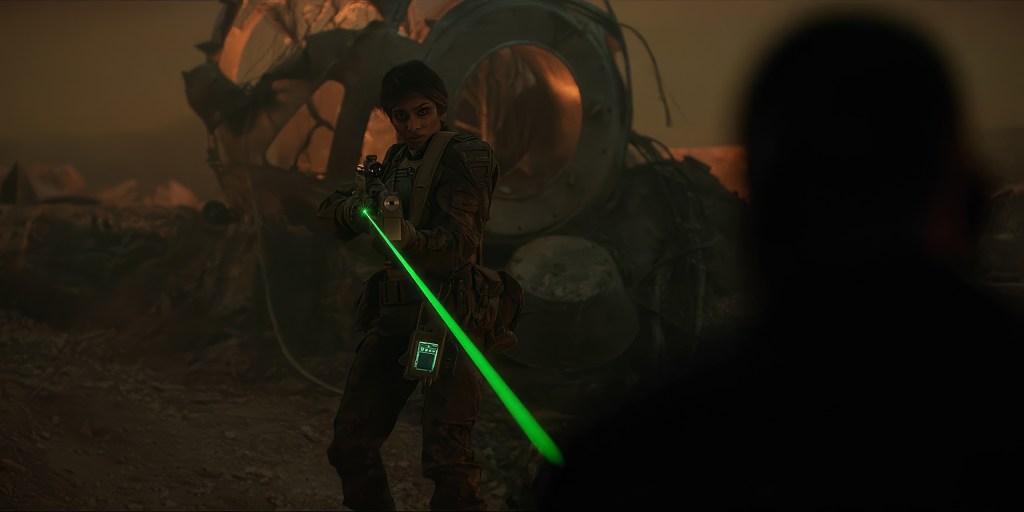
The Doctor’s psychology is the pivotal action for this story. Boom isn’t about running down corridors or dazzling laser battles. Whilst weaponry does feature occasionally within the episode, it’s largely designed to trigger a new obstacle for the Doctor to face. Mundy aiming her gun at the Doctor as he tries to explain his biology is there to exacerbate the plot’s ticking time bomb. Ruby getting shot at is intended to ramp up the stakes and trigger the plot’s final phase. These aren’t there to muster up action. They are there to create significant moments within the story. Their inclusion creates scenarios in which the Doctor becomes evermore consumed by fear and heartbreak. He is scared and broken throughout much of this episode, something which he must address all whilst standing as still as possible.
Moffat has always been an expert at wordplay and wit when it comes to executing the Doctor. Roaring speeches and razor-sharp wit has been central to his depiction of the character. Boom continues to showcase the usual servings of memorable quotes and thoughtful wordplay we’ve seen before, but again, it isn’t quite the same here. It’s darker, more serious, and sterner than usual.
Perhaps one of the most memorable examples is the “I’m a much bigger bang than you bargained for. I’m a lot more explosive than I look, and honey,” line. It’s some sharp and fun wordplay saturated with Moffat’s dialect, yet here it’s uttered by a man desperately fighting to explain the planet-shattering peril that his death would bring under the episode’s circumstances. He’s not trying to be sassy or evoke chuckles. He’s engaging in economic communication; trying to express the threat with the minimal time he has.
Even the central speeches usually deployed as a form of rallying cry are retooled into something more poignant and solemn. His final speech before the story ends is to talk about how all of us will die someday, and how the finality of life is what pushes us to make the most of our fleeting existences. It is beautiful, short, and sounds more like the musings of a man coming down from a perilous situation. It’s the episode’s memorable bits of dialogue, but it isn’t the sort of line you can envision being yelled as Murray Gold’s I am the Doctor blasts triumpantly in the background.
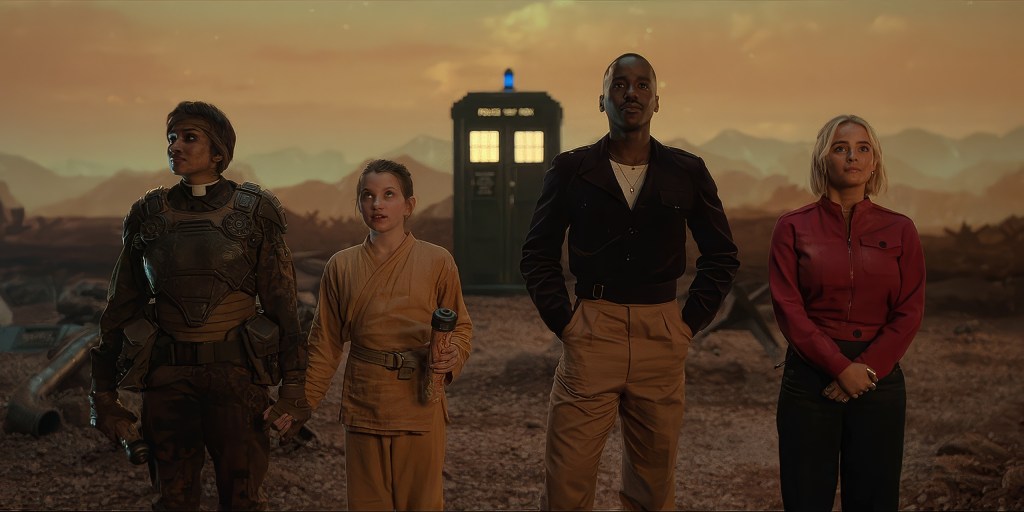
A mechanical product for a villain and a darker use of wordplay feeds into the idea of a Moffat script much more pessimistic than what we’re accustomed to. Make no mistake; this is not the first time he has done a Doctor Who story that’s bleak by design. 2014’s Dark Water and Heaven Sent were morbid to the point of being genuinely upsetting. What I mean by this is that it’s grim because it has so many threads in our own reality. This is a story about war, the profitability of suffering, and the cruelty that can be found within vast systems. This isn’t simply metaphors told through fantastical stories. It’s depicting a potential future we could find ourselves in if we carry on down some of the problematic and destructive paths our species are already embarking upon. There are echoes of Charlie Brooker’s Black Mirror in here; a cautionary tale of technology and greed amplifying human suffering, not hindering it.
Moffat has done systems as threats before. The nano-genes in The Empty Child and The Doctor Dances, not to mention the clockwork droids in The Empty Child were a case of technology harming people. Except that was a case of a glitch. The nano-genes weren’t trying to kill people; they were trying to fix individuals whilst possessing a limited understanding of the bodies they were trying to fix. Likewise, the clockwork droids wanted Madame de Pompadour’s head because there were huge gaps in its programming that it was trying to fill in. The major difference with Boom is that the ambulances and landmines are harming people specifically because they have been programmed to. This isn’t callousness by accident; it’s cruel by design.
The threat here is strictly systematic and political, not conceptual or malfunctioning. How can the Doctor fix a system that isn’t broken? Even the “love conquers all” resolution isn’t as rosy as the one we saw in The Doctor Dances. Echoes of John Francis Vater’s consciousness from his AI replica functions as an accidental virus; one that is able to infiltrate the Villengard system and trigger the war’s endgame. Vater doesn’t teach the Villengard a lesson or provide context to make it a better healer; it just tricks an automated system into disengaging.
Boom is not merely a rehash of Steven Moffat’s greatest hits but a re-evaluation of them. While not an entire departure from what we’ve seen before, it functions as more of a refinement of the themes and ideas that were developed and presented in Moffat’s work throughout the major body his Doctor Who career. Having stepped away from the relentless pace of showrunning for seven years, Moffat appears to have returned with a more reflective perspective. The whimsical, high-concept threats of his past, from quantum-locked angels to sentient shadows, have been traded for a cold, mechanical foe that feels chillingly plausible. Similarly, the Doctor’s trademark wit and bombastic speeches are now repurposed as desperate pleas for survival and mournful contemplation, stripped of their usual heroic flair. Ultimately, Moffat uses his own familiar creative toolkit, the bottle episode, the rule-based monster, the razor-sharp dialogue, to tell a more mature story. It’s a poignant turn where the very narrative devices which once upon a time piloted his science fiction fairy tales are now used to construct a sombre cautionary tale about the pitfalls of unchecked capitalism, the tyranny of automated systems, and the true cost of war. Boom is the sound of an artist grappling with his own legacy, using his past to engage in conversation with a more serious and unsettling present.






 Amber Poppitt
Leave a comment