
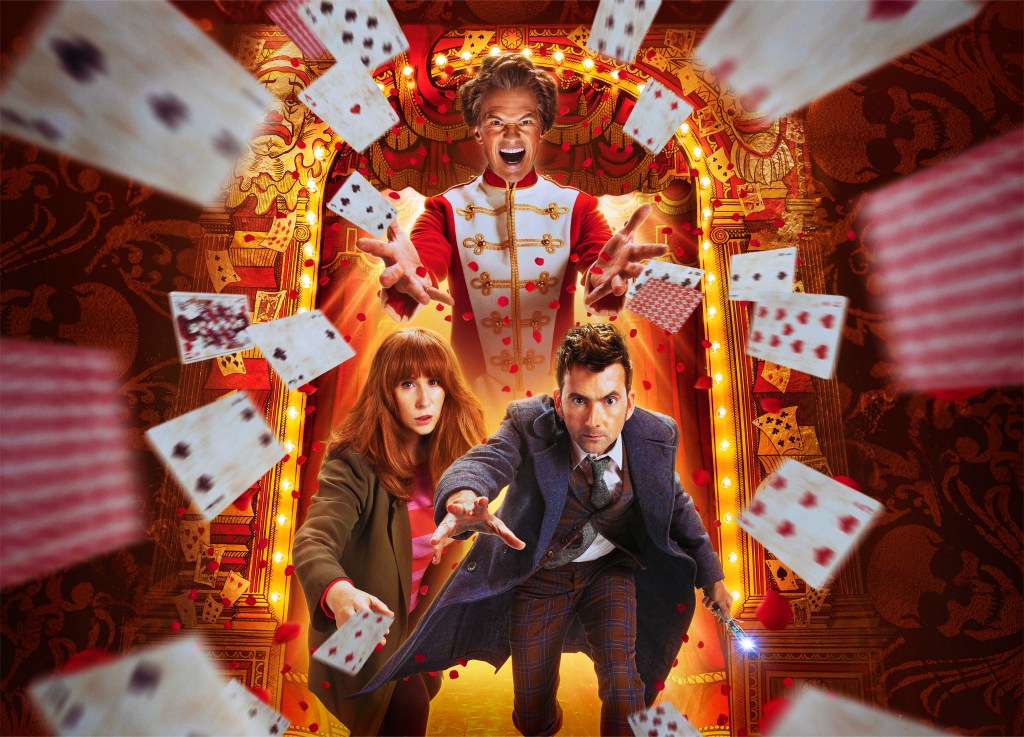
If Wild Blue Yonder was the subverted, slow-paced, peculiar entry to the jubilee line up, The Giggle is its barmy big brother. During the run up to its release, David Tennant and writer Russell T Davies emphasized the lunacy of the story. To be fair to them, they weren’t wrong. This is the story that exists to lean as far into the absurdity of Doctor Who is it possibly can.
To be clear, the episode is bonkers in a way that sticks with you. The Toymaker swaying through unit headquarters, dancing to the Spice Girls as he fiddles with the laws of reality are moments when the episode sings to the heavens, indulging in the type of writing Davies excels at. Like the wider episode surrounding this scene, it’s camp, twisted, and delicious in a way that works in its favour. There’s a dark fun to these scenes that stay with you long after the episode finishes. There are numerous moments like this throughout, selling the Toymaker as a villain burning the universe for the mere fun of it.
In many respects, the episode is as marvellous as it is messy. There’s a sense the script is trying to push the limits and show us something truly unique. The problem is, it’s moving far too quick to give any of the strangeness time to truly take flight. It’s like the televisual equivalent of a bright kid who’s had far too much fizzy pop. If only it could slow down, the ideas may have led somewhere truly remarkable.
For the 60th special, the Toymaker could have served as a conduit for a surreal celebration of Doctor Who’s legacy. In addition to being endowed with an encyclopaedic knowledge of the Doctor’s adventures, the Toymaker also wields the power to reshape reality with the whimsy of a child stacking lego bricks in his bedroom. He’s a villain with the liberty to craft narratives and watch them play out for his own pleasure. Introducing such a character into the Whoniverse during a diamond jubilee almost demands a tale that revels in the strangeness of the show’s wider existence. The Doctor’s saga would undoubtedly pique the Toymaker’s curiosity, compelling him to toy with the lore and reanimate it in its most surreal fashion. If there is ever a time to indulge in the history of this six-decade experimental gem, this is the time to do it.
There are hints of The Giggle venturing down this road on occasion. References of rebuilding the Doctor’s past like a jigsaw do worm their way into the dialogue. It’s certainly hinted that The Toymaker has been twiddling about with the Doctor’s biography. The only problem is, these glimmers of a weirder and more indulgent story feel more like attempts to hand-wave muddled continuity than using the Toymaker’s abilities to put on a visual display for Doctor Who. None of the jigsaw skullduggery is shown on screen. The Toymaker fails to truly indulge in the Doctor’s story or unravel it before our eyes. Sure, there’s a little puppet show to tickle the Doctor’s guilt, but then the idea skids to a halt to make way for a mediocre card game.
Why stop at the post-Donna puppet show? Why not have the Toymaker animate a theme park rerun of past eras, fashioning sets, monsters and companions that have come and gone over the years? Would it have been self-indulgent? Of course it would have. Then again, if there is ever a time to take a shameless bathe in fandom, a 60-year birthday special is one of the places to get away with it. The occasion and the villain flirted with the idea of something remarkable. If only the script’s attention span was up for the task.
Maybe it’s good they didn’t go too far. Perhaps an optical rollercoaster through Doctor Who’s lengthy and tonally varied past would have run the risk of alienating the very viewers Davies is fighting to win back. Even if that is the case, there’s still a sense that The Giggle fails to take advantage of a villain teaming with potential. There’s a sense of a missed opportunity here; a sense this could have been bolder and bigger than the finished product.
I suspect the runtime may be part of the problem. There’s an argument to be made that this needed to be a serialised story. The Toymaker is too big a threat to wrap up in a single hour of television, particularly when this is a story that’s also designed to regenerate its main character and kickstart a new era. It’s like trying to juggle during a 100-meter dash; a lot of skill to pull off at such a speed.
Even if we park the Toymaker’s potential for a moment, we must consider the scope of the script’s story. We open with the residents of 21st century earth taking their Twitter spats to the next level. The families of humanity are murdering one another over disputes, riots are kicking off in all the streets, and pilots fly jumbo into central London as though it’s no big deal. This is a massive story, one in which horrible things are happening on every street corner. Which is why it’s such a shame that we don’t get to see the Fourteenth Doctor and Donna properly interact with the chaos of the world below. We only get to see the pair of on the ground level for less than a couple of minutes. For the rest of the story, they are slipping back in time, or brainstorming with Kate Steward in one of Unit’s swanky Skyscrapers. Society being driven insane from binary thinking is a terrific idea. It’s the sort of premise you could build an entire show out of (imagine if Davies had based his fourth series of Torchwood around this concept!), which makes it more unfortunate that it’s only used as a backdrop here.
Ideas are far from the problem in The Giggle. This is a story that’s saturated in them. If only there was more space for the weirdness to breathe. We just need more time with these concepts, hence my wish for a more serialised approach. Turning this into a three part story would allow us more time to spend with the Toymaker, the burning world he’s responsible for torching, and the impact his presence has on our heroes.
Extending the scale would also give the whole bigeneration twist some more room to integrate itself into the story. For what it’s worth, I don’t think having the Doctor split into two versions of himself is a horrible idea. As farfetched as it may be, this twist serves as a nice way to organically reboot the show within the walls of its own reality. Much like the in-universe reset of 2009’s Star Trek movie, implementing a plot device that provides an internal logic to external motivations makes Davies’ creative decisions feel more authentic to the story itself. The Ncuti Gatwa era is intended to be a fresh start, and by having the character split down the middle serves as a bookmark for both the character and the show. The fifteenth Doctor isn’t just a changed man, he’s quite literally a new one altogether. The “original” Doctor, with all the baggage and backstory, can potter off to retire in his best mate’s garden, while our new hero swaggers off into the stars with his jukebox and charm.
Amidst the hustle and bustle of ideas firing through this episode, there’s a poignant narrative about trauma; one that explores the Doctor’s hesitation to confront the events that have shaped their existence. It’s in this exploration that The Giggle truly excels. Russell T Davies and David Tennant masterfully convey the image of a weary Time Lord yearning for respite, yet unable to stop. While Tennant’s matured appearance may enhance this in a more basic sense of the word, it’s the nuanced writing and compelling performance that truly bring the idea of this character’s fatigue to life.
One of the recurring themes throughout the anniversary trilogy is the absence of reflection and rest granted to our hero. This motif began in the first episode, where the Doctor quickly transitioned from restoring his best friend’s memories, after a millennia apart, to embarking on a new adventure without any pause to appreciate the extraordinary events that had just occurred. The subsequent episode, Wild Blue Yonder expanded upon this by having the Doctor only ever engage in contemplation unknowingly under threat by a shape-shifting doppelganger. Donna, in her role as the narrative’s conscience, even goes so far to highlight in that episode the Doctor’s inability to pause and process his experiences; whether they be positive or negative.
The trilogy’s structure emphasizes this theme of rumination, or lack thereof. The first part abruptly removes the Doctor from a reflective opportunity, the second part raises questions about this detail, and the third part compels him to face it directly. Donna’s persistent questioning and concern for the Doctor’s wellbeing underscore the central theme. A pivotal scene featuring the Toymaker’s puppet show encapsulates the Doctor’s accumulated trauma from countless losses and separations.
The conclusion of this plot development lies in the Doctor’s bigeneration, a process that splits him into two entities. This event allows both incarnations to collaborate against the Toymaker’s twisted games, before using the device of this bigeneration to align with the story’s themes as a means of concluding it. The bigeneration contrasts a rejuvenated Gatwa with a battle-weary Tennant, vividly illustrating the need for the Doctor to consider retirement and live out a life of post-adventure reflection. This turn not only validates Donna’s observations, but also presents the Doctor with a tangible chance to step back.
The 60th trilogy therefore functions as both an end to Doctor Who, as well as a new start. Perhaps this is where Davies’ attempt at an anniversary triumph over that of Moffat’s 50th. While the latter worked as a convincing endpoint to the Doctor’s story, the attempt to reboot the show thereafter never quite felt as innovative. Davies, on the other hand, has managed to create a transition that works as an off-ramp and a jumping on point in the same breath.
Above all, The Giggle is a fun, albeit rushed bit of TV. Although the ideas on display are electric, they are often left behind by the script’s breakneck pace. It’s also all a bit messy and underdeveloped, bringing me on to my conclusion of the 60th trilogy as a whole.
Having three standalone stories was a peculiar approach to utilise for this kind of story. The only one of the three that made this structure justifiable was Wild Blue Yonder, which worked because of how unpredictable it felt within a trio of nostalgic specials. As for part one and two, however, both felt as though they belonged to multi-part stories that would have benefited from a multi-episodic structure. The Star Beast was fun, but didn’t do much else beyond reviving Donna’s memories. The Giggle, on the other hand, felt like a three part story crammed into an hour of television. I’m curious as to whether Davies ever envisioned episode three as a multi-part story at some point, only to decide to split them up so he could include Wild Blue Yonder amidst the lineup. I’ve no evidence to suggest that this was his thinking, but it really does feel as though part three is the one which contained all the major ideas that motivated this special into existence.
Where this trilogy does come to life is in its theme about the Doctor’s relationship to trauma and reflection. Davies nails the notion of a hero burned out from the heartbreak and loss that has dominated a dozen lifetimes. We are sold the idea of a man in need of retirement. The fact we get to see this resolution play out in conjunction with the setup of the next chapter is a remarkable stroke of genius on Davies’ behalf.
Overall, Tennant’s return was a fun yet messy way to spend the show’s birthday before moving on to the next phase.



 Amber Poppitt