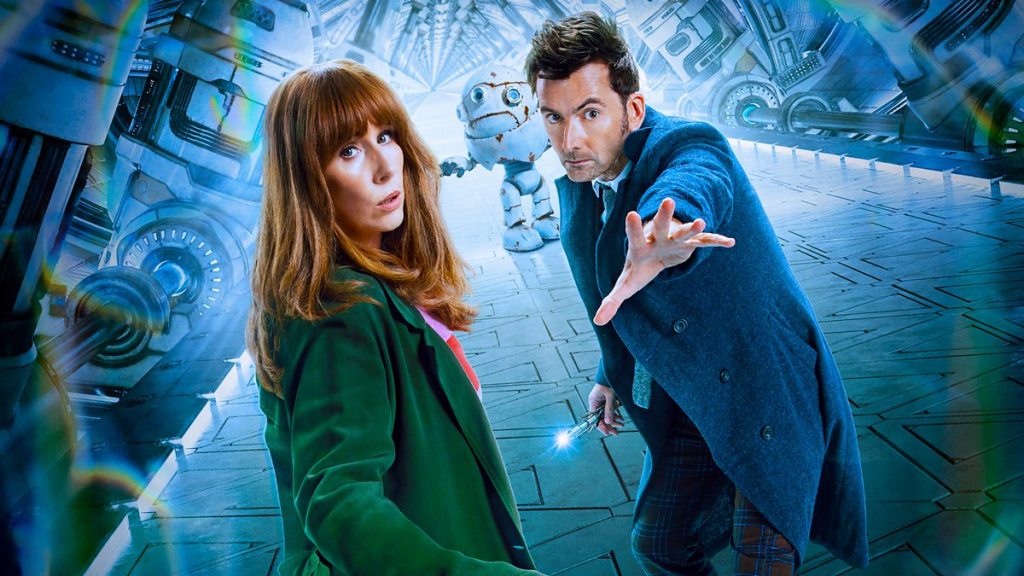
Prior to release, Wild Blue Yonder shrouded itself in secrecy. As is tradition, the internet set alight with theories as to what such confidentiality meant for the episode. Would the Master be dancing back onto our screens? Perhaps Davros would once again rain fire upon 21st Century earth with a shiny new set of Daleks. Could even more companions from the Doctor’s past be tagging along for the anniversary celebrations? It transpires the answer was none of these things. Instead Davies did not wish to provide further context, because by doing so would remove a great deal from the initial experience of the episode.
Going into Wild Blue Yonder with limited foresight and minimal knowledge makes for a tense, attentive and frankly peculiar watch. The episode teases its audience throughout, grinning in the knowledge that those watching will be trying their darndest to figure out what the hell this supposed celebratory episode is meant to be about. After all, wasn’t this supposed to be the second episode in a blousy, jubilee celebration of Britain’s most popular science fiction drama? Where’s the fireworks and familiar faces? Instead, what we get is a mystery relishing in the question of expectation.
This episode is much in keeping with Davies’ overall approached the show’s diamond jubilee, in which he’s sported his trickster cap with the same pride as a puppy with a stick. One example of this happened during the run up to the specials, in which he encouraged Whovians to ponder how Tennant and Tate may be returning to the show:
They’re back! And it looks impossible – first, we announce a new Doctor, and then an old Doctor, along with the wonderful Donna, what on earth is happening? Maybe this is a missing story. Or a parallel world. Or a dream, or a trick, or a flashback. The only thing I can confirm is that it’s going to be spectacular, as two of our greatest stars reunite for the battle of a lifetime.
In many ways, Wild Blue Yonder is the apex of Davies’ promotional teases. He knew viewers would approach this story desperate to understand its purpose within the 60th Trilogy. If The Star Beast was nostalgic opener, while The Giggle capped matters off with a Toy Maker extravaganza, then what on earth was number two supposed to be about?
We open with a scene that feels as though it belongs to an entirely different episode from what is to follow. The Doctor and Donna land in 1666, where they bump into Issac Newton on the very day a piece of fruit inspires him. The scene is jolly and daft, yet beyond the fact that it ends with the Doctor and Donna inadvertently reworking the term Gravity to Mavity, the scene does not really contribute much else to the larger story. Sure, there’s a chance it might be hinting at a universe in fluctuation – something that looks to be a wider theme of series one – but other than that, this is fairly inconsequential in the grand scheme of things. In many ways, the scene functions as the first red herring of the story; a tonal trick to throw us off and further disorientate us for the story that’s set to follow.
The scene which follows this feels so dissimilar to the Newton opening, you’d be forgiven for thinking it was a flash back. The Doctor and Donna are no longer cracking japes and larking about in a 17th Century Lincolnshire tree. Here Donna appears panicked and distressed, whereas the Doctor fights to hold back his frustration. The TARDIS is in tatters, and the recently reunited pair are stranded on a ship which they’ve learned has hostile activity aboard. The atmosphere is tense and far from the romp we were hinted at getting ourselves into moments prior.
We then get ten whole minutes of our heroes walking down the corridor of a spaceship, encountering a creaky old robot and learning that they are drifting beyond the perimeter of reality itself. It’s eerie and glacial to the point in which the whole thing feels off. For a 54-minute special in a three part anniversary extravaganza, it sure as heck takes its time getting to the point. None of which is intended as a criticism. Wild Blue Yonder‘s subtlety and reluctance to show its hand makes for remarkable first viewing. Expectations were astute to begin with when it came to this story. Throwing us off then drip feeding information makes this feel almost Hitchcockian in design. It’s a bomb under the table, waiting yet unwilling to detonate.
This is not an episode that shovels exposition down our gullets. Even when the narrative does start to progress, it makes a habit of utilising visual cues more so than dialogue. It’s a script that requires viewers to engage fully, to piece together the puzzle along with the Doctor and Donna. This is perhaps most notable during the sequence in which the non-terrestrial threats first enter the picture; showcasing a remarkable achievement in performance, editing, direction and non-diegetic sound. I’ll be making reference to Davies as a writer throughout this essay, yet rest assured, this is a story that’s firing on all cylinders because of those working both in front and behind the camera.
Upon first viewing, the unease of the threat feels almost invisible. We sense something isn’t quite right, though we can’t quite tell what, at least not immediately. It’s a blink and you miss it beat; another tonal plot shift that makes you think there’s been a potential time jump. Despite the visual information we’ve been given, it dawns on us that the Doctor and Donna haven’t been conversing with one another for the last five minutes they’ve been on screen together. Our heroes have been conversing with doppelgangers; unknown entities that have replicated one another to trick their human counterparts.
On second viewing, the twist feels as plain as the sky is blue. There’s a visible shift in the performances of Tennant and Tate when they aren’t playing the Doctor and Donna. As Tennant first enters the shot as the imposter Doctor, he’s stern, more reserved, and less playful than he was in the previous scene. He slouches, his eyes lifeless, quizzical and stern. He smirks as Donna expresses concern for her family. Watching the scene without foresight suggests the Doctor is humbled at his friend’s compassion for her family. On second watch, there’s a slither of amusement beneath his grin; a pretender trying to keep a straight face.
Likewise, Tate dials down Donna’s comedic edge when she’s on screen as the imposter. She plays the role of a pseudo therapist, allowing the Doctor to entertain various trains of thought while quizzing him on his feelings toward the loss of his home world.
Hindsight makes it evident that we are seeing four people conversing. Yet on that first watch, it takes minutes to clock the strangeness of what we are seeing. What looks to be a quite character moment turns out to be a moment of great danger. It’s like looking at a calming painting, only to discover it’s a battlefield several moments later.
Once the script is confident that the audience have clocked the anomaly, the curtain is whisked wide open, unveiling a surreal transition toward body horror. We get elongated arms, hands the size of wheelbarrows, oversized Doctors, contorted renditions of our leads, and several scenes in which we’re invited to guess the identities of four characters all claiming to be the other.
Even after the gloves are off and the true nature of the episode is out for all of us to see, Davies continues to mess with our heads and keep us as disorientated as can be. Watching it feels like being trapped inside a nightmare. Distorted bodies, sudden changes in circumstances, confusion over whose who; it’s like the subconscious taking the mind for a night time ride. The episode continuously unravels; toying with imagery, adjusting the narrative tempo, and placing our leads in positions which compromise the very identities in which they possess.
Amidst the strangeness and dream-like horror, there are moments of reflection. Even imposter Donna makes a point of this, demonstrating the Doctor’s refusal to stop and talk about things that have happened to him over the years. It’s fitting then, that in an episode as unpredictable and strange as this, we still manage to get quiet moments of reflection folded within the horror and confusion. There’s even talk about the Timeless Child debacle; a Chibnall era reveal many assumed Davies’ would ignore (including Chibnall himself). Despite popular belief, Davies does not seem keen on retconning or ignoring his predecessor’s decision to make the Doctor an immortal being from another dimension, going so far as to utilise it for dramatic effect.
Utilising the Timeless Child as an emotional consequence for the show’s protagonist is something Davies has since admitted he plans to do more often going forward, stating that the orphan angle is something he believes will resonate with people in the real world. Instead of leaning into the “wouldn’t it be cool if there was lots of Docs before Hartnell,” Davies is more interested in psychological implications of this reveal. Problems with the Timeless Child twist aside, it’s difficult not to admire Davies’ decision to stick with his predecessor’s choices and find a way to work something interesting into the idea. Turning our protagonist into a god responsible for all of Timelord regeneration might be as appealing as a popped binbag, yet examining the distress it causes him makes for a character arc with potential. This episode does not dive too much into the idea of the Doctor having an unstable sense of self following Series 12’s revelations, yet it does plant the seed for what looks to be an ongoing thread during future stories.
Whether or not this works in the long run, hearing the Doctor reflect on his place in the universe after this discovery feels intriguing in a way it seldom did during the Chibnall era. Could this simply be my pro-Davies bias flaring up? Probably. But all the same, hearing the Doctor and Donna discuss it, followed by the Doctor growing visibly distressed in the aftermath of the conversation makes for a surprisingly engaging continuation of a plot point I was certain would not be discussed again.
Wild Blue Yonder is a mystery amplified by its place as an anniversary special. Whovians went into this expecting something colourful, blousy and potentially seeped in familiarity. What we got instead was a tale about body shifting entities lurking in the corridors of a ship drifting outside the sphere of reality. It’s a cold, tonally erratic body horror of a story that feels remarkably experimental for a 60th special. Davies has taken expectation and subverted it into something completely alien. Many have compared it to that of Davies’ 2008 story, Midnight. There are certainly similarities that are difficult to ignore – substituting creature designs for conceptual horrors, utilising Tennant’s performative talents, and leaning into the horror are notable examples – yet in many ways, I would suggest that this one goes several step further. Wild Blue Yonder is a story that disorientates because of the time and circumstances in which it was made. Sure, it’s experimental and frightening in the way Midnight was back in 2008, but it’s the sort of story that flourishes precisely because it knows how wrong and out of place it is as a David Tennant victory lap. Placing a low-budget body horror as one of the three Disney Plus-funded reunion parties makes it all the more off kilter than it ever could have been in any other context. This is not simply a horror that relies on imagination and sharp writing, but a self-aware anomaly occurring slap bang in the midst of a Jubilee special.
This is a remarkably weird piece of television. Davies takes full advantage of anticipation and context to do something that discombobulates his audience. A one-of-a-kind story that sets out to disorientate us. It’s the sort of episode that could quite easily have fallen apart, had it been made at a different time or executed in a slightly less self-aware manner. It will be interesting to return to this episode several years down the line to see how fans feel about it when the dust has settled. At the time of its release, this is considered to be the nadir of the anniversary specials, and one of Davies’ more popular scripts to date.
Is it a perfect piece of writing? Nah. It does have a couple of issues toward the end that make it feel a little less impactful by the time the credits role. The final scene is admittedly a little rushed. Deus Ex Machina pops up in the form of the TARDIS swooping in like a much needed angel keen to save the day. I know it’s a sentient craft, but if we’re going to have moments like this, it begs the question why she doesn’t fly in to the rescue every time the Doctor is in danger. Plus the way in which the Doctor jettisons imposter Donna from the TARDIS feels rushed and lazy, particularly considering how well the build up to that particular moment is. As far as scripts go, it could have benefited from a couple of minor rewrites.
Nevertheless, as a whole, this is a remarkable and intuitive bit of television which dropped at the perfect moment. For anyone doubtful that Russel T Davies’ had anything new to say in his second run as show running, hopefully this episode brings you a healthy spoonful of hope. If there’s proof the man remains as sharp as a pin and packed with ideas, this is the story to reference.
It’s a remarkable 54-minutes of television. The sort that could only ever be written by someone who relishes in tricks and teases.
Speaking of tricks and teases, onto the Toymaker…