
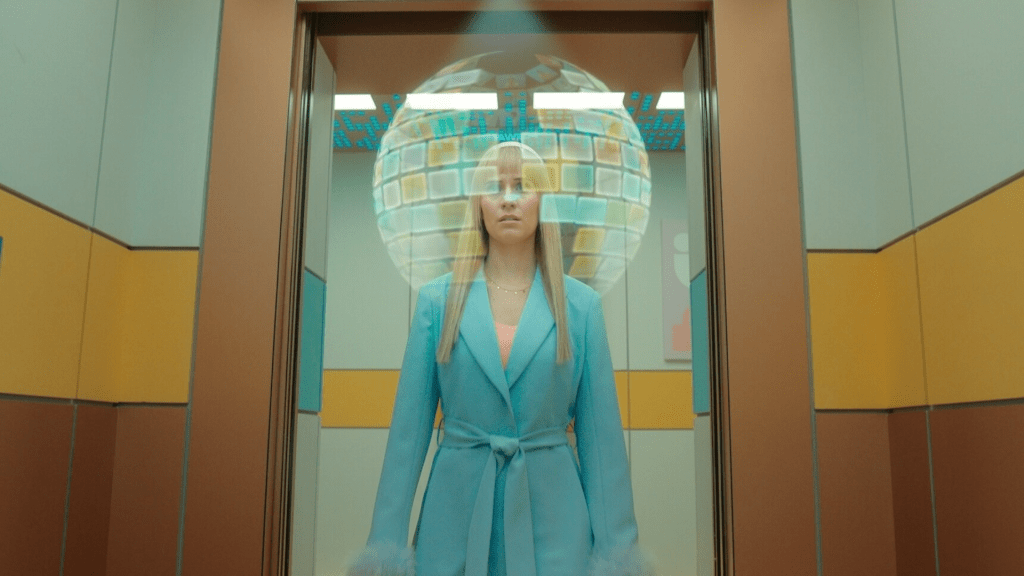
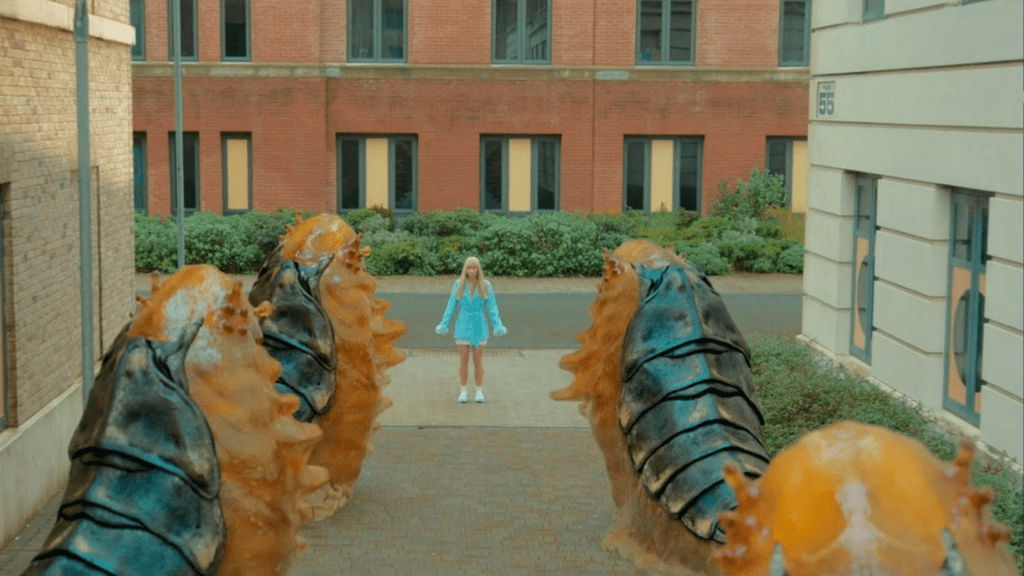
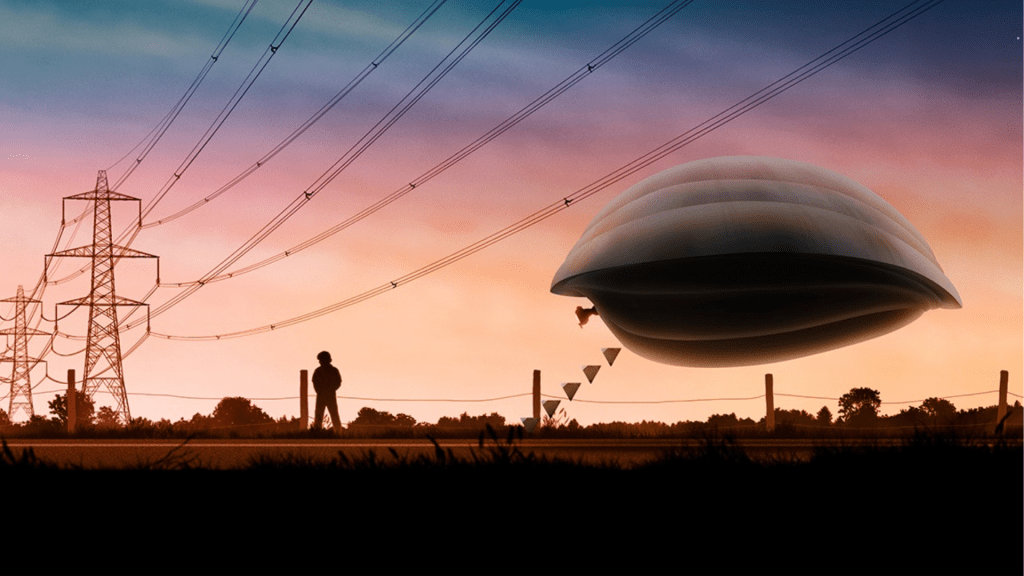
On the surface, Dot and Bubble looks like a more standard, fluffy instalment of Davies era Doctor Who. Murray Gold’s score is as bubbly as it often is, the colour palette more vibrant than James Cameron’s Pandora after sunset, costumes as camp as can be, and cinematography so crisp it would make a pork scratching envious. Even the monsters are as barmy as this show likes to make them on occasion. We’ve had humanoid rhinos, pigs, and cats. This time around, we’ve got giant, man-eating molluscs! Just your classic, run-of-the-mill, campy dashing down corridors, right?
Except, there is a core friction lurking beneath all of this. Despite the zesty lick of paint applied by Dylan Holmes Williams, Murray Gold and Russell T Davies, Dot and Bubble is actually the show’s attempt at incorporating the gritty, grubby mechanics of a fictional Charlie Brooker-inspired world into the mix.
This is far from the first time Doctor Who has fused itself with another genre or television show. In fact, it’s common practice. Sometimes it does so without having anything meaningful to say, serving as an aesthetic choice more than anything else. Other times, the decision has a deeper, more intentional purpose behind it. In the case of Dot and Bubble, I believe this story belongs in the latter camp. At the episode’s core, a ghastly trap has been constructed. It’s a trap that captures three distinct victims in its jaws; the protagonist, the audience, and the Doctor himself.
When we first meet the episode’s lead, Lindy, her life appears to be quite peachy. She’s bubbly, social, and only really has to worry about the completion of a two-hour work shift which requires zero physical or mental labour. As a resident of Finetime – an enclosed neighbourhood mummy and daddy pay for her to live in – Lindy doesn’t really have to worry about anything that plagues us mere mortals. No bills, breakdowns or job losses. What a lucky salmon she is! Heck, she doesn’t even have to learn how to walk in a straight line. Her personal Dot (a robotic device that hovers next to her temple) simulates a virtual Bubble world that caters to her every need. It connects her to her friends and guides her safely through the physical world. Think of Dot like a satnav for existence, guiding Lindy through every known process associated with being alive. It even tells her when she needs to go to the bathroom!
Lindy is quite literally living in a bubble that shields her from the physical reality she was born into. This, of course, has significant ramifications when that same reality is suddenly invaded by giant, man-eating Mantraps; creatures that the Dot doesn’t seem to be all that aware of (or bothered about). All of a sudden, Lindy finds herself standing before the jaws of a beast she can barely see or walk around, let alone outrun. The Dot’s virtual sphere obscures her vision, but without it, she can’t navigate.
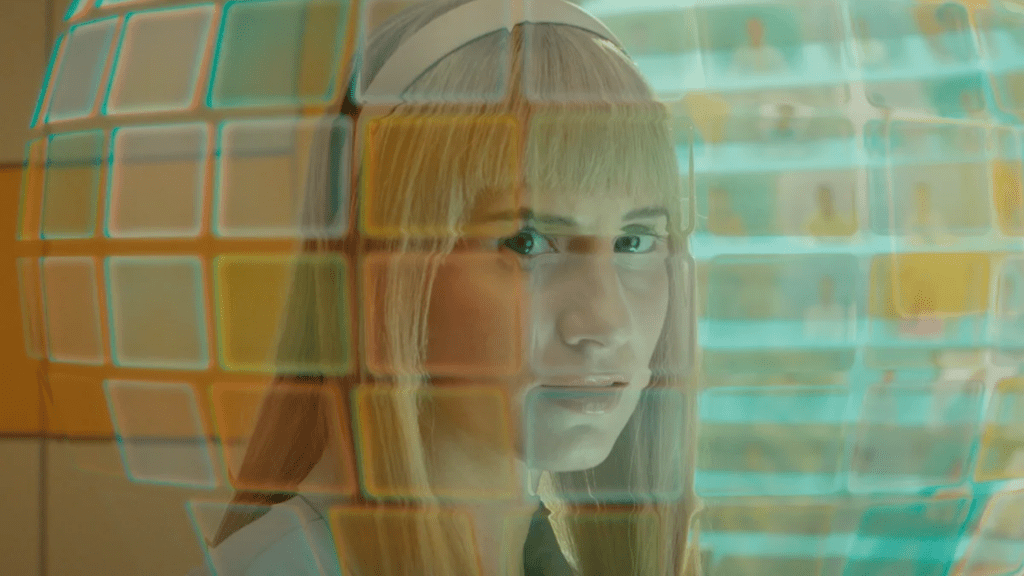
The sequence where Ruby and the Doctor first encourage Lindy to look beyond her virtual shell and acknowledge the Mantraps is a terrific bit of TV. It’s a slow, unsettling build toward the horrifying realisation that her world isn’t quite as rosy as she believed it to be. Finetime isn’t quite as fine as it seemed earlier that morning. There are literal monsters slithering into her workplace and devouring her colleagues mere metres away! Even when she is explicitly told this, she struggles to accept reality, first outright refusing to look, then trying to drown out the shock when she is no longer able to deny it. Lindy resorting to watching Ricky September dancing to Itsy Bitsy Teenie Weenie Yellow Polkadot Bikini on his feed after the horror hits her is a tough scene to sit through.
Lindy doesn’t want to face the awfulness lurking behind the rosy lie of the Dot’s vibrant illusion. She’s ignorant to reality, and being forced to face that fact is no easy task for her to deal with. Except Lindy’s ignorance doesn’t simply extend to the literal slug-shaped flesh-eaters slithering about her office space. There’s an even bigger, more systemic monster that this transient character equally ignores throughout her day-to-day life. The Mantraps aren’t the only grisly threat here; there is a larger, more insidious creature crawling in the periphery of the supposedly vibrant and scented Finetime. The truth is, Lindy’s world is rotten to its core.
For one thing, everyone who occupies this world is a vain, personality-starved, bigoted, self-centred brat. Lindy and her chums are unashamedly racist, constantly moan about having to do two hours of “work” each day, and seem interested in nothing beyond the digital spheres orbiting their skulls. Their lives are entirely meaningless. With the exception of darling Ricky September, none of them appear to do anything other than consume social media on a constant loop. They don’t interact with the real world, they don’t read, they don’t exercise, and they barely even seem capable of stringing an independent thought. They are vegetating in the digital bubbles they are encased within. What’s worse is they all seem to think they are wonderful and righteous. Their worlds are void of substance. Yet, Lindy and her pals don’t quite see it like that. They skip about as if their lives are important and marvellous, completely unwilling to acknowledge how vapid and hollow it all is. They are living in the devoured carcass of a deceased society, yet they don’t even seem to notice so much as a whiff of its stench.
Ultimately, this is a story about the ignorance of Lindy and her peers; both in terms of the literal Mantrap monsters and the wider, systemic beast that has been eating them alive since the moment of their births. Lindy wants to pretend she’s frolicking in the multicoloured fields of a Doctor Who-inspired utopia, yet really, she is burning alive in a Black Mirror dystopia. She is Dot and Bubble’s first victim, but she’s certainly not the episode’s last.
When I first saw this one, I will admit, part of me wanted to criticise it for the neighbouring show it was attempting to homage. My initial argument was that Davies’ Doctor Who and Charlie Brooker’s fictional canvas were too at odds with one another to work in tandem. Modern Who is generally self-contained and fast-paced. An episode typically starts with the Doctor and their companion falling out of the sky; they upset the status quo, save the day, then sail off into the stars in search of more adventure. Black Mirror, on the other hand, is a darker, more nuanced series that explores how humans and technology interact with one another. It looks at how technology can corrupt the human experience or exacerbate the darker side of our nature. I thought combining the two would be like trying to create a crossover between Teletubbies and Gaspar Noé’s 2002 crime drama, Irréversible; simply impossible.
Merging these two tones felt like too much for a single episode. Sure, Black Mirror often starts with a fully functional, pre-established world, much like this one, but the whole point of this in Brooker’s show is to allow for the rest of the episode to sit with the occupants of that story and see how they interact and evolved as a result. Dot and Bubble may have opened with a readymade society similar to the sort found in Nosedive or 15 Million Merits, but what was seemingly missing was a Bingham Madsen or an Alice Eve. Dot and Bubble didn’t seem to have the time to properly explore the ways in which the technology polluted Lindy’s mind or sent them spiralling down a doomed path. By the time the episode begins, Lindy is already toxified by the tech managing her life. We don’t see the downfall because it happened long ago. My scepticism even extended to the major plot revelation, in which Lindy reveals herself to be undeniably racist. Upon that first watch, I accused it of seeming somewhat out of the blue; more like an afterthought Davies patched onto the end of an episode about giant space slugs.
Upon a rewatch, I now suspect my reasoning to be a significant miscalculation. I didn’t handwave the shock reveal because it was unintentionally out of place. I did so because the episode did a solid and deliberate job of luring me into a false sense of security before pulling the rug from beneath my feet. Davies, Williams and Gold sold the idea that we were watching the more fantastical, swashbuckling version of the show; a caper in which a young girl tries to outrun space molluscs invading a colourful future metropolis. For all the talk of it being Black Mirror, most of the runtime presents itself as a light hearted Doctor Who story. The sinister, Brooker-esque edge actually lurks just under the surface. Lindy’s racism, the corruption of Finetime, and the absolute rancidness of these people’s lives only flicker to the surface on occasion; hinting that the rot is there without explicitly showing it until the last minute. Much like the Doctor and Ruby telling Lindy to peer through her bubble, we too are invited to look a little closer. Except, we don’t. We are far more content going along with the surface level glow.
Once the audience’s bubble finally bursts during those closing minutes of the episode, we are forced to look at the grubby mechanics churning away under the hood of Davies’ script. It feels startling, even out of place. This isn’t a light story; it’s an angry, politically charged, and deeply pessimistic tale about humanity at its absolute worst and vapid.
The moment Lindy and her peers reject the Doctor’s attempts to save them rattles us because it forces us to confront the fact that we’ve just spent 40 minutes rooting for a gang of xenophobes who are about to sleepwalk into their own inevitable demise. Not only have we been tricked into siding with the villains of the story, but we are also made to confront difficult truths about privilege, prejudice, and the corrosive nature of social media. This is a heavy, bleak, and unforgiving episode that lulled a part of us into thinking it was anything but. It’s a shock to us, but it’s also a shock to the story’s final victim; the Doctor.
Because not only do we, the audience, think we’re in a Doctor Who episode, but the protagonist does, too. Both the Doctor and Ruby spend the entire episode fighting to maintain their roles as the heroes of this tale. The Doctor attempts to uphold this position right up until the final moments. He screams and demands that Lindy and her Finetime friends listen to him, yet his pleas fall upon deaf ears. No matter how hard he tries, the Doctor fails to obtain agency.
To put it bluntly, the Doctor in this story comes face-to-face with his own naivety. It’s a blind spot he’s bumped up against before, albeit with differing results. Back in 2007’s The Shakespeare Code, the Doctor took his then-companion, Martha Jones, to the year 1599. After they land in Shakespearean England, in a justified panic, Martha asks the Doctor whether she is at risk of being carted off as a slave. Initially confused by her concern, the Doctor immediately handwaves her concerns away, telling her to just do what he always does; walk around and act as though he owns the place. The obvious issue with this advice, of course, is that at the time, the Doctor was living in a white body. He completely failed to recognise that the inherent risks of travelling to the past were considerably different for him than they were for his non-white companion. This problem presented itself again several episodes later in Human Nature and The Family of Blood, where Martha found herself subjected to racial abuse from the staff and students of a 1913 public school she was forced to work in whilst the Doctor hid away in a bid to outrun some time-hopping aliens.
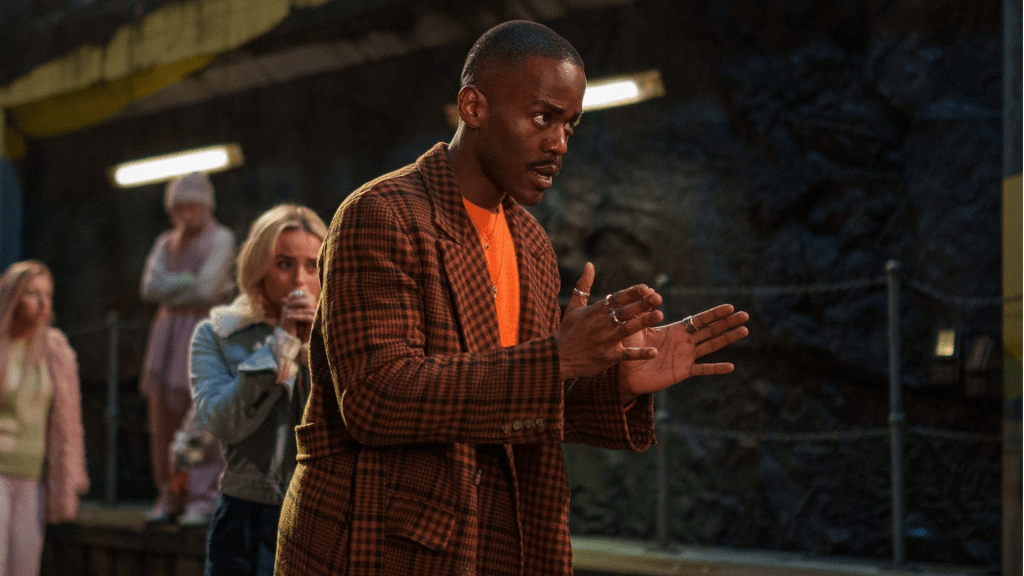
The point here is that for all the Doctor’s brilliance, the character has historically exhibited moments of staggering obliviousness when it comes to race and the worlds he visits. It’s as if they assume that their position as the immortal hero at the centre of an endless show exempts everyone associated with them from the prejudices and ills of the worlds they land in. The Doctor doesn’t have to worry, because the Doctor is the unstoppable force of good that will upend the status quo and right all wrongs.
Except, there are two crucial factors to consider in Dot and Bubble. The first is that the Doctor – in his current, conscious cycle of memories, is now a Black man. While the show previously introduced a Black incarnation in the form of the Fugitive Doctor (played by Jo Martin), she existed within a ‘mind-wiped’ secret history for the Doctor which he has no recollection of. In this context, Dot and Bubble is a moment of stark realisation for this character. He can no longer just handwave or ignore the reality of how the world around him reacts to him. His fifteenth (canonised and post-mind wiped) regeneration places him in the exact same context Martha found herself in back in 1599 and 1913. The Doctor has to reckon with that reality, first hand. Secondly, the Doctor has found himself in a story that refuses to function as a more traditional crossover episode. While show or genre collisions of this nature tend to end with the Doctor Who-ness finally taking the wheel by the third act, Dot and Bubble refuses to concede. It remains a Black Mirror episode to the bitter end, forcing the audience to watch the murky cogs of this story churn until the final frame.
The Doctor is forced to fail because of this reality. He is trying to be the Doctor inside a Black Mirror story. The problem is, he isn’t the hero of Brooker’s show. This world doesn’t operate by the rules he’s accustomed to. No matter how clever or confident he acts, he is facing off against a narrative over which he has no command. It is a story designed to make him fail.
As our hero screams as Lindy and her cohort sail off to their deaths, the Doctor, much like Lindy, and much like myself, is forced to look past the bubble of delusion that’s been flickering toward failure for the last 47 minutes.
Because that is what Dot and Bubble ultimately is. It isn’t merely a case of a Davies script colliding with a Brooker concept. It is the Doctor landing inside a cynical, dystopian Netflix anthology with no happy ending. It is angry, uncomfortable, and political in a way that Doctor Who absolutely can be, but executed in a manner that masquerades as a something that tricks us into thinking it is something more positive. It’s the happy song with disturbing lyrics; a nightmare presented to us as a dream. It’s a remarkably pessimistic episode that is void of any utopian ideals, features a villain serving as our point-of-view character, and ends without offering so much as a shred of optimism. The fact it dresses itself up in such pretty clothing with exaggerated space slugs as its monster of the week is the trap it lays for us all.
Dot and Bubble isn’t just a collision of two programmes; it is a monster wearing the skin of a romp.






Leave a Reply