
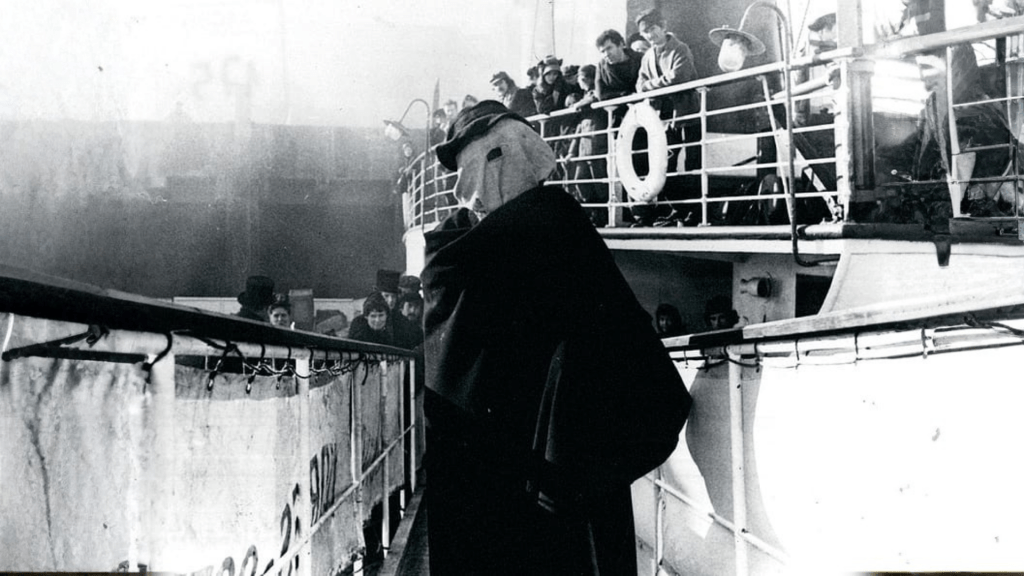
Curiously enough, David Lynch’s The Elephant Man does not open as a melancholic, heartbreaking tale of human tragedy, but rather more like an atmospheric gothic horror. As the film begins, we hear the deep hisses and thuds of colossal machinery, see close-ups of monstrous chimneys firing thick slabs of smoke into the night skies, and hear the ominous groans of freight ships stalking the invisible Thames lurking in the distance. Lynch uses close-up imagery, black-and-white cinematography and diegetic sound to lull us into expecting a classic monster movie, emphasising the cold, brutal tendrils of machinery that wrapped themselves around the foundations of industrialised Victorian Britain. Auditory and visual dread are laced into every corner of the film’s opening; establishing an atmosphere designed to unsettle its audience at every opportunity.
While at its core the film is ultimately a heartfelt story about a man who discovered his humanity at the tail end of a life filled with suffering, the cinematic grammar on display, particularly during earlier portions of the movie, is grim and gothic by design. What is perhaps most striking is how Lynch pulls us into this world with such menacing tone, only to perform a devastating subversion as the runtime progresses. For all the terror found throughout this movie, none of it emanates from John (Joseph) Merrick himself. It instead comes from the brutal, industrialised society surrounding him. By threading visual and audible horror into every frame, Lynch shifts the terror entirely away from the physical form of a suffering man, placing it squarely on the cold, mechanical hydra at the heart of Victorian Britain.
During the opening scenes, Lynch intentionally builds a framework which resembles that of a classic monster film. During these sequences, we do not see Merrick’s face. Instead, we are given only fleeting reaction shots, silhouettes in low-lit rooms, and glimpses of Merrick walking through night-time Victorian streets shrouded in a grubby hood. Yet from the moment Lynch reveals Merrick’s face, the horror does not fade; it simply maintains its focus on the surrounding world, whilst turning Merrick into one of its victims. The atmospheric dread of hissing pipes and steel monoliths decorating the streets of London is not there to frame Merrick as a monster, but as a monster which is enveloping him.
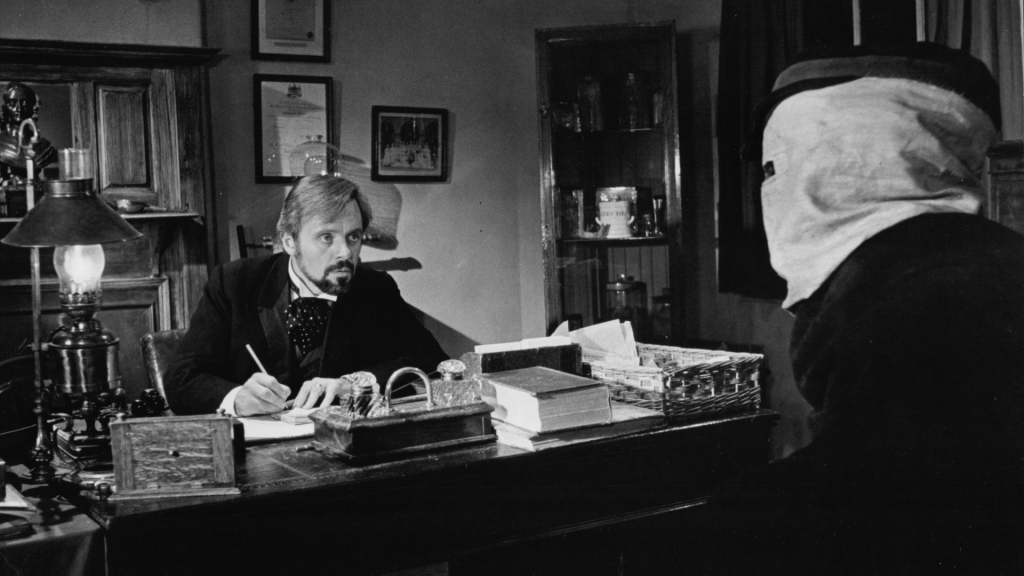
The Elephant Man frames the world constructed by the Industrial Revolution as the monster at the heart of this movie. This decision is demonstrated early on in the film’s run, after we see Dr. Frederick Treves treating a casualty patient, a worker who has been mutilated by some equipment at his workplace. As Treves removes shards of metal from the man’s torso, he comments to his colleagues how they have been seeing more machine-related incidents than usual in recent times. As this takes place, practitioners and assistant surgeons use various tools to sedate and treat the wounded man. Everything feels cold, clinical, and painful. Flesh is sliced and fused using steel equipment, presented to us as a grim, unnatural, and agonising feature of the time period.
There exists a raw and grubby authenticity to the portrayal of 19th-century London here. It was an era filled with suffering, exploitation, and pain for those living on society’s margins. Labour conditions for the working class were lethal. Men, women and children were exploited under dreadful circumstances to keep the vast and never-ending machines of industry churning away. Long before health and safety laws were mature enough to genuinely protect employees, factories and workhouses were defined by violent amputations, crushed limbs, scalping, and endless fatalities. Women and young girls with long hair were often forced to work within close proximity to unguarded rotary equipment, always at risk of getting their hair caught in the machinery they operated to earn their wages. Child workers were forced to crawl beneath active spinning mules and heavy apparatus; risking having their torsos and skulls crushed if exhaustion or poor judgement got the better of them.
Those who were not born into high society were forced to risk their health and existence under these conditions, solely because society offered them no other choice. In those days, there was no sick pay, unemployment benefit, or compensation for long-lasting injuries. If a worker refused to enter these lethal environments, they faced immediate risk of homelessness. It was a direct choice between the Victorian workhouse and starvation.
Labour was even coded into the notion of childhood itself. Society would thrust young people into work before they were old enough to even know what was happening to them. Abandoned or orphaned children were placed into workhouses at a young age, only to then be plucked out by parish authorities and “apprenticed” within factories until they turned 21. There, children lived in packed dormitories, kept alive on slops of gruel. By law, they were made to participate in labour. Any attempt to flee was a crime. These children were not treated as innocent, developing human beings; they were assets needed to keep a vast machine operating. In the eyes of the factory owners, lawyers, and politicians, they did not warrant basic humanity.
Prior to working on The Elephant Man, Lynch had some experience telling stories within this area. His debut feature, Eraserhead, is a film teeming with the visual cues of the Victorian Industrial era. Although that film took place primarily within a fictionalised dreamscape, far removed from British history, the nightmare world Lynch constructed shared distinct characteristics with that of the 19th century. Protagonist Henry Spencer’s world is filled with the monstrous tendrils of iron pipes, bellowing steam engines, churning cogs, and coal-covered structures. Even the high-collared shirts, buttoned-up suits, and dark attire mirrored the fashion from that time period.
Eraserhead was written prior to his filmmaking career, back when he was living near a large industrial zone in Philadelphia during the 1960s. His neighbourhood was filled with the crumbling corpses of former 19th-century textile mills and factories.
“We lived cheap, but the city was full of fear,” he reminisced in his book, Lynch on Lynch. “The feeling was so close to extreme danger, and the fear was so intense. There was violence, hate, and filth.”
Although the city filled Lynch with a deep sense of dread, to him, the industrial era became both a place of horror and a source of artistic influence to the filmmaker:
“I had my first thrilling thought in Philadelphia. Yes [the city] is horrible, but in a very interesting way. There were places that had been allowed to decay, where there was so much fear and crime that just for a moment there was an opening to another world. It was fear, but it was so strong, and so magical, like a magnet.”
Eraserhead is widely understood as being a psychological horror packed with surrealism and body horror at its core. While this makes sense for his debut movie, why juxtapose The Elephant Man with the harshness of industrial iconography? After all, isn’t this supposed to be a film about discovering the humanity of a man who was sensationalised and exploited throughout his lifetime? At first, this creative decision might appear counterintuitive or cruel, yet the more you examine this, the clearer it becomes that this is an ideal and necessary backdrop for this kind of story.
As already established, the Victorian era revolved primarily around machine-driven efficiency. A person’s worth was measured solely by their capacity for physical labour. Were they an efficient “cog” or not? This extended to those unable to engage in factory work due to pre-existing conditions. During the pre-industrial era, individuals with physical impairments could often carry out flexible, home-based tasks such as knitting, lace-making, food preparation, or tool maintenance, if they were unable to work out on the field. Yet as labour shifted into large factories, mechanisation usurped hand craftsmanship, and task-oriented labour transitioned to clockwork-oriented labour, it became far harder for vulnerable and disabled people to participate in the workforce. Consequently, those unable to exercise their physical capabilities were either cast out into the world of homelessness, or exploited in other ways.
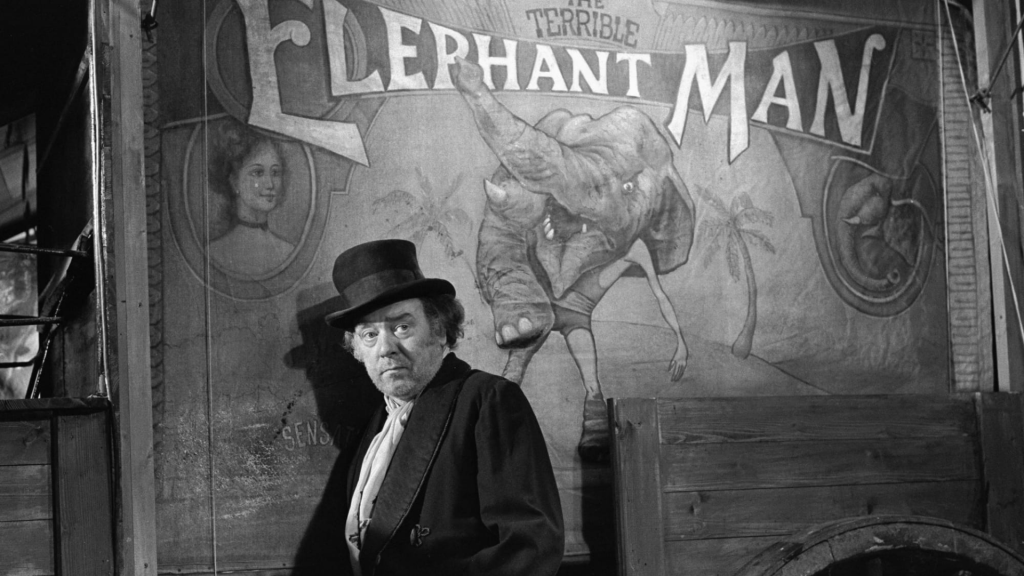
Individuals with obscure medical conditions, as was the case for Joseph Merrick, were at a higher risk of being commodified in more alternative manners to those forced to function in the workhouses. They were sensationalised and commercialised. They too had their humanity stripped away, becoming performers and spectacles to be ogled at as if they were exotic anomalies from another dimension. For souls like Merrick, sideshows, taverns, and travelling circuses became a grim and cruel form of alternative employment; a way to avoid being devoured by the jaws of poverty. It was dehumanising and filled with suffering, yet it was one of their only options in a world that measured human worth strictly on their financial worth.
Central to Lynch’s depiction of horror regarding the aggressive mechanisation of society is how it reduces people to sentient cogs in a relentless machine; one that cares only about keeping the gears turning. In such a world, humanity is stripped away because everybody beyond high-society becomes expendable. The patient on Treves’ operating table is not viewed as a full person, but as a component to be repaired. He is a man with a life beyond the walls of the London Royal hospital, yet during those early moments of the film, he is reduced to a slab of injured flesh, existing within a steel labyrinth that does not need humans; it needs operators. Within this context, Treves is not treating a person, but is acting as a maintenance engineer repairing an organic component.
Merrick is commodified in much the same way as Treves’ patient. Due to his physical condition, he is treated as a spectacle. His entire purpose, through the eyes of the Penny Showman, the Night Porter, and the paying patrons, is to entertain, horrify, or yield a profit. Even Treves initially takes him in not as an act of pure charity, but to elevate his own standing within the medical community.
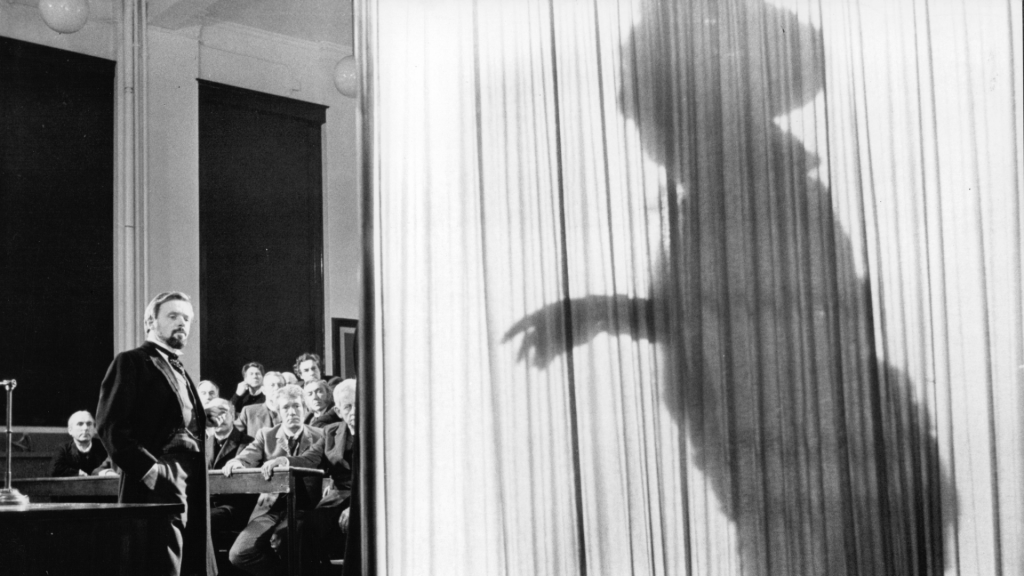
Even as Treves’ actions evolve in a more altruistic direction, he continues to grapple with the question as to whether he’s simply created a more upper-class version of the “Freak Show” he pulled Merrick from. This tension becomes glaringly apparent as wealthy members of society begin visiting Merrick in his new quarters at the Royal London Hospital. They are there not out of a genuine desire to engage with Merrick’s mind or character, but because he has become a fashionable social symbol. Visiting him becomes an act of public charity and humblebrag amongst various circles. Despite being removed from the harsh realities of the travelling circus, Merrick finds himself the lead actor in a different show that may well be dressed up more elegantly, yet still treats him as a performer acting out a role he has no control over.
What makes Dr. Frederick Treves so intriguing is that while he is by no means an antagonist of this story, he still remains something of a key participant in the Victorian industrial machine. He is not an exploited worker, but a wealthy member of the medical establishment, occupying an authoritative role in the system. Lynch never paints Treves as evil or consciously malicious, though he does not hesitate to frame him as an authority figure who unknowingly exploits Merrick, first by displaying him as a medical curiosity, then later allowing him to become an upper-class parlour trick.
Treves is eventually confronted by the head matron, Mrs Mothershead, who calls out the exploitation taking place under the hospital roof. Though Treves initially performs a series of mental gymnastics to justify his actions, he is ultimately forced to confront the reality of the situation, leading him to ask his wife, “Am I a good man…or an evil man?”
If Merrick is merely moved from an impoverished cage to a glamorised one within the walls of the Royal London Hospital, how does he go about reclaiming his humanity? The answer is a surprisingly simple, considerably wholesome and wholly accurate act from the real Joseph Merrick’s lifetime. Throughout the film, we see him constructing a cardboard model of St. Philip’s Church using architectural paper. Although St. Philips Church was itself a product of the industrial era, its role in the film serves as Merrick’s means of breaking free from the shackles of the exploitative system which governed his existence.
Constructing the St. Philip’s Church represents an act of creative imagination which transcends Merrick’s confinement. Because the base of the physical church is obscured by surrounding buildings from Merrick’s window, he must rely entirely on his imagination to complete the lower parts of the model. To complete his project, he must use his mind to build a world which physical limitations prevent him from seeing with his own eyes. Whereas society treats him as a visual curiosity to be analysed and displayed, Merrick’s project serves as proof of a man who can dream, compose and construct. He creates, he dreams, and he expresses an inner world. It becomes proof of his inner humanity, his salvation, and a simple act of defiance against the cog society demands him to be.
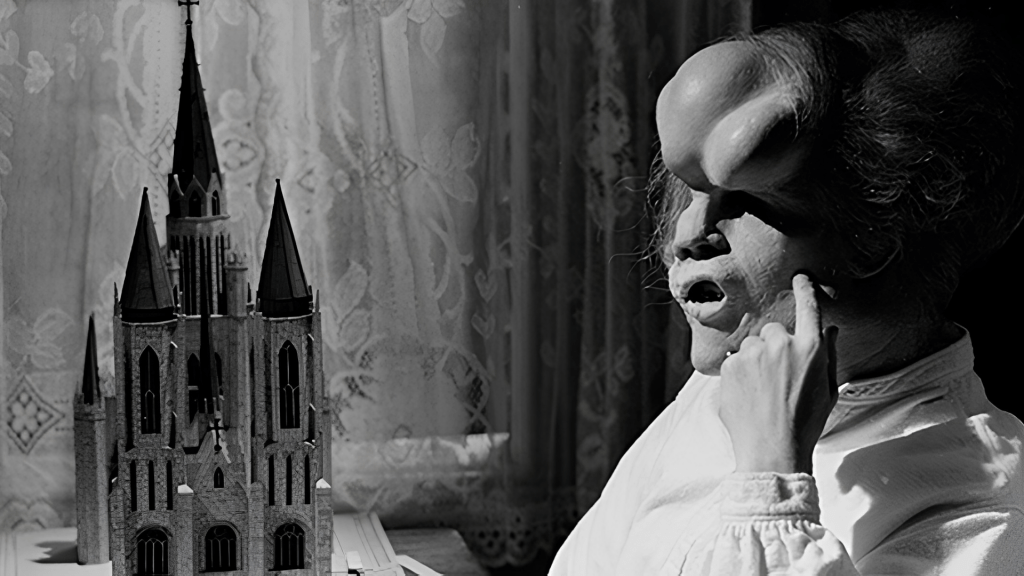
It is for this reason that when Jim, the Night Porter, raids Merrick’s room during the latter part of the second act, the destruction of this cardboard creation feels so violent and callous. It represents an attack on Merrick’s soul. It is also why during the final act, Merrick can be seen completing the repairs of the model before he chooses to lie down and sleep one last time. The act of building and restoring this structure prior to his (speculated) suicide becomes a physical declaration that Joseph Merrick, much like the millions of other souls violated by the industrial machine, is a human being.
Of course, there are indeed problems when it comes to utilising the St. Philip’s Church model in this manner, and we must be careful when discussing it in this context. Merrick’s project may well serve as a declaration of an inner world which society refuses to acknowledge, yet there is a silent tragedy in this act also. In a world where human worth is measured through creativity, there is an argument to be made that we are still measuring their worth based on their utility. In order to be seen as human in this film, Merrick must first be able to prove that he can communicate verbally, read literature and demonstrate artistic talent in order to be granted his dignity. While it serves as an arresting symbolic declaration of his humanity in the eyes of the Victorian machine, its presence still implies that his humanity is conditional. The truth is, Joseph Merrick did not need to prove he was deserving of kindness and love because of a paper church. Instead, it is important to see this act as a means of transcending the claustrophobic walls built by Victorian society. His creation is a refuge, not proof of his humanity.
On its surface, David Lynch’s The Elephant Man functions as a horror film, particularly during the earlier segments. Except it does this not by casting Joseph Merrick as the monster, but by exposing the Victorian industrial machine as the true engine of dread which is to be feared. The film makes use of oppressive cinematic grammar by utilizing hissing steel, belching smog, and clinical dehumanisation of those occupying this world. Yet it refuses to frame Merrick as the object of terror. Instead, he is its victim.
By placing a deeply sensitive, creative soul between the grinding gears of history, Lynch manages to achieve a subversion of the horror genre. The terror never stems from the fragile man behind the curtain, but the callous, profit-driven society which demands that he either acts as an instrument of labour or an instrument of fear. As Merrick’s story progresses, it’s his quiet act of creation which stands as a counter-narrative to the ambient hellscape surrounding him, proving that a human’s spirit can never fully be crushed, even when they are forced to function as disposable cogs in a world that treats people as disposable cogs.







Leave a Reply