
Whilst watching Christopher Nolan’s The Odyssey, I couldn’t help but cast my mind back to another of the director’s projects: Batman Begins. It wasn’t so much that the film shared any significant aesthetic similarities to a comic book about a crime-fighting bat, but rather the sense of glee it evoked within me. Back in 2005, after seeing Batman Begins for the first time, I found myself growing giddy over its general execution. Up until that point, we’d had Batman as a comic book, a campy ’60s movie, a gothic Tim Burton vehicle, and a daft-as-nails Joel Schumacher sequel.
Then, all of a sudden, Chris Nolan waltzes into the picture and delivers a version of the Dark Knight that felt more like a gritty, hyper-realistic, post-9/11 thriller. What was so joyous about that reinvention was how Nolan went above and beyond to construct a version of Bruce Wayne’s origin that felt like it belonged within a universe similar to our own. He took time to establish Bruce’s transition into Batman, providing us with a story that didn’t feel overly fantastical or far removed from our own reality. It gave off the impression of a deliciously detailed, pragmatic retelling that was fresh for the time period it was born into.
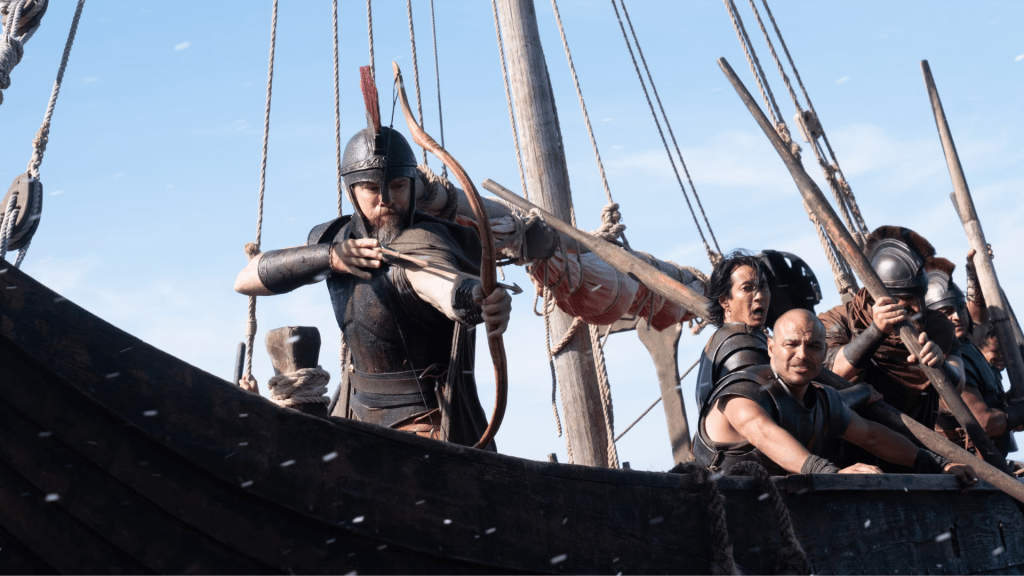
In many ways, The Odyssey appears to be performing a similar trick. It’s a swords-and-sandals Greek epic about men fleeing cyclops lairs and battling woodland giants. It’s a heightened, over-the-top story, yet it’s executed in a way that feels like it belongs in a universe operating within a similar fashion to that of our own.
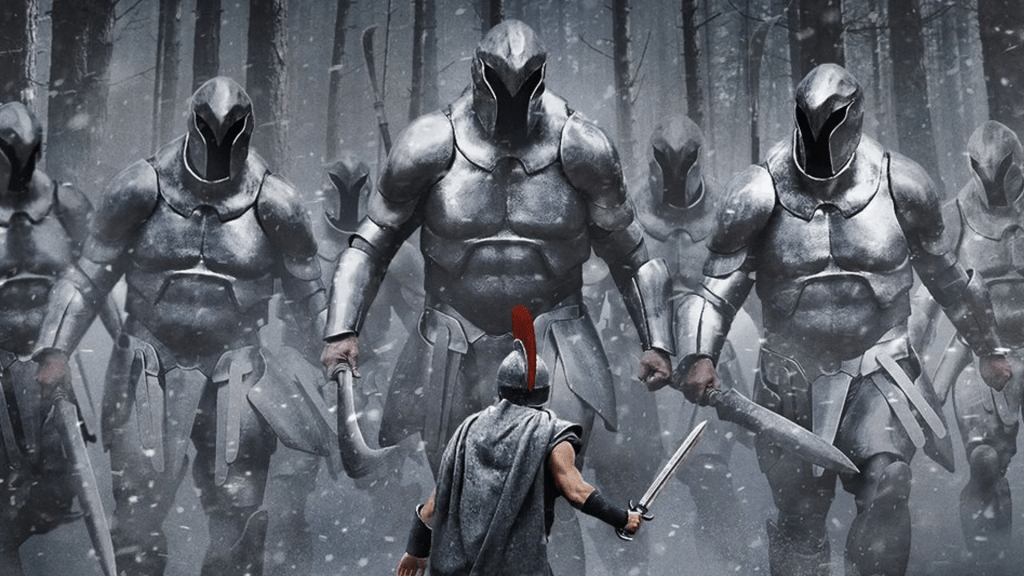
One of the ways Nolan achieves this feat is through The Odyssey’s visuals. He doesn’t simply hand us CGI-riddled vistas or creatures. Sure, there’s CGI used in here, as there is within every Nolan film to an extent, but it serves more as a tool to compliment the assortment of techniques taken from this director’s filmmaking toolbox. Vast sets are constructed from the ground up, thousands of extras fill every shot, house-sized puppets are erected, and seven-foot stunt actors are used to depict giants. Nolan utilises real, physical props and people to bring this fantasy to life. Such elements operate under the physics of the universe in which they were filmed. They aren’t programmed by computers or drawn entirely digitally. They feel real and weighty; on screen and interacting with their co-stars.
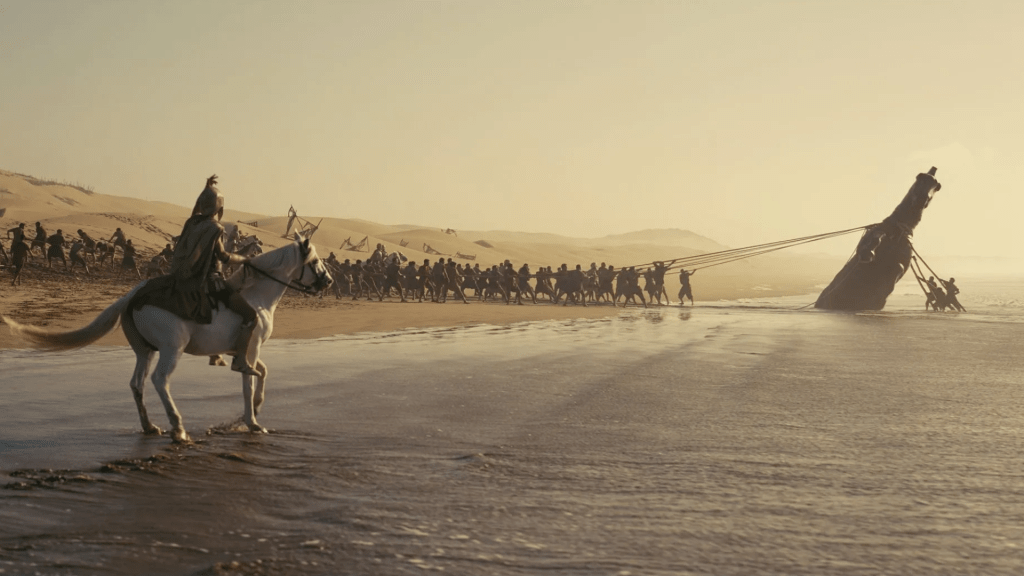
Nolan invests heaps of time and attention to detail when it comes to constructing a set-piece, making everything on screen feel as though it exists in the physical realm; a realm much like our own. I’m not saying it’s The Odyssey set in the modern day. This isn’t Odysseus hanging out in Tottenham. I mean it looks and sounds like a story that could have happened, except for the fact that it’s got giant beasts we’ve never seen before.
On the one hand, this makes for an excellent spectacle. It’s gorgeous seeing gigantic, one-eyed entities chasing our leads into the ocean as they flee for their lives. It’s the sort of cinema that really makes you gasp; exciting, horrifying and thrilling in equal measure. Yet I can’t help but also suspect this pragmatic depiction constructed by Nolan makes an alternative reading of this film all the more plausible.
As the movie opens, a title card appears reading “A Time of Apparent Magic.” While some have read this is Nolan suggesting this is a story from a time back when magic was apparent and visible upon earth, before the Gods left us to our own devices, there is another reading which suggest the magic depicted in this world is an interpretation of less fantastical events. If we opt for the latter interpretation, then it can be argued that Nolan is setting the stage for a reading of this film which plays out more like a psychological drama than a supernatural Greek epic. In this version, the monsters and supernatural beings we encounter aren’t literal creatures, but the products of Odysseus’ traumatised mind.
There are a number of reasons as to why Odysseus is recalling events through an unreliable lens. One could be that Odysseus is experiencing the lingering effects of trauma and PTSD. After a decade-long war, his mind is naturally going to be flooded with paranoid, hypervigilance, grief, survivor’s guilt, and a roster of graphic recollections. These are emotions, ideas and imagery that are difficult to make sense of, meaning restructuring them as fables and divine interventions becomes a coping mechanism that helps to rationalise the chaos and horror that floods our protagonist’s mind.
A number of psychological frameworks pre-dating Nolan’s adaptation exist to support this idea. Prior to the release of his 2002 book, Odysseus in America, psychiatrist Jonathan Shay spent decades working with Vietnam veterans who were suffering from PTSD and moral scarring. In his work, Shay argued that the mythical trials encountered by Odysseus serve as symbolic translations of real-world battlefield atrocities. When considered from this perspective, encountering monsters and vengeful deities serves as a form of psychological externalisation, offering traumatised veterans a way to process memories too unbearable to confront through a literal lens.
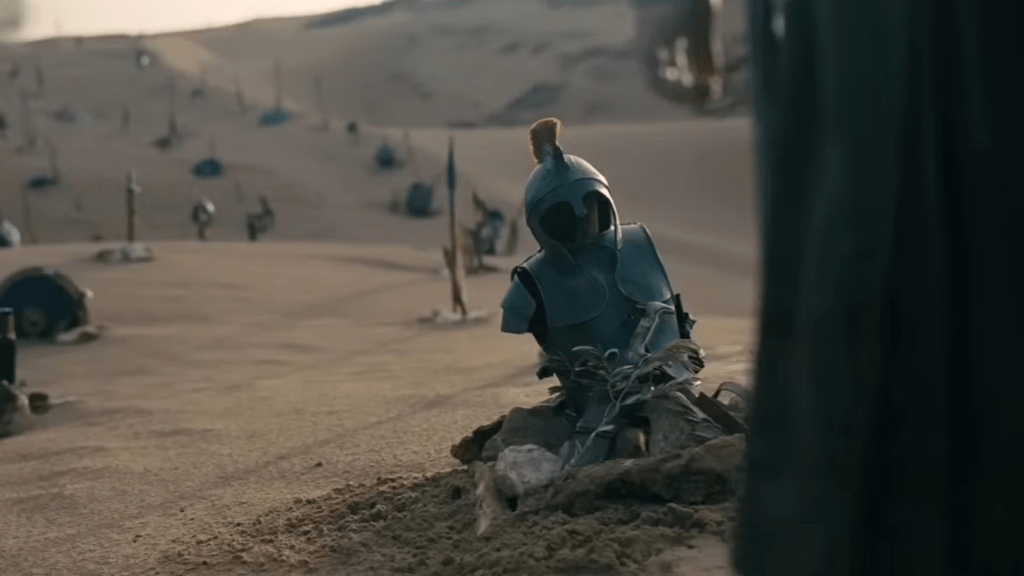
Likewise, in classical psychoanalytic theory, externalisation and symbolisation are psychological tools which a human’s ego utilises in order to protect the wider mind from overwhelming bouts of guilt, anxiety or grief. By reframing survivors guilt through that of fantasy, the survivor adapts trauma into a more manageable narrative structure. Death and destruction are turned into supernatural phenomena as opposed to atrocities tied to a personal failure or moral compromise.
Clues present themselves throughout (both in the film and the original text) which back-up the theory that he is hallucinating large portions of the narrative. One detail we must consider is that the only time we ever hear about the supernatural entities supposedly furnishing this world is when Odysseus is recounting his journey to Calypso. During these retellings, not only are we hearing events journaled by a traumatised mind, but also by one who is under the influence of the Lotus flower. In Homer’s text, the Lotophagi Lotus-Eaters would consume plants which triggered intense bouts of euphoria and forgetfulness. In essence, they functioned as a drug which compromised the mind and influenced perspective on the world around those who consumed it.
Whenever the framing of the narrative shifts away from Odysseus and toward the likes of King Menelaus, we move away from the fantastical. Menelaus instead focuses on the siege of Troy. Likewise, as Eumaeus recalls memories of our hero, he shares stories about how he rescued his dog, Argos, as a puppy. Such scenes do not provide anything that could be considered the products of a fantasy world, all of which paints Odysseus as an unreliable narrator, feeding us information that may not have matched the events as they really happened.
When considering hallucinations in a clinical sense (at least for the most part), there is a tendency for them to share similar visual and auditory schemas to the one the brain uses when processing non-hallucinatory information. Sounds and sights which are not rooted in reality are most effective when they camouflage themselves with everyday information. That way, they become more believable to the individual experiencing them.
Therefore, in a peculiar sort of way, creating a fantasy so deeply rooted in our own physical world makes this hallucinatory theory all the more plausible within the context of Nolan’s pragmatic-visuals execution. The cyclops and the woodland giants feel so natural because Odysseus’ brain registers them as such. If these were CGI-heavy or cartoonish in design, it would feel as though the universe of this movie was heightened, naturally making us default to the idea that we were witnessing a fantasy world play out on screen. The Batman Begins effect doesn’t simply create a realistic looking fantasy, but a film that can be argued to not have any actual fantastical elements in it at all.
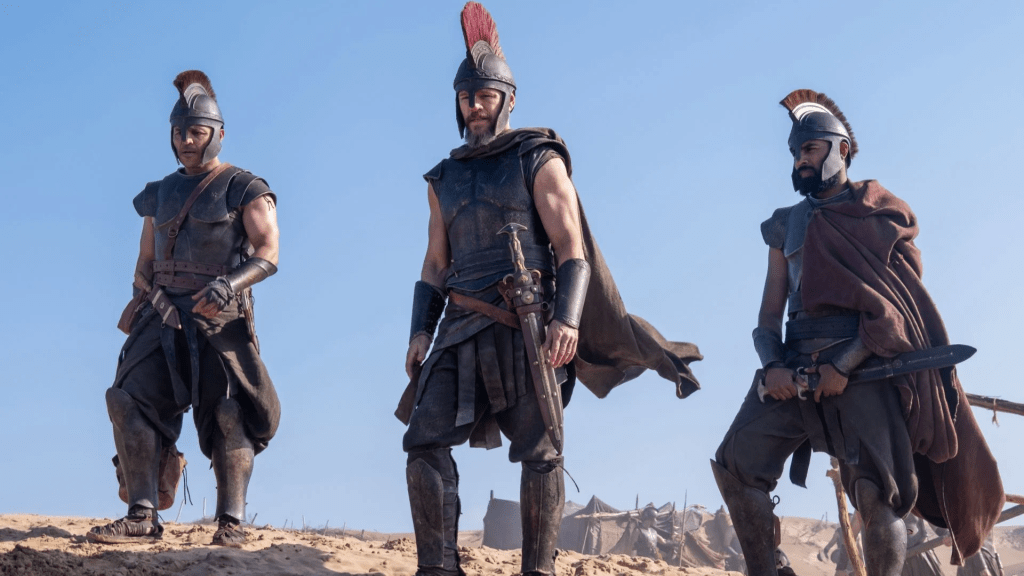
In some respects, providing a reading in which Odysseus is trapped inside an unravelling mind leans into the more personal aspects functioning at the heart of this movie. While this personal angle can still apply if you take it as a fully-fledged fantasy world with monsters occupying its terrain, Nolan’s invitation to consider the protagonist’s subjective reality invites us to look inward just as much as toward the wider fictional environment. Regardless of Odysseus’ interpretation of reality – whether compromised or actively witnessing divine events – this is clearly a man who’s burned and bruised by the guilt of his actions. He is fleeing horrors he participated in, afraid to return home knowing he has not only become a monster himself, but also let down the men he marched into battle.
By anchoring the film in the lead’s trauma, The Odyssey becomes a deeply personal tale. Amidst all of the vast sets, weighty visuals and epic battles, it’s a story about a man who must come to terms with the very thing he’s running away from. He isn’t a hero as such in this story, but a veteran with blood on his hands. It’s this detail that makes Nolan’s adaptation a product of the time period it was made in. The director understands that the large-scale blockbusters of today often requires a central mind to hone in on in order to appeal to a contemporary audience. If the vast, sprawling epics of today lack this, they become far too unwieldy for audiences. They give modern stories a contemporary shape for consumers to resonate with. The narratives of the 21st century cannot simply be about the narrative’s outer world changing; the inner worlds of its characters must change also.
The original Homeric epic was brought into existence in a significantly different world, however; one which operated upon a vastly different philosophic framework. Stories from the ancient Greek era centered far more on status, cosmic alignment, and societal restoration. Even if we consider the fact that Odysseus is an unreliable narrator – something that was also present in the original text – his reasoning for this would have been far more outward reaching than inward. His motives for bending the truth and inserting supernatural deities would have been more about him doing so to project ideas of heroism and victory. It would be to sell the idea that the Greek army were indestructible warriors; an unstoppable force central to the victories of the Bronze Age. It would have been part of the grand fable of Nostos (homecoming).
Even the very idea of Nostos itself would have been an idea rooted in political and social roots. It’s entire purpose would have been there to try and restore the idea of order to the status quo. It was selling the idea that the Bronze Age was eternal and unbeatable; that no being, opposing army or entity could usurp its dominance.
But this is where Nolan’s adaptation retools itself for the modern era. He has taken the source material of the original, then translated the socio-political subject matter so that it is more focused on the self. What’s interesting about this is that it exposes something interesting about the modern era. It shines light on the idea that storytelling and society in general has become more self-centered as time has moved on. Whereas past myths were about broader social and political narratives, the fables of today are more focused on our inner worlds.
Storytelling has shifted inward because contemporary culture treats the individual as a fundamental unit of reality. Younger cultures focused on collective rituals to appease the gods found in religious texts and maintain communal order. It wasn’t until the rise of philosophies, and religious traditions (such as Christianity) which prioritised personal morality that works of fiction started to shift toward the inner human conscience. Furthermore, prior to print culture, oral epics were more communal events performed to a crowd. It wasn’t until the invention of the novel in the 17th and 18th centuries that reading became a more private, one-on-one experience. Then came the 20th century, where psychoanalysts such as Freud and Jung provided us with deeper understandings of subconscious trauma and suppressed desires. The world of the ID was born, and with that, human tendencies to look inward within art deepened further.
While this has served as a rod for criticism for some, the insertion of a more self-centered, inward approach helped me to connect with Nolan’s adaptation in a way I’d have struggled to with Homer’s original. After all, I am very much a product of the world I was born into; someone who loves films that peer inward and tell stories about the human soul. None of this is meant to sound as though I’m suggesting this is a superior secret ingredient which makes all movies palatable. Nor do I mean to suggest that this improves the original Homeric epic. There are indeed many who disapprove of the portrayal of these characters in Nolan’s version. Emily Wilson, the classicist whose 2017 translation sparked the director’s interest in this text, has famously gone on the record to state that she felt the characterisation was considerably weak. She referred to the screenplay as “abysmal,” claiming the characters lacked clear motivations of believable arcs.
Wilson’s argument is that restructuring Odysseus’ journey into a story about PTSD turns him into a generic modern archetype. Under this reading, Odysseus becomes a brooding solider rather than a 3,000-year-old trickster whose personality shifts and reshapes itself as the narrative unfolds. She further argues that this narrows the scope from a multi-character fable into story about one man and his suffering. She believes the film dials down Penelope’s role as a mastermind puppeteering a kingdom, reducing her to a woman-in-waiting. By prioritising the individualistic nature of modern storytelling, there is a valid argument that Nolan’s version downplays the communal mechanics of Homer’s original. The social, cosmic, and political hurdles fade, prioritising a single character’s psychological interior above the wider scope of this fictional realm.
As far as the story worked on a personal level, however, the inner world of Odysseus was one I found to be both intriguing and engaging throughout. It kept me invested throughout the feature’s 3-hour runtime. Nolan’s 21st century reinvention presented a mystery for me I felt compelled to untangle as I watched; was Odysseus navigating an unreliable mind that twisted his trauma into an impossible fable, or had his actions at Troy really concluded with a showdown against the gods? Which layers of reality existed, and which were the product of a mind that had been snapped? Was he a hero, or a wounded monster running from his own memories? While part of me did wish there was a version where Penelope, Telemachus and co had a bigger part to play – particularly when it comes to the politics and motives of the slimy would-be Kings infesting their home – the depiction of Odysseus left me with a puzzle I found myself fascinated by.
Nolan’s version of The Odyssey manages to paint a captivating canvas; one capable of hinting at valid alternative readings coexisting within the same space. Is it a psychological thriller with an unreliable narrator at the wheel, or a fantastical epic that depicts on a pragmatic scale? The film is packed with imagery and ideas which flirts with both ideas, presenting a strong case for multiple interpretations. At the tail end of all this, The Odyssey isn’t simply a static adaptation of an ancient text. Instead, it functions as a mirror held up to modern storytelling. By grounding a sweeping fantasy inside the mind of a messy, traumatised, and unreliable human, Nolan invites us not just to a cinematic spectacle, but to a puzzle about a man at war with his own memories. It’s a storytelling decision that might not work for all, but will certainly guarantee my continued return to this over many years to come.



Leave a Reply