
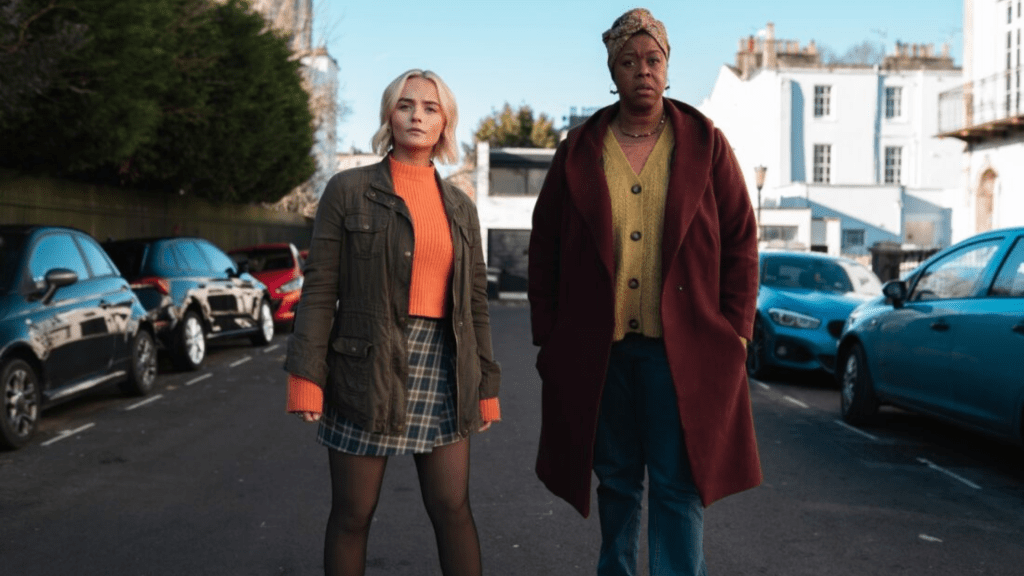
73 Yards is an episode of television that confuses me to no end. And no, I’m not referring to the obvious ambiguity perched at the heart of this story, but rather my subjective opinions toward the script itself. Whenever asked whether I like this one, I can’t quite land on a definitive or confident answer. I’m caught between shifting thoughts that alter depending on what part of the episode I’m thinking about at the time of being asked. There are moments where I think this is staggeringly good, yet there are also moments where I can’t help but wonder what on earth Davies was up to when penning this one.
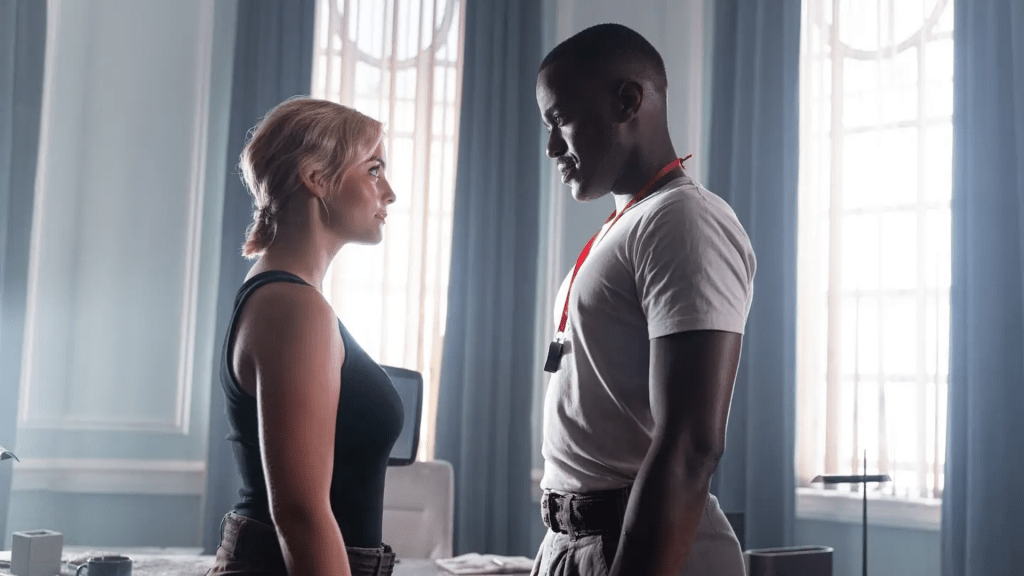
Let’s start with the obvious; Davies wrote this out of necessity first and foremost. Ncuti Gatwa had limited availability during the shooting of Series One due to prior commitments on the Barbie movie. Therefore, the showrunner needed to produce a Doctor-lite episode that focused primarily on Millie Gibson’s Ruby Sunday.
What we get is an episode that is rarely boring, constantly changes shape, and is packed full of fascinating character moments. It’s also messy and exceedingly ambiguous.
When you zoom in on the various set-pieces and characters, it can feel like you’re watching a masterclass in televisual directing and writing. Davies’ individual scenes feel sharp and teeming with ideas, whilst Dylan Holmes Williams’ direction is as gorgeous as it is creepy in parts. Williams manages to capture the ever-changing tone and style that the screenplay demands in a manner that feels almost effortless.
If you take a step back and look at the wider episode, however, the bigger picture is slightly more difficult to define than simply calling it “good” or “bad”. The truth is, it’s technically neither of these things when viewed as a whole. It’s an addition to Series One that manages to feel significant and pointless all at the same time.
To try and set the stage, let’s look at a particular sequence from early in the episode, which I think can help us make a little more sense of the bigger picture. During the sequence in question, Ruby finds herself in the fictional village of Glyngatwg in Wales. There she comes across Y Pren Marw; a village pub run by a lady named Lowri Palin. To put it bluntly, Lowri is a remarkably rude woman at best and a bully at worst. As a matter of fact, everyone having a tipple at Y Pren Marw that night is pretty cruel. For starters, Lowri is unnecessarily snappy with Ruby when she asks whether she can pay for a room by phone. I know it’s 2024 at the time of this story, but at that point in time, there were still many places that were funny about people paying for items and services via card, let alone paying on a smartphone. Heck, even as I write this in the year 2026, it still isn’t a universal option. Just last week, I found myself having to locate a cashpoint so I could order a takeaway from a “no card” store. Ruby enquiring about payment methods is far from a stupid question, by any stretch of the imagination.
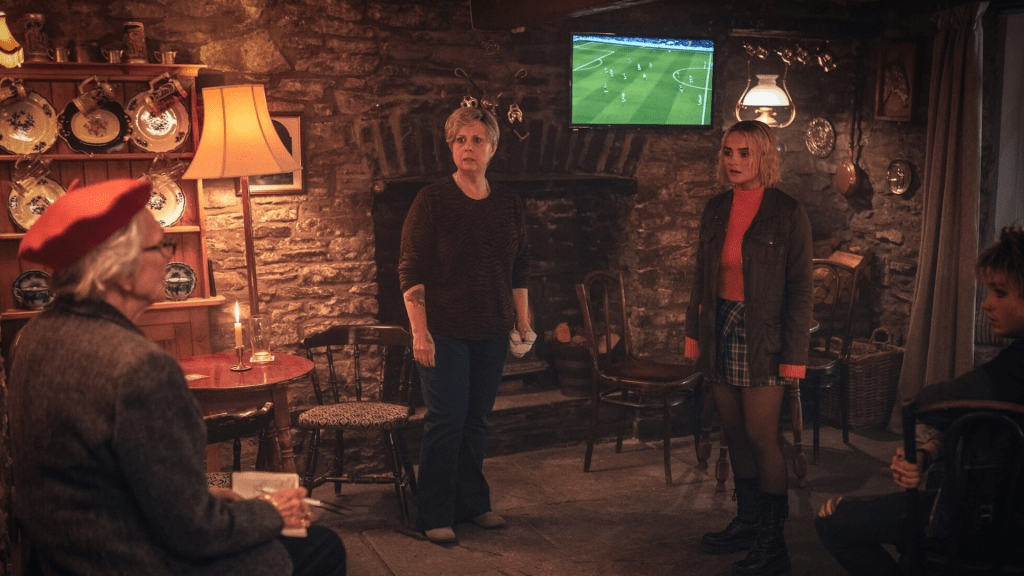
Nevertheless, the entire pub treats Ruby like she’s just asked them if they know how to use a crayon. They all chime in on the gag, sarcastically talking about how they’re hoping to “get Christianity” in the town soon. Okay, so they are all a bit arsy, “so what?” you might be wondering. Only they don’t stop there, opting to push their luck further by improvising an entire skit in which they lead Ruby on into thinking they’ve all bought into a curse about some supernatural chap called Mad Jack and how breaking fairy circles on Welsh coasts is likely to summon him. All of this, of course, turns out to be them further winding her up, even going so far as to calling her a bigot for her gullibility.
Sure, there’s a solid point in suggesting that people who assume Welsh folk are superstitious is an idea rooted in prejudice and xenophobia, but when applied to this particular context, that doesn’t quite work. Even ignoring Ruby’s awareness of the supernatural, and acknowledging the locals’ ignorance of this detail, this was hardly the time or place to be making such a point. From their perspective, Ruby is lost, alone, cannot find her friend who went missing on the West coast, is being stalked by a stranger and is visibly distressed. Surely, no one in their right mind would use this as an opportunity to play a prank on such a person, only to then call them racist for taking the bait.
The reason I’m poking holes in this scene is because in many ways, I think that it acts as an effective snapshot for both this episode’s strengths and weaknesses. If you accept the scene without applying too much thought to it, it’s a remarkably effective sequence. It has some interesting ideas in it, dishes up an engaging fable, and is spooky. It does a decent job of establishing tension, allowing the dread to play out between the characters involved in the scene before the rug is pulled from beneath us. It’s an effective scene that evokes a series of differing emotions in viewers.
Yet beyond watching it in isolation, if we step back and apply logic, it’s all a bit directionless and nonsensical. Ruby’s just interacting with a bunch people who’ve decided to bully her for about nine minutes’ worth of the episode’s runtime. After that, we never really see them again (aside from a momentary flashback when we meet Gwilliam). It’s an atmospheric scene, but it does very little to move the plot in any significant direction. It’s there to entertain, creep us out, make a few points about unconscious biases, and mislead both Ruby and the viewers. It’s not a bad scene on the surface; it’s just that its main goal is to add atmosphere to this story.
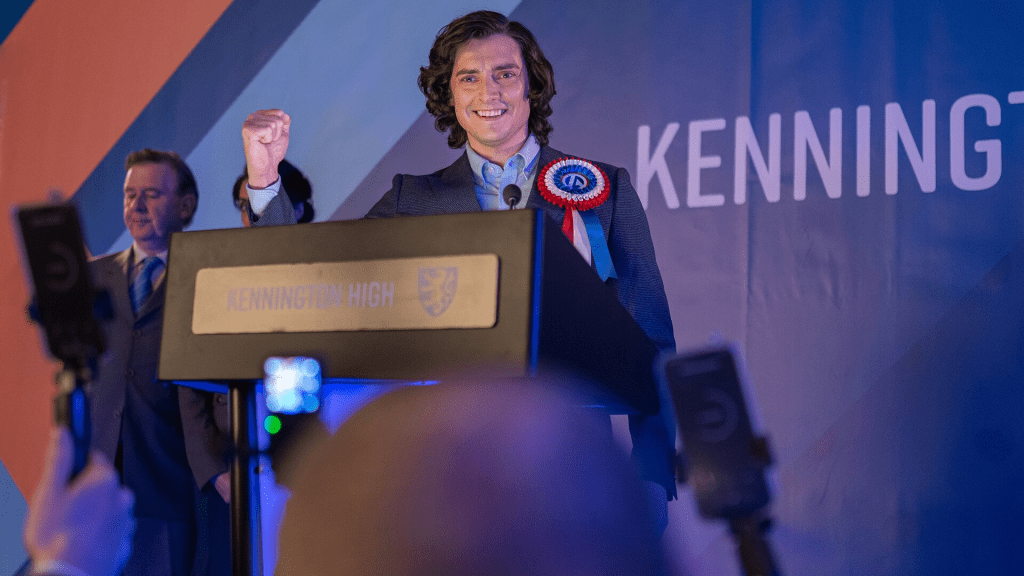
You could argue that the purpose of this sequence is to provide audiences with something resembling a potential explanation for why Ruby has spiralled off into an alternative timeline for 47 minutes. Furthermore, the whole “Mad Jack” reference ties into the Prime Minister, Roger ap Gwilliam, who Ruby will eventually bring down using the very mechanics of this story’s “antagonist”. Yet despite this, the scene itself isn’t exactly framed as a definitive explanation for what’s going on. Its punchline reveals that the locals are reciting a folklore to wind Ruby up before they erupt into fits of laughter. It’s one of several forms of exposition delivered during the episode, one which you could suggest is a form of plot logic threaded into a communal windup. However its purpose is delivered as a means to troll the protagonist for a little bit before everyone shrugs their shoulders and gets bored of being unnecessarily nasty to someone who’s lost their mate in the countryside.
All of which leads me to wonder, much like the scene referenced above, can 73 Yards as a whole be considered that of a shaggy dog story? For those that haven’t heard the term before, this is a literature trope where a long, involved setup leads to an intentionally anticlimactic or irrelevant conclusion. Think of it as the narrative equivalent of an intoxicated chap at your local pub harping on about an encounter he had before forgetting entirely what he was chatting about in the first place.
Is this entire story an extended “gag” that builds towards something that’s ultimately irrelevant? By comparing the entire screenplay to the scene in the pub, my initial inclination is to suggest that it is. Only the more I think about it, the more I start to doubt whether this is an accurate claim to make.
The thing is, I don’t think you can just write this off as being a “nothing” episode, just as much as you cannot write off the scene in the Welsh inn as being pointless. As mentioned, that scene actually has quite a lot packed into it, despite it revealing itself to be essentially meaningless by the end of it. It is used to offer up a theory as to what caused the Doctor to vanish from history, plus it is also used to trigger Ruby’s memory when Roger ap Gwilliam enters the picture. Is the whole episode like this; a seemingly dead-end story that is actually entirely meaningful if you squint hard enough?
The point I’m trying to make is that 73 Yards is an episode that seems to shift between being an ambiguous, random, Doctor-lite story caked in ambiguity, to being a story that’s teeming with ideas and significant character development. It’s the type of episode where as soon as I start arguing that it’s one thing, I’m reminded of another moment which challenges whatever claim I’ve just made.
For instance, if I say this is an ambiguous tale with a threat that’s never explained to us, I’m reminded that we do get hints of potential explanations throughout. The tales of witchcraft in Y Pren Marw, Kate Stewart wondering whether the TARDIS landing within range of a folklore symbol triggered a supernatural event, and even Ruby discovering that the woman is a future version of herself implies there’s more going on here than just some random tale. There’s a clear alien threat present, and while Davies never explicitly reveals what that alien threat is, we are drip fed information that is open for interpretation. If you want the Y Pren Marw patrons to be teasing Ruby with a tale that’s actually real in this universe, then you’re welcome to make that the answer. If you like Kate’s theory about the TARDIS turning a fable into a fact, then go ahead. Should you wish to believe it’s something entirely different from anything implied by the characters of the story, then so be it. Davies is hinting that it could be one thing, or another, or a mixture of them. There isn’t a right or wrong answer, it’s up to the audience to decide.
It might be ambiguous, but it isn’t void of an actual idea. In fact, the script goes out of its way to stop and sit with the threat driving the plot forward. Ruby tries multiple ways to communicate with the mysterious woman, utilising phones, UNIT, and intercoms to try and bypass the mysterious reaction people have toward confronting the figure. She even talks about how she fears placing herself in environments where the woman physically can’t manifest, such as going on a plane or boat. For a story some might argue as being pointless, Davies really does dedicate an awful lot of pages of the script to actively questioning and exploring how this concept might work in different scenarios.
Then there’s the fact that 73 Yards does serve a deeper purpose. These aren’t just 47 minutes of terrible things happening to Ruby. It’s an entire story that actively simulates a deep-rooted fear of this character. Seeing as her biological mother left her at birth, Ruby has abandonment issues. She’s terrified of being left behind by those she cares about. This episode literally places her in a position where those fears become reality, only for it to then linger on that realization while she rebuilds her life from the rubble of that devastation. This is a pocket story that allows the Doctor’s companion to actively go on a journey that explores the groundwork which was laid down during her debut episode.
To add to this, 73 Yards has a beginning, middle and an end. We start with Ruby’s “normality” collapsing around her. The Doctor vanishes from reality, leaving her alone, confused and directionless. As we lead into the second act, Ruby finds the intensity of that isolation amplify when she discovers she can’t even revert to her pre-Doctor life. Stepmum Carla abandoning her, and Kate Stewart equally doing the same, forces her into a life where everything she once knew has collapsed. She must learn to live with this, before actively utilising the curse of the mysterious woman to stop Roger ap Gwilliam from triggering nuclear armageddon. The mechanics of the concept behind the episode might be hazy and theory-driven, but Ruby and Gwilliam’s plotlines all follow an internal logic that resolves the internal conflict by the end of the episode.
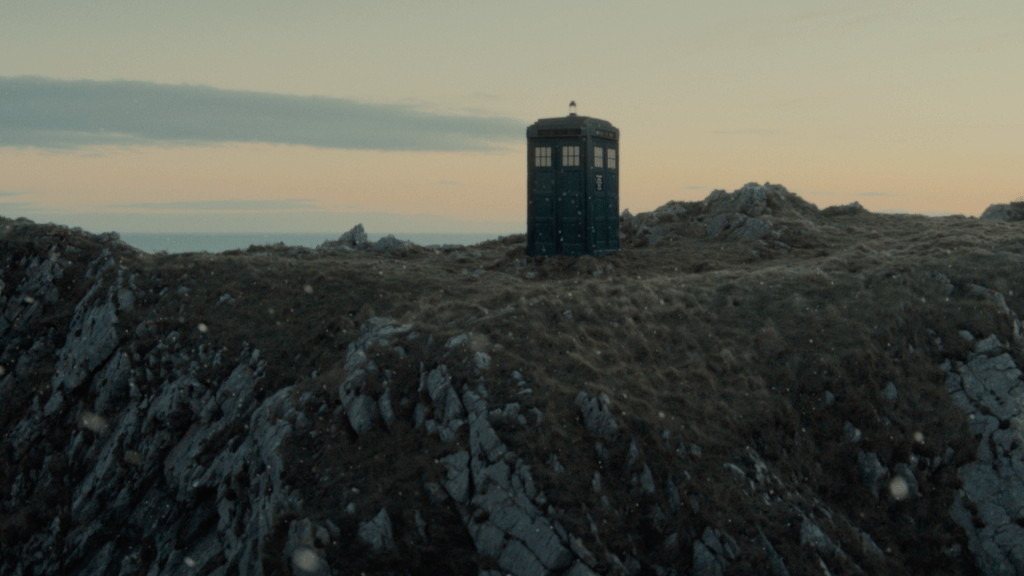
Except it sort of doesn’t, because even after arguing all of that, there are more details to contradict all of that! Ruby might stop Gwilliam from blowing the world up, but technically, she doesn’t. Before the credits roll, the timeline is reset, Ruby figures out she’s the mysterious woman that’s been haunting her younger self the entire time, and the story literally undoes itself. Everything that we’ve been through crumbles away into nothing. Much like the patrons at that Welsh inn, Davies bursts into fits of metaphorical laughter, before declaring, “nah, not really.”
It’s a meaningful story that has character development, a sequential series of events, and a dedication to sitting with the ideas it is raising, but this strictly works purely in isolation from the wider Doctor Who show. It is entirely self-contained, serving more as an anthology instalment that doesn’t really belong in any continuity beyond its release. It borrows character elements established pre-existing Doctor Who episodes (in this case, The Church on Ruby Road), dives into exploring those elements, then Thanos-snaps itself out of existence before we’ve had time to consider what it all means for Ruby and the show going forward.
Part of me has been tempted to compare this to episodes such as Listen from the 2014 series starring Jenna Coleman and Peter Capaldi. That was another atmosphere-driven story that functioned as a self-contained narrative that wasn’t elaborated beyond the confines of its own episode runtime. It even had an ambiguous threat allegedly stalking the Doctor; one of which we’re led to believe may not even exist. The only difference with that episode is that it wasn’t erased from existence by the time it ended. This one is. In that sense, it’s probably more similar to 2011’s The Wedding of River Song. It’s a bottle episode, tucked away in its own pocket universe, serving as an interesting and atmospheric “what if” story.
There is another episode I haven’t spoken about, however, which is perhaps the one most like this. Back in 2008, Davies wrote an episode preceding his series four finale titled Turn Left. As is the case here, that was an episode set in a pocket universe, largely designed to function as an isolated “what if” tale about what the David Tennant era would have looked like had the tenth Doctor died a third of the way into his tenure. Again, that was an episode packed full of fascinating ideas, allowing room to breathe, and prioritised character over plot. Likewise, that was a story which reset itself before the next episode had time to air. Donna Noble’s journey through Turn Left had no wider impact on the show’s future, and the events of that story had no wider impact outside of its runtime.
Where Turn Left and 73 Yards differ in this respect, however, is in where they were positioned within their respective eras. Turn Left came at the tail end of both the David Tennant and the first Russell T Davies era. It was an experimental story that invited viewers to view past episodes through a different lens. It also gave Davies an opportunity to explore some dark-yet-fascinating ideas about humanity in the midst of an apocalyptic crisis. It was a playground for an outgoing showrunner several episodes before the show was due to reinvent itself. Doctor Who as we understood it at the time was coming to an end, so why not do some self-contained thought experiments? Where 73 Yards differs, is that it comes during the earlier stages of a new era. Ruby and the Fifteenth Doctor are new to viewers, and we’re still in the process of trying to deduce at this stage who they are and how they function. This is further complicated by the fact that Davies had returned to the show 14 years after his last departure. The episode came out slap bang amid a period where we were trying to figure out what his approach to the show was going to be for his second run. What were his philosophies for Doctor Who? What would be the overall shape of this new series? And what tone would he adopt during his return? Going for something so self-contained and experimental this early on felt more like a story that might have better belonged at the tail end of an era, not during its establishing stages.
All of which leads me to wonder: do I like this episode? The answer ranges from a resounding “yes” to a hesitant “probably”. For one thing, I adore Millie Gibson in this story. She takes the material given to her in the script and absolutely runs with it. Her performance comes alive in this story in ways she hasn’t done in any other episode. She’s not just the overly giddy companion who laps up the madness of the Doctor’s world. She feels like a real character trying to adapt to the appalling circumstances she’s found herself in. I can feel her pain, her confusion, and even the pragmatism this character experiences throughout. This is the episode that defines not only the inner workings of Ruby’s character, but the talent of the performer playing her.
I also love the pacing of the episode. Doctor Who is notoriously fast and boisterous. Most episodes tend to swoop in, present a far-fetched science-fiction idea, then dash about trying to wrap everything up in under an hour. This one doesn’t quite feel the same. It allows itself to sit with an idea and ponder how the concept introduced might interact with the characters and world it exists within. It is a noted change from the usual frantic, breakneck pace of the series, and I love it for that.
The fact it fizzles away at the end frustrates me. It feels like Davies drafted out a version of this show that functioned as a slower, darker, more contemplative version of his previous era before instantly panicking and wiping the whiteboard clean. It’s a snapshot of something brilliant, moments before its deletion.
It’s an episode that works, but it’s also an episode that doesn’t. Much like Ruby at the Y Pren Marw inn, 73 Yards tells us one thing before breaking the facade and chuckling at our gullibility. It’s an alternative and fascinating suggestion at what the Ncuti Gatwa era could have been in terms of tone and pacing, before the story yanks the rug from beneath our feet the moment we start to believe.
Had it come at the tail end of a well-established era with a fixed, multi-series companion at its centre, it could have been a true classic; a bottle episode unshackled from the mythos its writer had built up during the preceding years. The fact that it arrives at the top of an era still attempting to define its identity does not do it any favours.





Leave a Reply