
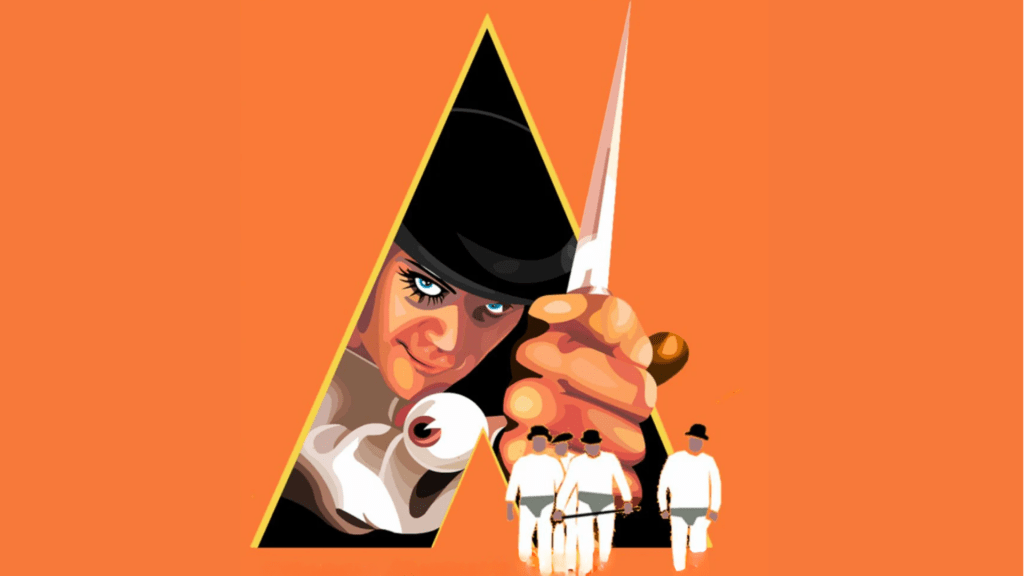
In 1966, Dr Strangelove screenwriter Terry Southern introduced Stanley Kubrick to a novel he’d discovered through photographer Michael Cooper. The book in question was a commercially unsuccessful and polarising work penned by Anthony Burgess, written at a point in the author’s life when he was broke and desperately in need of a paycheck. At this stage in his career, Kubrick was locked into production on the most technically ambitious project his career had seen to date; 2001: A Space Odyssey.
Though Kubrick initially dismissed the novel, dissuaded by the U.S. paperback edition’s use of bikers on its front cover, he would come around to it several years later. In 1969, following A Space Odyssey’s completion, Kubrick’s wife Christiane persuaded her husband to give the book a second chance. This additional read-through captured his imagination, drawing his attention to the political, philosophical and dream-like potential lurking within the text printed across its 192 pages. Yearning for a smaller-scale project to sink his teeth into after the exhaustive efforts brought about by 2001: A Space Odyssey, Kubrick decided that Burgess’ 1962 release would fit neatly into that scope.
What stemmed from that second read-through would be one of the most controversial and polarising releases of this filmmaker’s career; a film that fed directly into Kubrick’s lifelong fascination with authority, morality and the nature of power.
The film adaptation of A Clockwork Orange has undergone a fascinating evolution over its 54-year lifespan. Upon its initial release, the film raked in a whopping $114 million on a humble $1.3 to $2.2 million budget. Yet despite its commercial success, it was met with severely divided opinions among critics following its debut. While many praised the film as a “tour de force” for Kubrick (some even claiming it to be more technically impressive than 2001: A Space Odyssey), those less warm to its subject matter accused it of being vile, pornographic, and manipulative toward its audience in getting them to side with a barbaric monster of a protagonist.
In the years following its release, a moral panic formed around the movie, with the British press blaming it for a series of supposed copycat crimes. An incident involving a 16-year-old who beat an elderly person to death, a 14-year-old accused of manslaughter, and a horrific gang attack in which the attackers reportedly sang “Singin’ in the Rain” during the atrocity were all linked back to Kubrick’s feature in the tabloids. Widespread censorship followed these accusations, resulting in an X rating being slapped on U.S. releases, local councils banning screenings in several UK towns, and total bans in numerous countries across the globe.
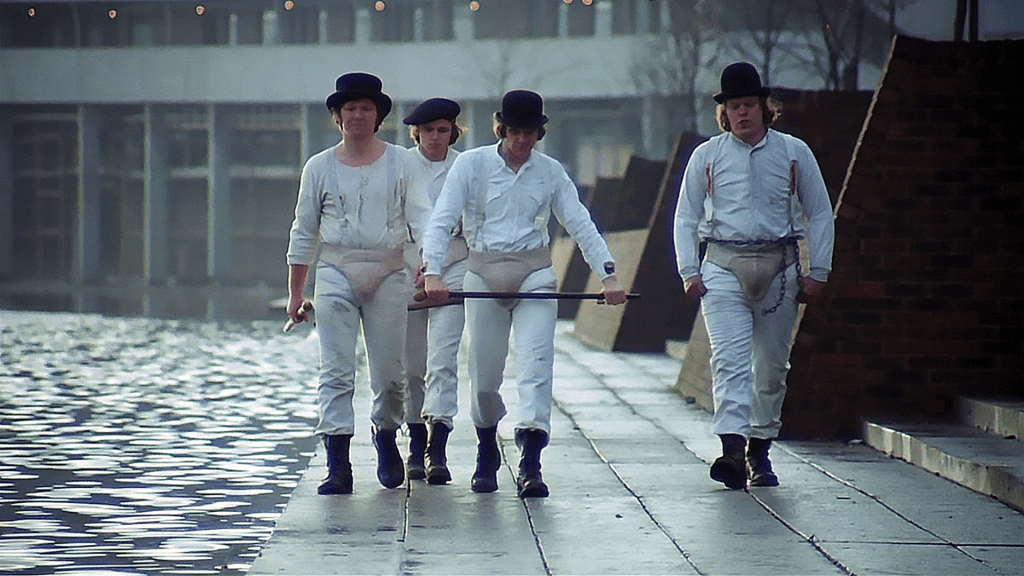
Controversy reached such a fever pitch that Kubrick himself resorted to withdrawing the film from UK distribution in 1973; a ban which remained in place until his eventual death in 1999. This was a decision which stemmed directly from the graphic death threats he and his family received following the hysteria in the press. While he continued to argue that he did not believe art caused real-world violence, he took the decision to self-censor as a means to protect his family from potential harm.
In some respects, the real-world hysteria surrounding the film’s release created an ironic meta-narrative; one which reflected the world of A Clockwork Orange itself. In a peculiar case of life imitating art, A Clockwork Orange came to mirror the very institutional anxieties present throughout both the novel and Kubrick’s adaptation. The attempt by the media and authorities to scapegoat a piece of art for the deep-seated violence of youth culture mirrored the same acts of performative morality which Burgess and Kubrick were exploring. Those fanning the flames of this moral panic saw violence as a moral evil when it benefited them to do so, yet actively played a part in inciting real-world violence by enraging various readers enough to the point where they were sending death threats to Kubrick and his family.
As time marched forth, the public panic passed, and the conversation shifted from a surface-level debate over cinematic censorship into something deeper and more complex. The film would come to be seen as a troubling philosophical exploration of human nature, state-led control, and the inner workings of morality itself.
This shift in critical perspective ultimately hinges on how the narrative chooses to resolve its narrative conflict in both versions of the text available. To fully understand how A Clockwork Orange explores the idea of morality, it is best to look at the ways in which both Burgess and Kubrick opted to conclude Alex’s story. I say this because the film adaptation differs significantly from that of the novel; or at least the version originally released in the States.
Originally, Burgess wrote twenty-one chapters for the book; a number chosen because he believed the age of twenty-one signified a human’s transition from childhood to adulthood. In this final chapter, a time jump occurs, showing readers an older Alex who has grown bored of criminality, ultimately desiring to settle down and start a family. It transpires that Burgess’ core message when writing this book was that criminality cannot be conditioned out of a person by the state or any other member of authority, but must leave that individual naturally. His point, it would appear, is that maturity is what ultimately cures those who have committed wrong during their youth.
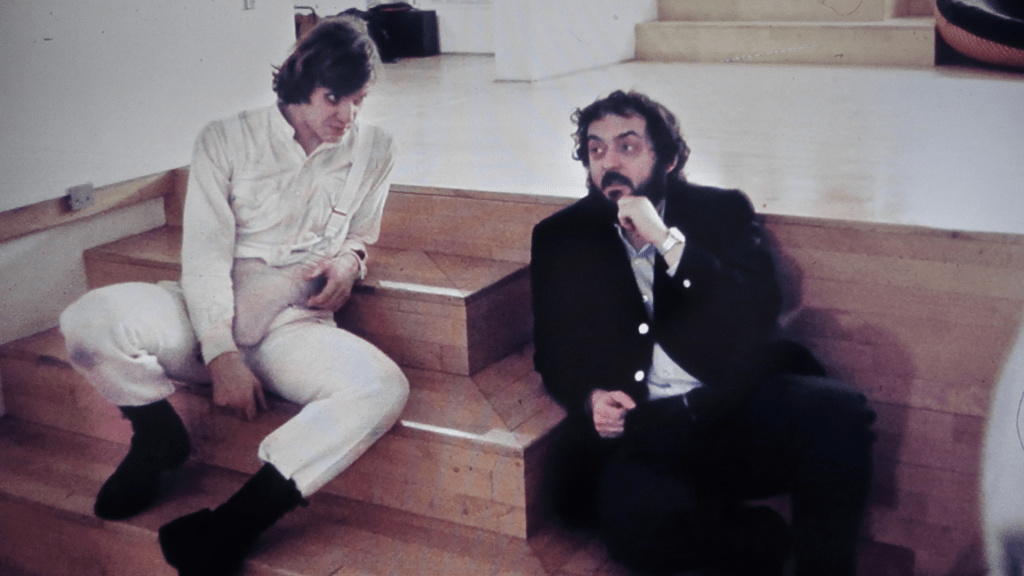
During those initial reads before committing to the adaptation process, Kubrick had only ever read the American edition of the book, completely unaware at the time of the original UK release’s twenty-one-chapter version. U.S. publishers felt that Burgess’ chosen ending was far too unrealistic, opting instead to release a shorter, twenty-chapter version which would ultimately become the basis for the cinematic adaptation. Kubrick, having read the U.S. edition, immediately set out to adapt this version for the big screen. He had no idea at the time of the UK version’s existence; yet even when Burgess later revealed its existence to him, he still refused to include it, feeling that the absence of chapter twenty-one made the story significantly darker and more satirical in his eyes.
Kubrick wished to lean exclusively into the idea that the government was never truly determined to reform Alex (or society as a whole) out of a sense of moral righteousness. Instead, their sole objective was to control for their own benefit. At first, they attempted this by conditioning Alex so he was physically unable to commit crime. Later, they resorted to bribing him into helping salvage the administration’s public image. Ultimately, he serves as nothing more than a political prop whose actions only concern them when he’s not serving their agenda.
This further feeds into the cynical reality that governments and state-run systems rarely combat crime for altruistic motives. Instead, the theatre of fighting crime is used to sell a message to voters and curry favour in the polls. Curing Alex was never intended to make the streets of Britain safer; it was simply a tool designed to win votes. In this story, criminals are not enemies of the system, but a product which fuels it. Why else would the state give Alex’s former Droog buddies, Dim and Georgie, jobs as police officers? Considering their names had likely been circulating alongside Alex’s when word of his heinous crimes spread, surely they’d have never made it onto the force if recruited by a just system. The message is clear; the powers that be don’t care, so long as you’re helping them.
Alex is no different. First, he was a prisoner paraded about as a symbol of the police successfully locking up a dangerous gang leader. Next, he became the face of a reform programme framed entirely around the votes it would score for the Minister of the Interior. Finally, he was transformed into a state spokesperson who’d speak kindly of them in exchange for a cushy job and a hefty salary.
Kubrick’s decision to end the story here makes for a grotesquely dark conclusion, essentially handing Alex the keys to happiness despite the multitude of crimes we’ve witnessed him commit over the previous two hours and sixteen minutes. Yet it also feels remarkably close to home in 2026. When we glance at our own modern political landscape, it often feels like we’re living in a world where violence and criminality are only vilified when they fail to serve a larger political purpose. Institutional powers round up street-level criminals and throw away the key when it musters up votes or paints a picture of “tough on crime,” yet when those same sorts of abuses or criminal wrongdoing occur within the highest levels of office, suddenly they become exempt from the same rules; as if the wealthy and the powerful have access to cheat codes the rest of us do not possess.
What is most fascinating about these two endings is how they shine a light on the distinct moral philosophies of both creators. Burgess was a devoted Catholic, deeply concerned with the concept of free will. His faith taught him that to lose one’s free will is to become a mere cog in the machine; A clockwork orange, if you will. What is perhaps most unsettling about his view of Alex is the implication that his monstrous behaviour during the earlier portions of the story were merely the natural manifestations of a young man in the midst of adolescence. By bolting on that twenty-first chapter, his argument appears to suggest that governments cannot engineer violence out of a person. Instead, outgrowing it is a natural evolution. To Burgess, people eventually (or hopefully) mature out of gangs and criminal activity as if violence was a predictable neurological growth spurt which fades out like some sort of rite of passage.
Kubrick’s philosophy, however, differs fundamentally. He was far more nihilistic in his outlook, concluding that all humans possess the potential to become monsters under the right circumstances; regardless of class, age, upbringing or profession. His version argues that beneath the fragile veil of civilisation lies a mass of primal creatures capable of great evil. Alex is the perfect vessel to showcase this idea. While it was Burgess who originally made Alex an educated, well-spoken, Beethoven-loving hooligan, Kubrick amplified these traits to show us someone considered highly cultured engaging in monstrous acts. Alex wasn’t a stereotypical byproduct of a broken home or gang-ridden environment; he was intelligent, had loving parents, was financially secure, and in theory should have known better. Yet still he chose to commit atrocious acts of violence. In Kubrick’s hands, Alex becomes the epitome of the beast lurking beneath the guise of the civilised gentleman.
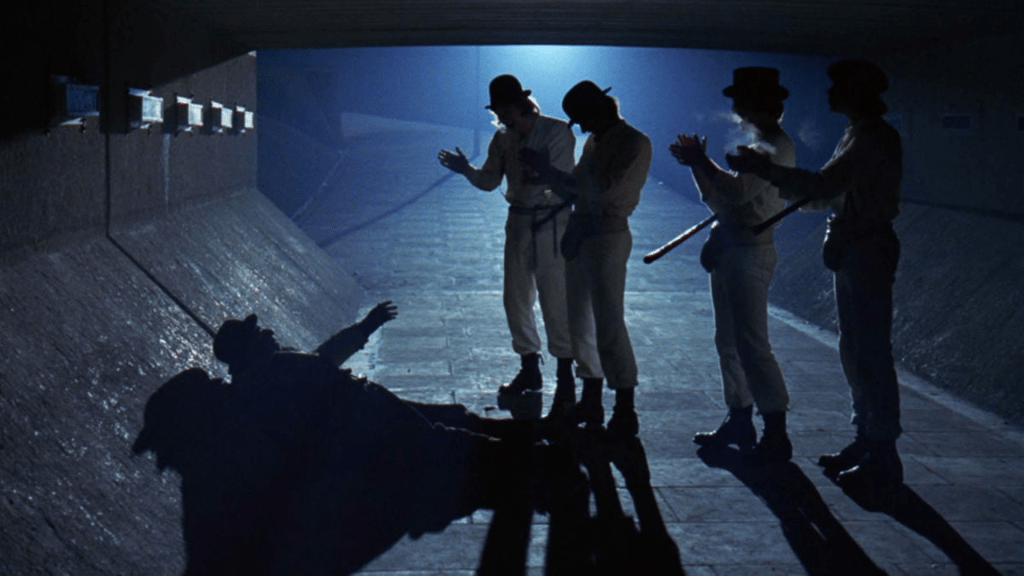
Kubrick used the book’s twenty-chapter edition to further sell this notion, refusing to tell a story about crime being something a soul simply grows out of. By the end of the film, Alex has not learned a single thing. Sure, he has endured some short-term suffering during his journey, but he is going to come out the other side completely fine. He will have a decent job of his choosing, will be exonerated entirely by the state, and is once again physically capable of committing crime, should he so desire. The government didn’t want to make a hero out of Alex; they wanted a puppet they could manipulate for their own gain. The state even locks away Mr Alexander; one of Alex’s victims, solely to save their own political skin.
It’s remarkable how tonally distinct each of these endings are. Burgess offers a naive, albeit somewhat optimistic, perspective, whereas Kubrick is much more nihilistic in design. Burgess suggests that people naturally outgrow criminality, an outlook that almost seems to absolve perpetrators of responsibility. Be that as it may, Burgess is also serving up the idea that immoral people will eventually shed their callous nature as they age. Kubrick, on the other hand, implies that we are all monsters just beneath the surface, and that authority simply doesn’t care, provided the status quo supports their continued existence. Where both versions start to feel somewhat familiar, however, is in how they treat their victims, none of whom leave this story with any sense of justice. All those who were traumatised, sustained lifelong injuries, or lost their lives will never get any kind of closure.
So, what is the purpose of the victims in A Clockwork Orange? Are they just throwaway props designed to move the story forward? Well, yes and no. There are several on the receiving end of Alex’s atrocities merely as a means of establishing the brutality of the Droogs. Mrs Alexander is on screen solely for the notorious “Singing in the Rain” brutality, before being killed off-screen later down the line. There are also the two young girls whom Alex lures back to his home. Then there is also Miss Weathers, whose death is simply the catalyst for Alex being locked up in the first place. Yet while these particular characters take on a more passive role, never receiving justice for their mistreatment, the narrative also utilises those, such as the homeless gentleman and Mr Alexander, to play a more curious role within the story.
The homeless gentleman assaulted by Alex at the start of the movie, crosses paths with Alex again following his completion of the Ludovico Technique. You could argue that the homeless gentleman manages to attain a small degree of vengeance during his second encounter with Alex; what with him rallying a cohort of other homeless men against our protagonist. The crowd beats Alex relentlessly before his former gang mates, now police officers, step in to disperse the crowd. It may not represent justice through a legal trial, but the homeless man essentially gets his own back by inflicting violence upon Alex in much the same manner Alex inflicted violence upon him years prior.
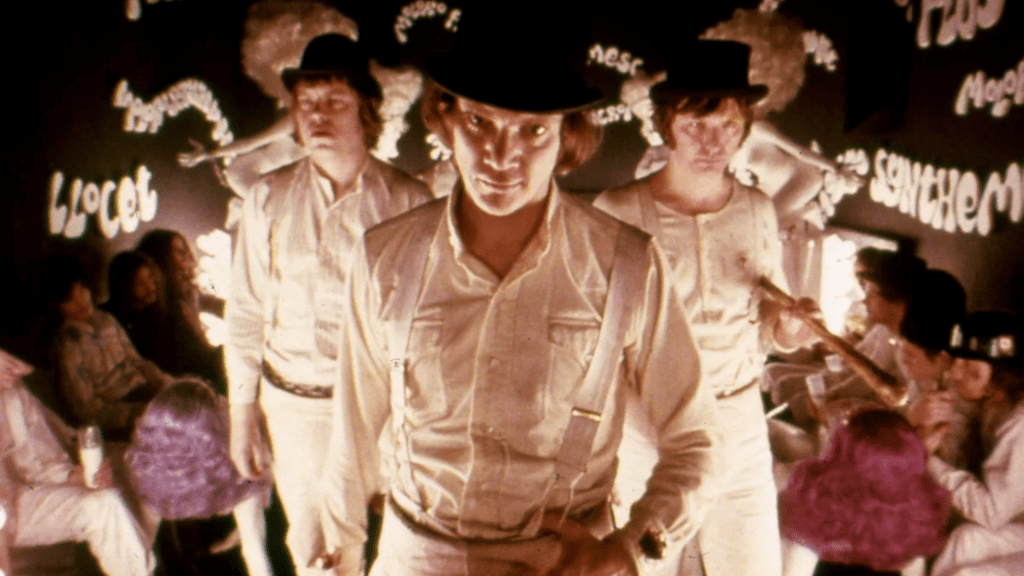
When it comes to Mr Alexander, the now wheelchair-bound man decides to use Alex as a political pawn. While one could argue that this is another form of revenge, we see Mr Alexander clearly orchestrating his plans for Alex to become expendable before he even registers that he is the same young man who violently assaulted him and his deceased wife. His plan is to manipulate the nausea brought about by the Ludovico Technique to drive Alex to suicide, allowing Mr Alexander and his peers to weaponise the tragedy to bring down the government.
It is also through this character that Kubrick delivers a sharp satirical stab at the political spectrum as a whole, suggesting that both sides are equally sadistic in their own ways. Whereas the Minister of the Interior represents the totalitarian leanings of the far right, Mr Alexander and his team represent the hypocritical left-wing intellectual. The former champions absolute control, the performative optics of law and order, and state-mandated compliance. The latter, on the other hand, champions civil liberties and human rights, yet is fully willing to torture and destroy a seemingly vulnerable young man to help sway an election. Ultimately, beneath the performative ideologies each side represents, both treat Alex as a political prop, not a person.
Interestingly, the decision to make Mr Alexander a satire of a radical left-wing intellectual was devised largely by Kubrick himself. In the novel, Burgess wrote the character largely as a stand-in for himself; the brutal crimes inflicted upon Mr Alexander’s wife directly parallel a real-world tragedy that befell Burgess’ own wife, who suffered a horrifically similar attack at the hands of a gang of Americans during the second World War. It was Kubrick’s choice to retool him from a sympathetic, likeable figure into a more repellant individual whose methods mirror the cold pragmatism of his political opponents.
All of this serves as another pillar supporting A Clockwork Orange’s argument that violence is an inherent part of human nature. Much like the state which tries to control him, even those who have been on the receiving end of our protagonist’s wrath appear entirely capable of, and comfortable with, acting out in much the same manner as the very monster we’re invited to follow during this story. Whether it is the predatory probation officer, the prison guards who gleefully beat Alex following his incarceration, the homeless man unleashing a mob upon his attacker, or Mr Alexander trying to drive a young man to suicide for political gain; everyone in this world appears to possess the capacity for malice, regardless of their status within society. According to this adaptation, sadism is universal.
In addition to driving home this thematic message, perhaps these acts of violence from all around Alex are also calculated to make its protagonist more palatable in the eyes of its audiences. As mentioned toward the start, one of the criticisms aimed at this movie following its release was its manipulative nature. This could well be used as a solid argument to support that claim. After all, asking an audience to invest in someone like Alex is no small feat. While the film never explicitly expects us to root for him, particularly as he refuses to show so much as an ounce of remorse throughout, it does demand that we follow him for an entire 136 minutes. This makes for notoriously uncomfortable viewing. However, making the police officers, parents, prison guards, and even the victims capable of cruelty serves as a psychological buffer for the audience. Just as Burgess engineered the Nadsat dialect to create linguistic distance between Alex’s actions and the reader, Kubrick achieves a similar effect by emphasising the institutional brutality of the wider system. By making everyone capable of cruelty, the text creates a necessary cushion when it comes to stomaching the blows of Alex’s atrocities.
Regardless of whether it’s Burgess’ or Kubrick’s version one experiences, A Clockwork Orange raises a frightening idea surrounding the concept of good and evil; largely by suggesting that such a binary does not exist. Instead, we are left with a far more terrifying question to ponder; what if violence is a pre-packaged facet of our species? What if the darkest acts committed by humanity are not the byproduct of defective minds or poor upbringing, but are an intrinsic part of who we are?
While the two storytellers’ philosophical approaches differ in their conclusions, they ultimately arrive at a similar unsettling destination. Burgess views violence as a passing phase of human maturity; one that people naturally grow out of as healthy minds develop. Kubrick, on the other hand, flirts with the possibility that we are all merely murderous apes, masking our primal nature behind the mask of civilisation. Both argue that we live on a rock populated by violent primates hiding in plain sight. One author believes we grow out of it, whereas the other believes we are attempting to maintain an illusion which hides it from consequence.
Both seem to suggest that morality and justice are an illusion, and that our punishments ultimately depend on whether we can be controlled, or if we can help to feed that machine.







Leave a Reply