
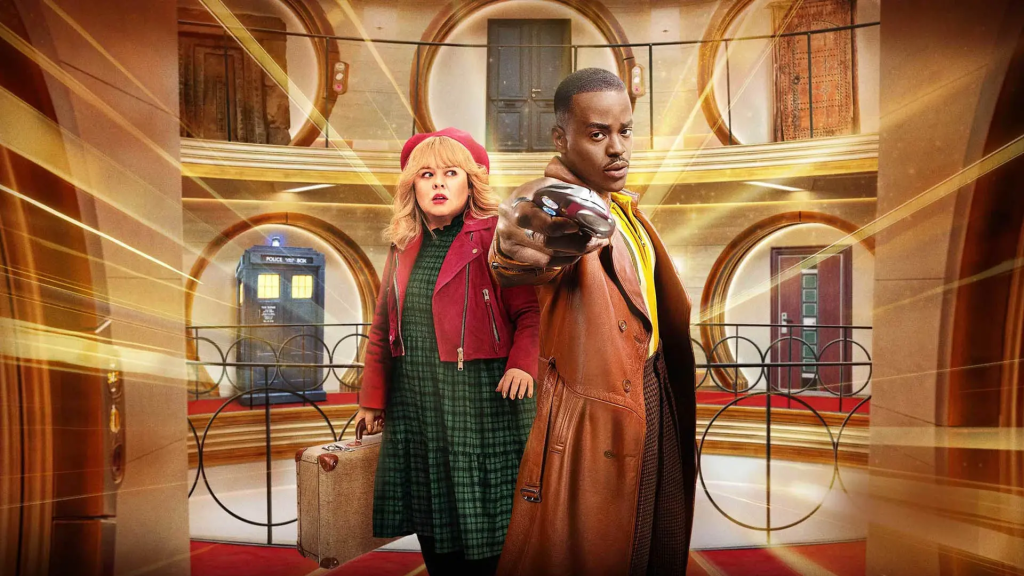
For seven years, it was assumed that Twice Upon a Time would be Steven Moffat’s Doctor Who swan song. Russell T Davies’ appointment to helm a second era, however, rewrote that story. Moffat returned for two additional episodes, giving him a chance to not only pen additional entries without the pressure of being a head writer, but also to revise his curtain call.
Though Moffat may someday contribute to the Whoniverse again in some capacity, Joy to the World feels like the writer’s attempt to wrap up his time on the show, presenting all his quirks, central ideas, and overall philosophy toward the show as a whole. Moffat’s default writing style is on full display – a rogues gallery of the many characteristics we’ve seen play out before, albeit folded into a single 54-minute chunk of television.
The opening timey-wimey setpiece, which sets the stage for the episode, fits Moffat’s main selling point as a returning writer. The Doctor zipping through different eras of Earth, hunting down a mysterious gentleman handcuffed to a briefcase is energetic, full of mystery, and effortlessly strings multiple time zones into a coherent sequence of events. This is familiar territory, and whilst it’s the sort of Moffat gimmick I’m instinctively likely to bring up when people ask me what makes him a solid Doctor Who writer, Joy to the World actually has something else tucked within its story which reminds me that this was not what drew me to his work in the first place. Despite all the fun that can be mined from this writer’s ability to use time travel as a narrative playground for his ideas, Moffat’s magic stems from something simpler and less spectacular by design.
One of the things this episode does remarkably well is found in individual scenes peppered throughout. These are the moments when the script homes in on particular characters, allowing the Doctor to both connect with others and learn a bit more about himself.
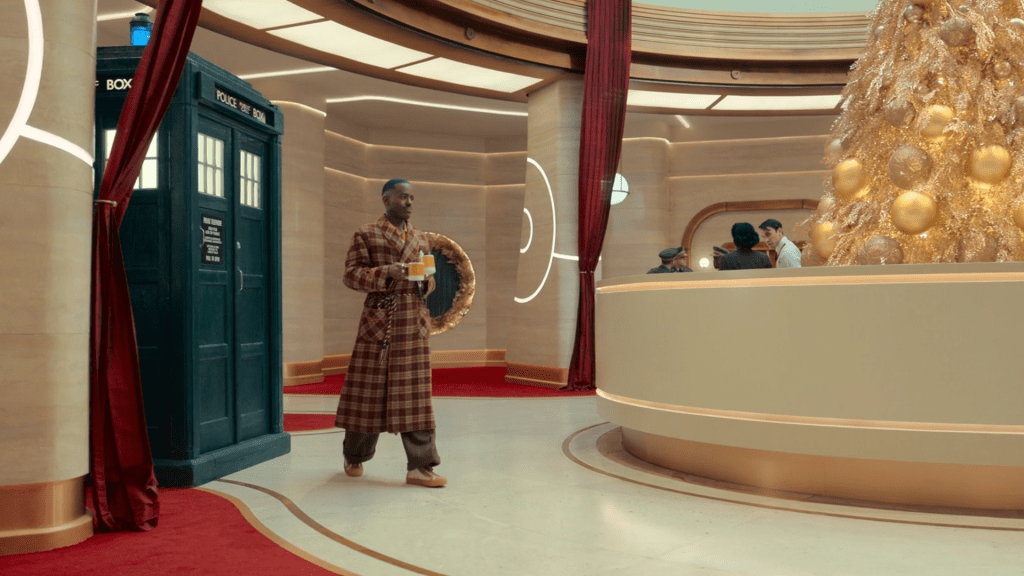
Perhaps Joy to the World’s best example comes from when the Doctor spends a year with Anita Benn. Around 20 minutes into the story, our lead must cultivate a paradox-originating plot device by forcing himself to spend a year residing in the Sandringham Hotel. Here he is reminded of something he told his younger self during the events of 2023’s The Giggle, as he tells his Fourteenth incarnation to get more chairs for his TARDIS. This alludes to the Doctor’s tendency to address his traumas by running around and embarking on adventures. Fifteen advises Fourteen to actually sit down, rest and process his trauma in a way this character seldom does.

Since The Giggle, Fifteen has experienced several fresh traumatic events, of which he hasn’t followed his own advice on addressing. Rogue is a perfect example – an episode where he witnesses someone he cares about perish before his eyes. The Doctor’s attempts to brush this off were momentarily confronted by Ruby; yet by the following episode, he’s back to his usual antics of sinking his teeth into story arcs and endgame-level threats.
Moffat addresses this in part here, forcing the Doctor to sit still for an entire twelve months. Though Rogue is never directly referenced, Anita asks the Doctor if he has a boyfriend. He looks up at the fireworks in the sky and says with a hint of melancholy that he doesn’t. The trope of the Doctor as a cosmic entity forced to settle in a human environment to address narrative obstacles is commonplace during the Moffat era. It often provides some of the more interesting elements of his tenure. It lets the story explore the Doctor’s inner workings whilst giving the other characters room to breathe.
The trope shines bright here. Anita, who up until this point functioned largely as a background character, suddenly takes centre stage. We get glimpses of a lonely woman bonding with a stranger as he carries out a task she has no involvement in. Two strangers, crossing paths by chance, keeping one another company as the months move forward. A plot beat evolves into a therapeutic process for our lead while spotlighting a character who was initially introduced as a glorified extra.
It is also important to consider the scenes in which we see Joy recount the pains of losing her mother during the pandemic of 2020. What starts life as a plot mechanic to unshackle Joy from the grasp of the protostar briefcase escalates into a heartwrenching revelation about the loss that this character has papered over with her overly jovial persona and colourful attire. It is an opportunity to break this character open, offering us a glimpse into her history. She ascends from a transient companion between series one and two to someone with a painful recent history, one she too is running from. It isn’t just the Doctor who is forced to slow down and reflect in this story, but Joy herself, who has to contend with the pain of losing her mother in the midst of a catastrophic pandemic which fell upon the globe years prior.
Someone less enthusiastic about Moffat’s work might look at these moments and accuse them of being distractions. After all, the Doctor and Anita’s bond punctuates a bootstrap paradox engineered to get the Doctor out of an impossible situation. If a future version of the Doctor had just stormed into the hotel room and given his past self the code to spare him from detonating a cosmic nuclear blast, it would have come across as the author freeing himself from a self-inflicted corner. Veering off and having an entire montage of sentimentality distracts from the script’s tendency to cheat its way out of a doomsday scenario. Likewise, Joy breaking down about her mother to essentially prevent her from suffering the same fate as Trev, Melank and the mysterious guest serves to write around the problem of what will happen to her when the protostar briefcase is detached from her. Though some could complain about this, I’d argue it’s here that Moffat’s abilities as a writer flourish. This narrative trick creates opportunities for his stories to focus in on characters and provide insight into their inner worlds. Cheats are reframed as triggers to kickstart the human elements of the story.
We saw this executed to great effect in 2007’s Blink, where Inspector Billy Shipton is thrown back in time and used to explain how the Doctor inserts his hidden messages into DVD easter eggs. Once again, what could have been a throwaway plot development becomes a moment in which two characters can sit together and reflect as one of them comes to the end of their life.
Still, none of this places Joy to the World among Moffat’s top-rated episodes. Though I consider it one of the stronger episodes amongst the Gatwa era, and a particularly thrilling festive entry, it has issues. Even the lovelier character moments outlined above tend to get undermined by the plot’s exceptionally fast pace, not to mention the more sombre moments getting devoured by less impressive Moffat tropes.
For instance, the writer’s habitual hesitation to kill characters off rears its head once again here. Whenever the episode sacrifices a character or exposits the loss of a loved one, fantastical sci-fi concepts arise to immortalise these characters. Trev’s unwitting sacrifice, Joy’s mother passing in hospital, and even Joy’s sacrifice are all undone during the episode’s climax. Even the melancholy in Anita’s subplot is overshadowed by the job offer she’s given at the time hotel as the episode concludes. The quieter, human moments that make this episode a tear-jerker are consumed by the fact that this is a big, boisterous, festive special. This creates an emotional whiplash. Moments of heartbreak are suddenly yanked up high into the sky as Joy is transformed into the immortal star of Bethlehem. Moffat wants us to cry and punch the air for joy, occasionally within the same plot beat.
We have seen all of this before. By this stage, Moffat has contributed 50 screenplays to this show. He has guest-written for prior showrunners, and overseen six series of his own. The canvas he’s been given to explore and build his ideas and philosophies for the show is vast. While his decision to participate in the RTD2 era was a joyous opportunity for fans to reminisce about the delights of his writing, it is clear that he has nothing new to contribute to Doctor Who’s canon. And that is completely fine. Both the man himself and his fans have been fortunate enough to have a dizzying amount of content from this writer. We have seen his vision play out on screen and reach its natural conclusions over many years. But it means his two entries into the RTD2 era feel like showreels of past eras, reminding us that the days of looking forward to new ideas from his mind materialising on screen are behind us. By now, timey-wimey antics and whimsical technological glitches aren’t awe-inspiring; they are clichés.
Perhaps this is why Joy to the World fits perfectly as a festive special. What is normally a slot exclusive to present showrunners, Davies broke tradition by allowing someone other than himself to write the episode. This gives Moffat freedom to do as he pleases without consequence. It exists in the midst of a transitional state for the show. There is no incoming Doctor to define, no overarching companion arcs to resolve, and the context of a Christmas Day romp which liberates it from threading itself into the events of a main series. It is a free 54 minutes in which Doctor Who’s longest-running, consistent showrunner is given liberty to tell a story of his choosing.
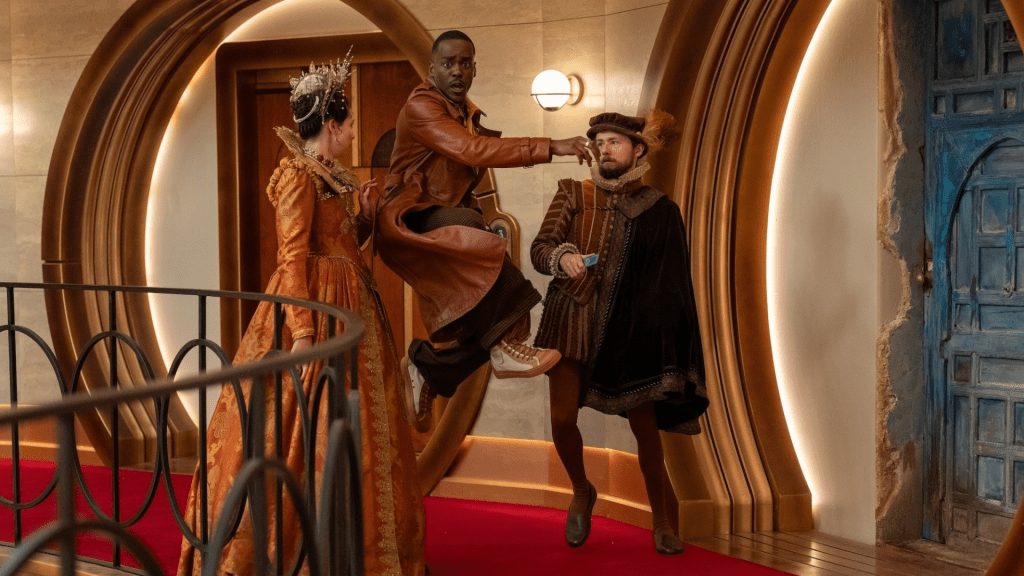
The irony, however, is that Joy to the World arguably presents a vision of what the Ncuti Gatwa era could have been. As the Fourteenth Doctor bigenerated into Fifteen at the end of The Giggle, Davies proposed a fascinating notion of a post-timewar Doctor; one more in touch with a part of himself than past incarnations. Whereas every Doctor from Nine to Fourteen blindly raced into battle instead of squaring up to his inner demons, Fifteen hinted at a more self-aware version of the character. I’ve occasionally referred to Fifteen as a cosmic therapist; a more introspective, emotionally intelligent retelling of the grand chessmaster hinted at during the Seventh Doctor era. This incarnation could have peered into the souls of both his allies and his enemies, using his newfound emotional intellect to empower, understand, and even destroy those before him. This could have presented opportunities for conflict, as I hinted at in my previous article regarding Ruby’s orphan arc. A Doctor with a firm grasp on his companion’s inner workings, occasionally intervening without first getting their consent.
Joy to the World hints at such an incarnation. Here, the Doctor is a hero who stops and dives headfirst into internal worlds between the story’s plot beats. Whether it’s his personal need to get more chairs, connecting with the occupants of the world he’s fallen into, or even using people’s emotional states to overcome narrative obstacles, Moffat uses the cosmic therapist concept to the story’s advantage. The Doctor isn’t merely an adventurer dashing through time zones serving up ham and cheese toasties and a pumpkin latte; he’s an otherworldly being with the power to look into your eyes, see the truth behind the mask, and use that to his advantage. It’s a trick that allows him to be the best of friends. It’s also a morally questionable trick that gives him power to become both a manipulative and powerful incarnation.
At the time of writing, Joy to the World remains Moffat’s Doctor Who episode swansong. Though there is a minuscule chance he might find himself penning for the show in the years to come, if this does turn out to be his last outing, it serves as a nice bookend to his work on the show. It is a festive special packed with interesting ideas, timey-wimey skullduggery, adorable character-driven setpieces, and engaging ideas. Though it does not look toward the show’s future, it celebrates its past and hints at the potential folded into its present. It’s a story that communicates Moffat’s ability to mine potential from the scope of the source material. Davies introduced ideas at the start of the Gatwa era that he seldom explores. Moffat uses these ideas as opportunities to move the story forward and flirt with the possibility of an era more interesting than the one we ended up getting.
Certainly not an outstanding episode, but one that remains thoroughly enjoyable.








Leave a Reply